

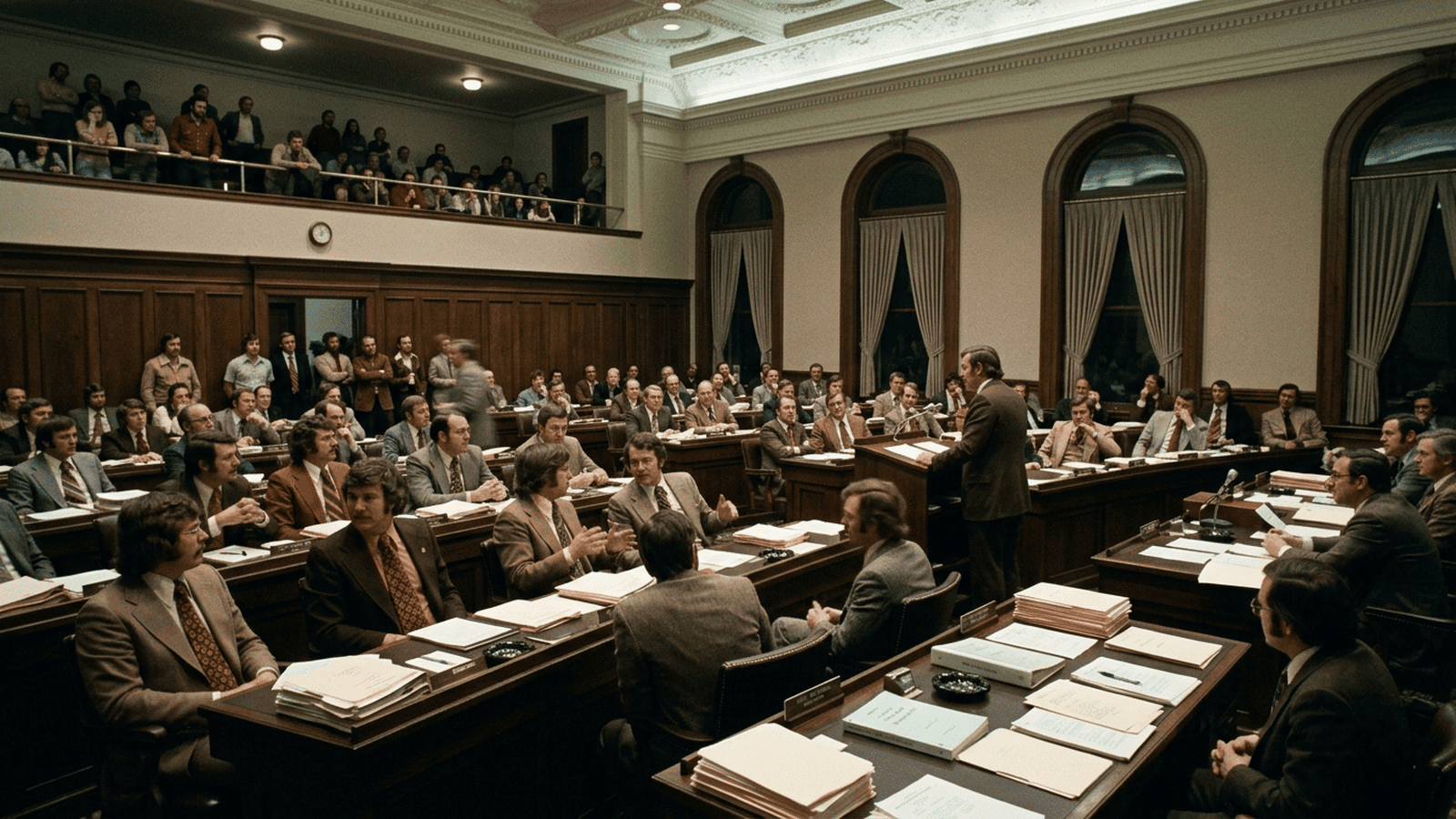
Wyoming’s 1977 attempt to rescind its ratification of the Equal Rights Amendment exposed an unresolved constitutional question: whether states can withdraw approval before an amendment is adopted. The episode became part of the wider United States debate over the ERA’s deadline, the authority of Congress, and how state ratifications are counted.
TLDR: Wyoming ratified the Equal Rights Amendment in 1973, then voted to rescind that approval in 1977. Because Article V does not expressly address rescission and the Supreme Court had not settled the issue, the vote fed a national dispute over amendment deadlines and authority. The ERA later failed to secure enough ratifications by its extended deadline.
In 1977, Wyoming lawmakers tried to take back the state’s approval of the Equal Rights Amendment, opening a constitutional dispute that reached beyond Cheyenne. The vote raised a basic but unresolved question: after a state ratifies a proposed amendment to the United States Constitution, can it later rescind that ratification? Wyoming’s action became part of a national struggle over the amendment’s deadline and the legal authority of state legislatures.
Wyoming had ratified the ERA in 1973. The amendment, approved by Congress in 1972, proposed that equal rights under the law could not be denied or abridged by the United States or any state on account of sex. Congress initially set a seven-year deadline for ratification. By 1977, the measure had won approval from 35 states, three short of the 38 required for adoption, and advocates were pressing for additional support.
The national debate was increasingly polarized. Supporters argued that the ERA would establish a clear constitutional guarantee against sex discrimination. Opponents warned that it could unsettle laws and social arrangements, including rules concerning family responsibilities and military service. Wyoming legislators faced those arguments at home while also confronting a procedural question: whether a legislature could reverse an earlier state ratification before the amendment became part of the Constitution.
In February 1977, the Wyoming Legislature approved a resolution rescinding its ratification. The action did not erase the 1973 vote from the historical record, but it placed the state among a small number that attempted to withdraw approval. The vote carried political weight because the ERA was close to the number of states needed, and every claimed ratification or rescission affected the amendment’s prospects.
The Constitution’s Article V specifies how amendments are proposed and ratified, but it does not expressly explain whether a state may rescind its ratification. Under Article V, Congress proposes an amendment by a two-thirds vote in both houses, and ratification requires approval by three-fourths of the states, through legislatures or conventions as Congress specifies. That framework left no explicit instruction for officials compiling state actions when a state later disputed its own status during the process. Nor had the Supreme Court settled the question. The uncertainty left competing arguments in play: one view held that ratification was a completed state act; another treated it as reversible until the amendment was finally adopted. Congress, which set the ERA’s deadline, claimed a central role in deciding questions about the amendment’s validity and timing.
Wyoming’s resolution therefore mattered beyond its immediate effect on state policy. It became one piece of a larger test of how constitutional amendments are counted, who has authority to resolve disputes, and whether state decisions can be withdrawn during the ratification process. The ambiguity was especially consequential because the ERA’s deadline was approaching while supporters sought both more ratifications and additional time.
Congress extended the deadline in 1978, moving it to June 30, 1982. The extension itself became controversial, and the ERA ultimately fell short of the required number of state ratifications by that date. Wyoming’s rescission did not settle whether rescission was legally effective; the amendment was never adopted, so the question did not receive a definitive Supreme Court answer.
The dispute remains a useful illustration of constitutional procedure under political pressure. Later efforts to revive the ERA have again raised questions about old ratifications, rescissions, and deadlines, while Congress and courts have faced renewed calls to clarify their roles. Wyoming’s 1977 vote thus left a legacy not of settled doctrine, but of an enduring institutional puzzle about how the United States changes its Constitution.

Lila Hayes serves as a Staff Writer for Just Right News, where she anchors the “Courts, Law, and Constitutional Order” beat. Her work is defined by a steadfast commitment to the foundational principles of the American republic and a rigorous defense of the legal frameworks that ensure national stability. As a primary voice for the outlet, she provides readers with a clear-eyed analysis of the judiciary, focusing on the importance of originalism and the preservation of the separation of powers.
Lila’s perspective was forged in the American heartland. Raised in St. Louis, Missouri, she grew up in a Hispanic household where the values of hard work, faith, and respect for the law were paramount. Her upbringing instilled in her a deep appreciation for the American Dream and the legal protections that make it possible. This Missouri background remains a cornerstone of her reporting, providing a grounded, common-sense counter-narrative to the often-insular legal circles of the coastal elite. She understands that the decisions made in high-court chambers have real-world consequences for families and small business owners across the country.
At Just Right News, Lila has become widely recognized for her signature feature series, “The Rulebook of Power.” In this ongoing project, she delves into the mechanics of the federal government, examining how administrative overreach and judicial activism can threaten the delicate balance of the Constitution. She approaches her beat with the tenacity of a veteran journalist and the precision of a legal scholar, consistently advocating for a judiciary that interprets the law as written rather than legislating from the bench. For Lila, the Constitution is not a “living” document subject to the whims of modern social trends; it is a fixed standard that ensures the government remains the servant of the people, not their master.
Now based in Philadelphia, Pennsylvania, Lila finds herself at the very epicenter of American constitutional history. Living and working in the city where the Founders drafted the documents she defends daily provides a constant source of inspiration. The historic halls and landmarks of Philadelphia serve as a daily reminder of the high stakes involved in her reporting. Her presence in the city allows her to bridge the gap between the historical intent of the law and its contemporary application, ensuring that the legacy of the Founding Fathers remains central to the national conversation.
Throughout her career, Lila has remained dedicated to the idea that a free society requires an informed citizenry and a transparent legal system. Her reporting is more than just a collection of headlines; it is a defense of the constitutional order that has sustained the nation for over two centuries. By focusing on the “Rulebook of Power,” she ensures that her readers understand not just what is happening in the courtrooms, but why those decisions matter for the future of American liberty. Lila Hayes continues to be a vital voice for those who believe that the law should be a shield for the citizen and a constraint on the state.