

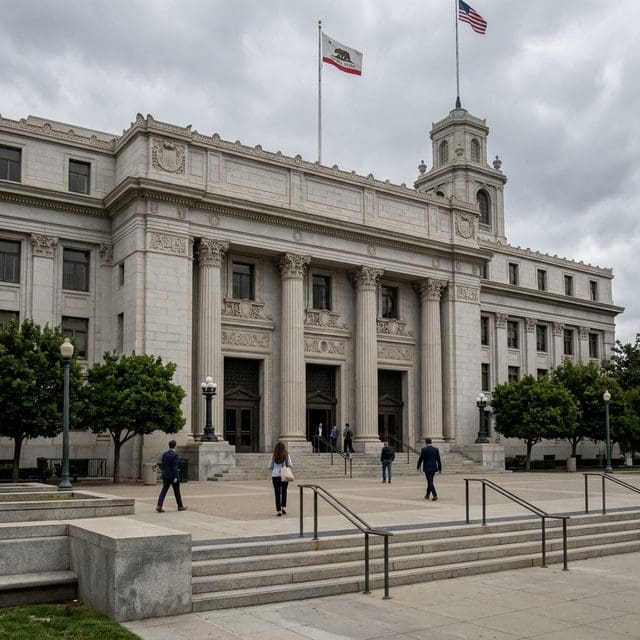
District attorneys and victims’ relatives are asking California’s Supreme Court to block Gov. Gavin Newsom’s death-row commutations, arguing that required safeguards were bypassed.
A dispute over Gov. Gavin Newsom’s death-row commutations is testing the limits of a California governor’s clemency power—and the safeguards state law requires before it is used.
The Criminal Justice Legal Foundation filed a writ petition with the California Supreme Court on Sunday, Nov. 15, asking it to block the commutations and grant permanent relief. As of Nov. 16, the court had not said whether it would hear the case. The petition was filed directly with the state’s highest court rather than through the ordinary appeals process, the Sacramento Bee reported.
The plaintiffs include district attorneys from 30 counties and more than two dozen relatives of murder victims, according to NBC News. Victims’-rights groups, police organizations and prosecutors’ organizations are also part of the coalition.
The petition argues Newsom made a categorical decision based on opposition to capital punishment rather than reviewing each case individually. Plaintiffs also say required investigations should have been referred to the Board of Parole Hearings and that the governor cannot use unilateral action to bypass constitutional and statutory safeguards. Those are claims in the petition, not findings by a court.
The coalition cites what it describes as a possible error in the case review: plaintiffs say they have identified at least one inmate listed as having one felony conviction who may have two. They argue the discrepancy could affect the required review process. The allegation has not been established by a court.
Newsom’s office referred Courthouse News to the governor’s Nov. 5 statement defending the action as consistent with how previous governors and presidents have used clemency. That position sets up a dispute over the reach of executive authority and the procedures that constrain it.
The case is a state-governance test, not a clash over federal preemption. The reports available do not identify a federal action controlling the commutations. Instead, California’s Supreme Court is being asked to interpret the state’s rules and determine whether the governor followed them.
Clemency is exercised by governors under state law, but its boundaries depend on each state’s constitutional structure, statutes and judicial interpretation. California’s justices will have to weigh the governor’s defense of his authority against the plaintiffs’ claims about individual review and required safeguards.
The case may offer other states a point of comparison, though clemency systems and procedures vary. The available reporting does not show that another state is copying Newsom’s approach or proposing a similar policy. Any broader significance will depend on whether the California court takes the case and how it explains the limits of the governor’s power.
For now, the legal outcome remains open. The petition asks the justices to halt implementation and grant permanent relief, but the court had not said whether it would hear the challenge. The governor’s defense and the plaintiffs’ procedural objections remain competing arguments awaiting judicial review.

Dylan Brooks serves as the Senior Correspondent for Statehouses and Local Governance at Just Right News, where he brings a principled, constitutionalist lens to the often-overlooked machinery of state-level politics. As the lead voice behind the acclaimed feature series “Fifty Laboratories of Power,” Dylan has dedicated his career to the idea that the most impactful governance happens closest to home. His reporting consistently champions the Tenth Amendment, exploring how individual states can serve as testing grounds for innovative, conservative policy solutions that prioritize personal liberty and fiscal responsibility.
A native of Des Moines, Iowa, Dylan’s journalistic philosophy was forged in the heart of the American Midwest. Growing up in a community where local school board meetings and town halls were the bedrock of civic life, he developed a deep appreciation for the “retail politics” of the heartland. This upbringing instilled in him a fundamental belief that the American experiment is best preserved when power is decentralized. He carries the values of his Iowa roots into every assignment, maintaining a healthy skepticism of federal overreach and a steadfast commitment to the concerns of everyday citizens over the interests of the administrative state.
Now based in Madison, Wisconsin, Dylan operates from one of the nation’s most pivotal political battlegrounds. His location in a state capital known for its rigorous policy debates allows him to provide Just Right News readers with a front-row seat to the legislative process. From Madison, he tracks the ripple effects of statehouse decisions on local municipalities, ensuring that the connection between high-level policy and community impact is never lost. His work often highlights the success of conservative governors and legislatures in fostering economic growth, protecting parental rights, and securing the integrity of local institutions.
As an African American man in the conservative media landscape, Dylan offers a vital perspective on how limited government and free-market principles empower individuals and families. He frequently reports on how deregulation and school choice initiatives provide new avenues for success in underserved communities, challenging the monolithic narratives often presented by legacy media outlets. Dylan’s work is characterized by a commitment to the facts and a refusal to shy away from the complex realities of modern governance.
Throughout his tenure at Just Right News, Dylan has become a trusted authority for readers who value a rigorous, principled approach to the news. Whether he is dissecting a complex state budget or profiling a local grassroots movement, his goal remains the same: to provide the American public with the information they need to hold their local leaders accountable. By focusing on the “Fifty Laboratories of Power,” Dylan Brooks ensures that the vital work being done in statehouses across the country receives the national attention it deserves, always through a lens that respects the traditions and sovereignty of the American people.