

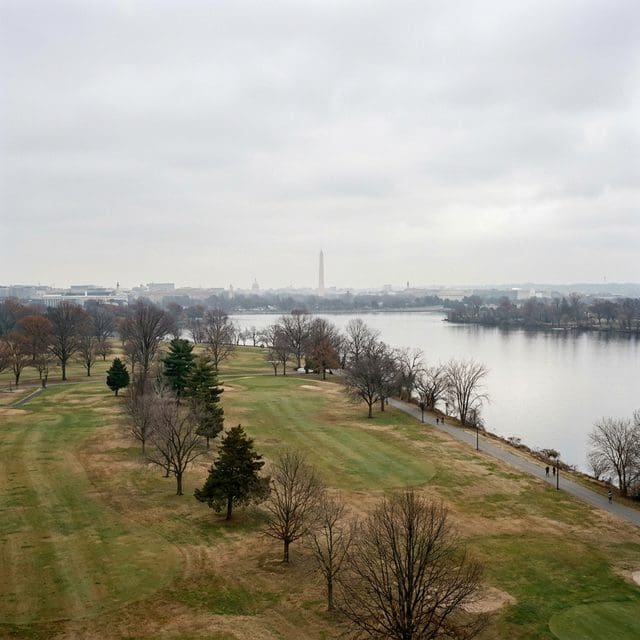
A temporary order blocks the Trump administration from closing much of East Potomac Park through Nov. 28, while allowing golf operations to stop and limited closures for repairs or imminent safety threats.
A federal judge has temporarily blocked the Trump administration from closing much of East Potomac Park in Washington, D.C., preserving public access through Nov. 28 while a lawsuit over the planned closure proceeds. The order does not require the government to continue operating East Potomac Golf Links or its miniature-golf course.
Judge Ana C. Reyes issued the order Nov. 14, a day before the administration planned to close the area. It covers land south of Buckeye Drive SW, including Ohio Drive SW, Hains Point, waterfront paths, fishing areas and the public golf facilities. The order remains in effect through Nov. 28 unless the court acts sooner. The government may close areas for active seawall repairs or imminent safety threats.
The ruling’s immediate effect is narrower than a final judgment against the administration’s plans. It preserves access for now but does not resolve whether the government may ultimately close the park, renovate the course or proceed without further review. Nor does it direct officials to keep golf operations running. Public access is protected by the temporary order; the government is not required to provide golf services or maintain course operations.
Reyes found that the plaintiffs were likely to prevail on claims involving federal environmental review and administrative requirements. She also described the government’s safety and staffing explanations as pretextual, according to reports on the ruling. Those are preliminary findings at this stage, not a final determination of liability or a ruling that all planned work is unlawful.
The National Park Service had cited deteriorating buildings, walkways and a seawall, along with insufficient staffing after National Links Trust was scheduled to stop operating East Potomac. On Nov. 14, the agency filed reviews concluding that the closure qualified for a categorical exclusion from further environmental review and would not affect historic properties. The court’s order prevents the planned broad closure from taking effect while the dispute continues.
The legal question is whether the government met applicable environmental and administrative requirements. A categorical exclusion is an agency determination that a proposed action does not require more extensive environmental review. The temporary order does not establish a general rule against such exclusions or decide whether the agency’s conclusions are legally sufficient. It keeps the status quo in place while the court considers the parties’ arguments.
The order leaves in place an earlier injunction restricting the removal or damage of additional trees. Reyes denied the government’s request to pause that injunction pending appeal on Nov. 9. The two orders limit certain changes to the site while litigation proceeds, but neither amounts to a permanent prohibition on redevelopment.
For the administration, the immediate consequence is that it cannot carry out the planned closure of the covered area on its announced schedule. For park users, access continues subject to the order’s exceptions. The government may respond to an imminent danger, though it must notify the court and plaintiffs after restricting access on that basis. Active seawall repairs are also an exception.
The case now turns on whether the plaintiffs can establish their claims beyond this preliminary stage and whether the agency’s steps satisfy governing law. The available reports do not describe a final merits ruling or give a definitive timetable for the next stage. For now, Reyes’s order limits executive action temporarily; it neither resolves the legal dispute nor requires the golf course to operate.

Lila Hayes serves as a Staff Writer for Just Right News, where she anchors the “Courts, Law, and Constitutional Order” beat. Her work is defined by a steadfast commitment to the foundational principles of the American republic and a rigorous defense of the legal frameworks that ensure national stability. As a primary voice for the outlet, she provides readers with a clear-eyed analysis of the judiciary, focusing on the importance of originalism and the preservation of the separation of powers.
Lila’s perspective was forged in the American heartland. Raised in St. Louis, Missouri, she grew up in a Hispanic household where the values of hard work, faith, and respect for the law were paramount. Her upbringing instilled in her a deep appreciation for the American Dream and the legal protections that make it possible. This Missouri background remains a cornerstone of her reporting, providing a grounded, common-sense counter-narrative to the often-insular legal circles of the coastal elite. She understands that the decisions made in high-court chambers have real-world consequences for families and small business owners across the country.
At Just Right News, Lila has become widely recognized for her signature feature series, “The Rulebook of Power.” In this ongoing project, she delves into the mechanics of the federal government, examining how administrative overreach and judicial activism can threaten the delicate balance of the Constitution. She approaches her beat with the tenacity of a veteran journalist and the precision of a legal scholar, consistently advocating for a judiciary that interprets the law as written rather than legislating from the bench. For Lila, the Constitution is not a “living” document subject to the whims of modern social trends; it is a fixed standard that ensures the government remains the servant of the people, not their master.
Now based in Philadelphia, Pennsylvania, Lila finds herself at the very epicenter of American constitutional history. Living and working in the city where the Founders drafted the documents she defends daily provides a constant source of inspiration. The historic halls and landmarks of Philadelphia serve as a daily reminder of the high stakes involved in her reporting. Her presence in the city allows her to bridge the gap between the historical intent of the law and its contemporary application, ensuring that the legacy of the Founding Fathers remains central to the national conversation.
Throughout her career, Lila has remained dedicated to the idea that a free society requires an informed citizenry and a transparent legal system. Her reporting is more than just a collection of headlines; it is a defense of the constitutional order that has sustained the nation for over two centuries. By focusing on the “Rulebook of Power,” she ensures that her readers understand not just what is happening in the courtrooms, but why those decisions matter for the future of American liberty. Lila Hayes continues to be a vital voice for those who believe that the law should be a shield for the citizen and a constraint on the state.