

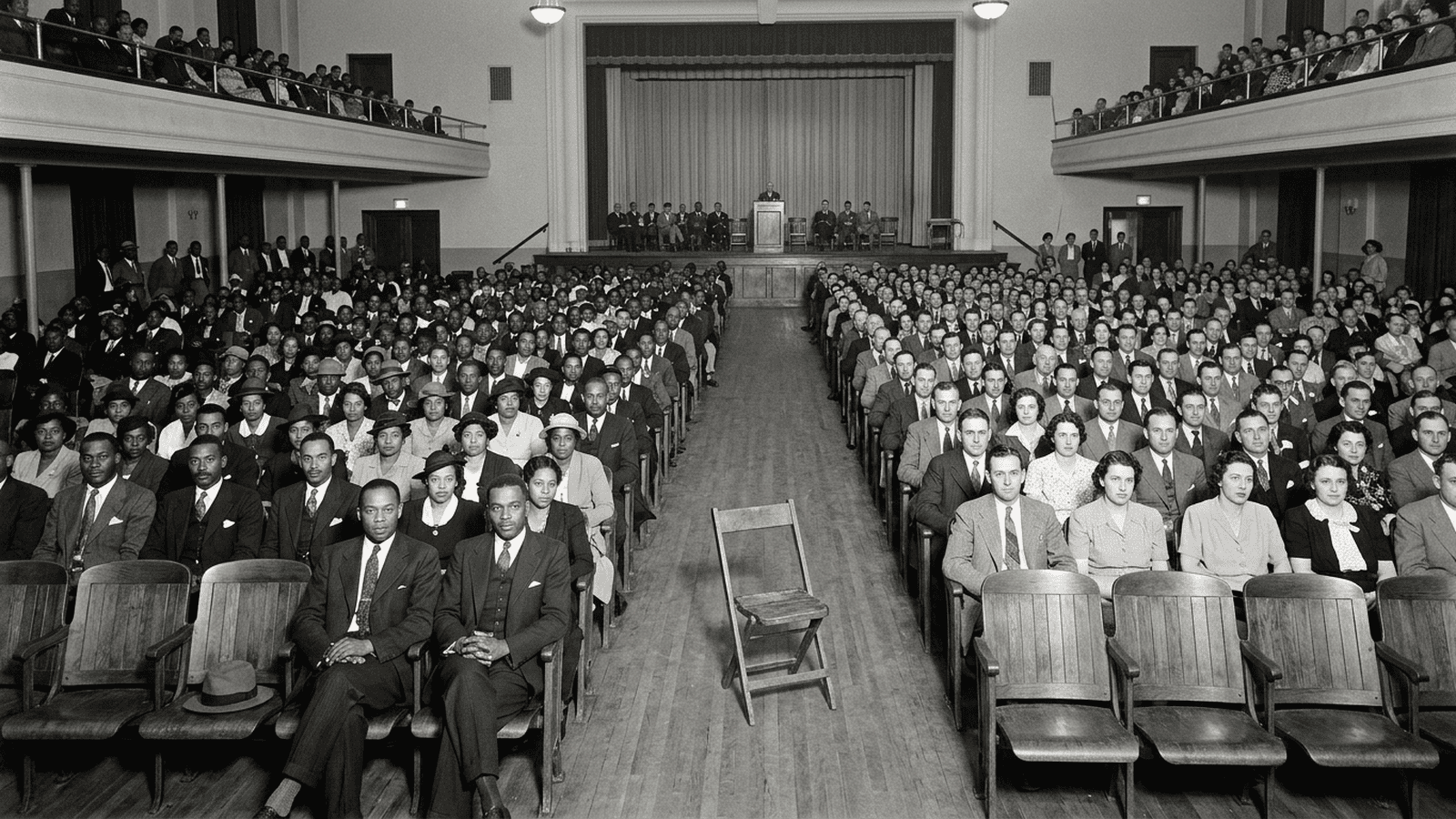
The 1938 founding meeting of the Southern Conference for Human Welfare in Birmingham brought civil rights and economic reform into a public debate over segregation. Eleanor Roosevelt’s decision to sit between racially separated sections drew national attention to the challenge facing interracial reformers in the United States.
TLDR: At a 1938 interracial reform conference in segregated Birmingham, delegates linked civil rights with poverty, labor and voting access. Eleanor Roosevelt’s gesture of sitting between racially divided sections made the conflict visible, while the newly formed Southern Conference for Human Welfare pursued reform without the power to end segregation.
In November 1938, an interracial gathering in Birmingham, Alabama, brought a direct challenge to the region’s segregation customs. The Southern Conference for Human Welfare convened delegates to discuss poverty, labor, voting rights and racial discrimination across the South. Its founding meeting made civil rights part of a broader debate over who would benefit from reform during the New Deal era.
The conference grew from organizing by southern reformers who believed federal programs could not address the region’s economic problems while leaving racial inequality untouched. Among the organizers were Virginia Durr, Clark Foreman and Joseph Gelders. They sought a coalition that could bring together labor advocates, religious leaders, academics and civil rights supporters, despite the political risks of opposing segregation in the South. The New Deal had expanded federal relief and public-works programs, but their administration often left local officials wide discretion to preserve discriminatory practices.
Birmingham offered a stark setting for that effort. The city enforced racial separation in public life, and the conference’s use of the municipal auditorium brought those rules into immediate view. Black delegates faced segregated seating arrangements. Rather than treating the division as an incidental inconvenience, organizers and attendees made it a public test of whether an interracial organization could practice the equality it endorsed. Their strategy depended on translating local grievances into a regional agenda and pressing elected officials to treat them as national policy.
Former first lady Eleanor Roosevelt attended the meeting, drawing national attention. When she learned that Black and white attendees were expected to sit separately, she reportedly placed her chair in the aisle between the sections. The gesture did not abolish the auditorium’s rules, but it visibly rejected the seating division and gave reporters a concise image of the conference’s dispute with local custom.
The gathering addressed more than the seating controversy. Delegates considered the South’s low wages, rural poverty, inadequate schools and limited political participation. These conditions overlapped: disfranchisement weakened Black citizens’ ability to influence public policy, while economic dependence and racial discrimination constrained opportunities for both Black and white workers. Conference supporters argued that democratic government and economic security required confronting those barriers together. For many Black southerners, poll taxes, literacy tests and intimidation restricted access to the ballot, while poor farmers faced seasonal work and debt.
That position was politically contentious. Southern conservatives criticized the organization, and opponents portrayed its interracial work as radical. Organizers had to navigate suspicion of federal intervention, resistance to labor organizing and the region’s entrenched racial hierarchy. The conference could bring disparate reformers into one room, but it could not make their coalition immune to intimidation or erase sharp disagreements about how far reform should go. Critics also used appeals to states’ rights and anti-communist accusations to isolate reformers, while organizers had few institutional means to protect participants.
The meeting helped establish the Southern Conference for Human Welfare as a continuing organization, not merely a one-time gathering. Its members pursued public education and political advocacy on issues including voting rights and economic reform. The effort had limits: it lacked the power to compel states or local governments to change, and segregation remained firmly enforced in Birmingham and throughout much of the South.
Still, the 1938 conference mattered because it connected civil rights to the region’s wider social and economic agenda and made interracial cooperation visible in a segregated city. The organization continued its work into the 1940s, while its campaigns contributed to a longer tradition of southern reform activism. Later civil rights organizing would confront many of the same barriers, using public pressure, coalition-building and federal action to challenge them.

James Foster serves as the Senior Correspondent for Inequality and the Social Safety Net at Just Right News, where he brings a principled and nuanced perspective to the most pressing economic challenges facing the nation. With a career dedicated to exploring the intersection of policy and personal responsibility, Foster has become a leading voice in documenting how government programs and economic shifts impact the American family. His reporting is characterized by a commitment to the “human element,” moving beyond cold statistics to highlight the stories of resilience, work, and community that define the modern American experience.
Foster’s perspective is deeply rooted in his upbringing in Birmingham, Alabama. Growing up in a city with a rich industrial heritage and a history of economic transformation, he witnessed firsthand the importance of the dignity of work and the strength of local institutions. In Birmingham, he saw how the most effective safety nets were often those woven by neighbors, faith-based organizations, and local civic groups. This background instilled in him a lifelong skepticism of “one-size-fits-all” solutions from distant bureaucracies, favoring instead the localized, community-driven support systems that he frequently champions in his writing.
Now based in Atlanta, Georgia, Foster operates from one of the most dynamic and rapidly evolving metropolitan hubs in the South. His location provides a front-row seat to the stark contrasts of the modern economy. From the gleaming towers of Atlanta’s financial districts to the struggling neighborhoods on the city’s periphery, Foster finds the stories that illustrate the complexities of upward mobility. His reporting from the Sun Belt serves as a microcosm for the national debate on poverty, highlighting how inflation, housing costs, and labor market shifts affect the working class in real-time.
As the lead for the acclaimed feature series “America’s Balancing Act,” Foster explores the delicate tension between providing a necessary hand up and fostering long-term independence. The series has become a cornerstone of Just Right News, offering a deep dive into the unintended consequences of social welfare policies. Foster’s work often focuses on the “cliff effect” and other systemic hurdles that can inadvertently discourage employment, arguing that true compassion is measured by how many people are empowered to leave the safety net, rather than how many are added to it.
Throughout his tenure, Foster has remained dedicated to the mission of Just Right News, providing a clear-eyed, conservative analysis of social issues. He believes that a free society thrives when individuals are empowered and the private sector is allowed to innovate. Whether he is interviewing small business owners about the challenges of a changing workforce or documenting the success of private charitable initiatives, Foster’s goal is to provide readers with the truth about the state of the American Dream. His work serves as a vital reminder that while the challenges of inequality are great, the solutions are often found in the strength of the American spirit and the preservation of traditional values.