

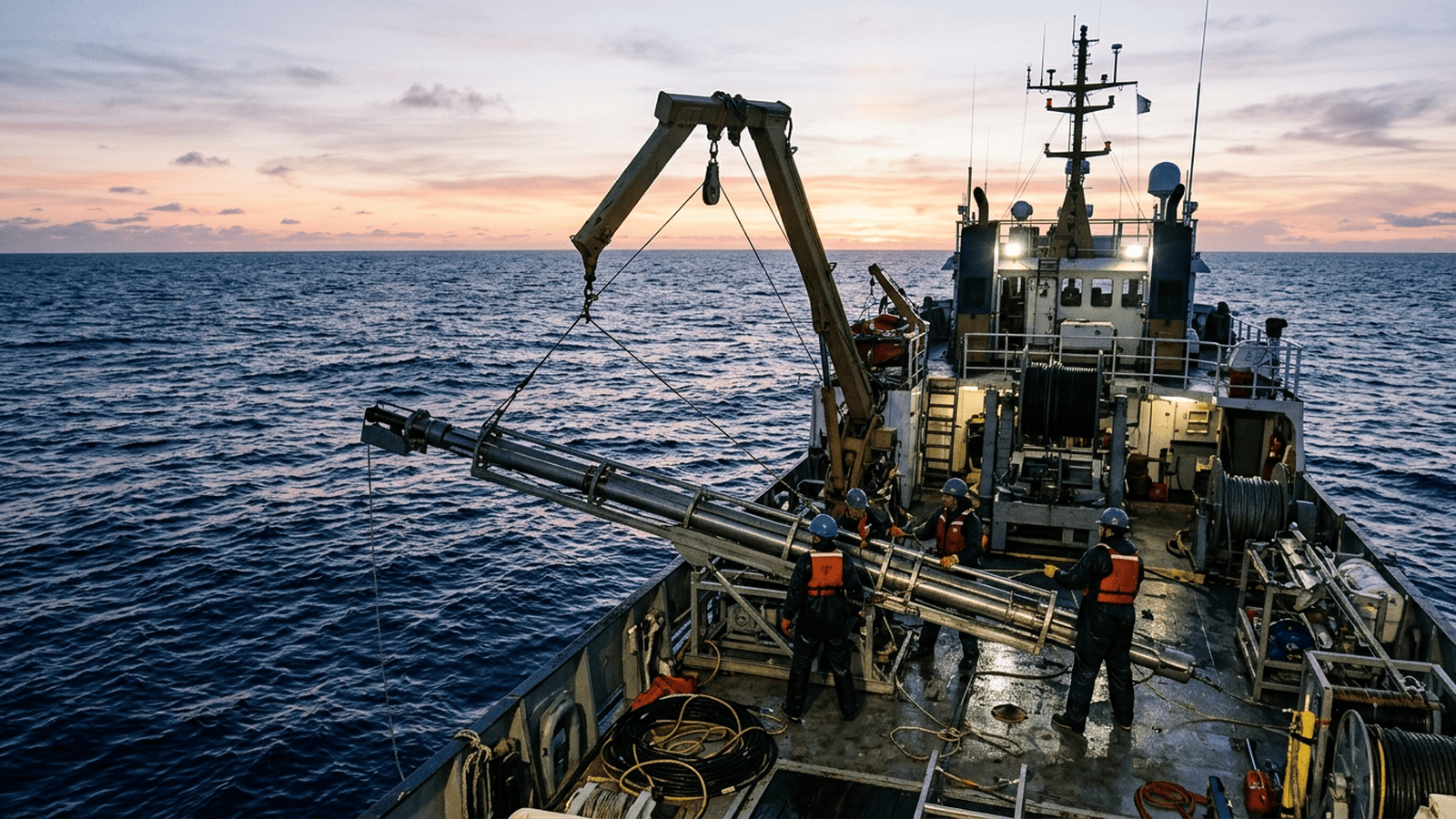
Scientists found living microbes in ancient, nutrient-starved sediments beneath the South Pacific Gyre. The results show that microbial life persists in conditions once thought too barren to support it, prompting new questions about how these organisms survive and how much of Earth’s seafloor they inhabit.
TLDR: Researchers found living microbes in seafloor sediments beneath the nutrient-poor South Pacific Gyre, including layers deposited up to 101.5 million years ago. Laboratory tests showed that many cells could resume activity when supplied with food. The findings expand scientists’ understanding of where microbial life can persist.
Far beneath the South Pacific, where surface waters receive little of the material that sustains ocean life, researchers found microbes living in sediment deposited as long as 101.5 million years ago. The organisms occupy a world with almost no food, buried under the seafloor in one of the ocean’s most remote regions. Their discovery shows that extremely old, nutrient-poor marine sediments can still host living communities.
The samples came from beneath the South Pacific Gyre, a vast circulation system whose central waters are exceptionally clear and biologically unproductive. Sunlight supports microscopic plankton near the surface, but the amount of organic matter produced there is limited. When plankton and other particles die, only a fraction sinks through the water column and reaches the seabed. This makes the gyre a natural place to examine how far life can persist when the supply of fresh food is unusually small.
Researchers collected sediment cores, which preserve layers accumulated over long periods as particles settled onto the ocean floor and were gradually buried. The deeper layers represent older deposits; in this case, some date back more than 100 million years. Their age describes when the sediment was laid down, not the lifespan of any individual cell. Microbes found there must have persisted through burial and changing conditions, but the discovery does not mean a single organism lived continuously for millions of years.
Conditions below the seabed differ sharply from those in sunlit waters. There is no sunlight to power photosynthesis, and the buried community depends on the small amount of usable material carried down from above or already present in the sediment. As organic matter is consumed, what remains may become increasingly difficult to access. Cells in such environments can have very low energy budgets, and their activity may be slow or intermittent. The findings therefore raise a basic question: how do these organisms maintain themselves when the usual inputs that support microbial growth are scarce?
To test whether cells in the cores were capable of activity, researchers supplied samples with nutrients in laboratory experiments. Many microbes responded by becoming active and growing. That response is evidence that viable cells were present, rather than only remnants of organisms preserved in the sediment. It also suggests that at least some cells can remain ready to resume activity when conditions improve. However, growth after nutrients are added does not show how quickly the microbes were active in their natural habitat, or whether they had been continuously growing before the experiment.
The distinction matters because a laboratory meal is very different from the sparse resources available in the deep seafloor. The experiment reveals potential: cells that appear inactive or nearly inactive can still respond under favorable conditions. It does not establish the exact survival strategy of each organism, how much energy they use in place, or how often they encounter enough food to grow. Further work will be needed to identify the organisms, measure their activity under natural conditions, and determine which compounds they can use.
The discovery broadens the known setting for microbial life and sharpens questions about the extent of the deep biosphere—the communities living within ocean-floor sediments. If viable cells occur in exceptionally old deposits beneath a region with little food reaching the seabed, comparable habitats may deserve closer study elsewhere. Their slow, resource-limited activity could also affect how scientists estimate the movement and transformation of carbon and other elements in marine sediments. The results do not settle how widespread such life is, but they show that apparent barrenness is not proof of lifelessness, even deep below the ocean floor.

Eric Nolan serves as the Senior Correspondent for Food, Water, and Environmental Health at Just Right News, where he brings a principled, common-sense perspective to the most fundamental issues facing the American public. With a career dedicated to uncovering the truth behind the policies that govern our natural resources, Eric has become a trusted voice for readers who value traditional stewardship over bureaucratic overreach. His reporting is defined by a commitment to the idea that true environmentalism is rooted in the protection of the American family and the preservation of the nation’s agricultural heritage.
Raised in Fresno, California, Eric’s worldview was shaped in the heart of the San Joaquin Valley. Growing up in one of the world’s most productive agricultural hubs, he witnessed firsthand the vital connection between the land, the water, and the dinner table. In Fresno, he saw the resilience of farmers and the devastating impact that distant, top-down regulations can have on local communities. This upbringing instilled in him a deep respect for the producers who feed the country and a lifelong skepticism toward the alarmist narratives often pushed by mainstream media. For Eric, environmental health is not an abstract political talking point; it is a matter of ensuring that the people who work the land have the freedom and the resources to do so effectively.
Now based in Eugene, Oregon, Eric operates from a unique vantage point in the Pacific Northwest. Living in a region often defined by intense environmental debate, he provides a necessary counter-narrative to the prevailing trends of the area. From his base in Eugene, he monitors the shifting tides of federal and state policies, ensuring that the voices of rural citizens and property owners are not drowned out by urban activism. His reporting often bridges the gap between the rugged realities of the outdoors and the legislative halls where decisions are made, offering a grounded perspective that prioritizes local sovereignty and practical solutions.
As the lead for the acclaimed feature series “Earth on the Table,” Eric explores the intricate journey of the American food supply. He tackles critical issues such as water rights, soil health, and food security through a lens of national stability and individual liberty. He believes that a healthy environment and a thriving economy are not mutually exclusive, but rather two sides of the same coin of national prosperity. His work consistently highlights how innovation and private-sector ingenuity are the most effective tools for ensuring clean water and a safe food supply, rather than the expansion of the administrative state.
At Just Right News, Eric’s reporting serves as a vital resource for those who seek accountability and transparency. Whether he is investigating the impact of federal land management on local economies or examining the safety of the national food infrastructure, his work remains anchored in the values of heritage and hard work. Eric Nolan continues to be a leading voice in environmental journalism, championing the belief that the best way to protect our natural resources is to empower the people who live and work closest to them.