

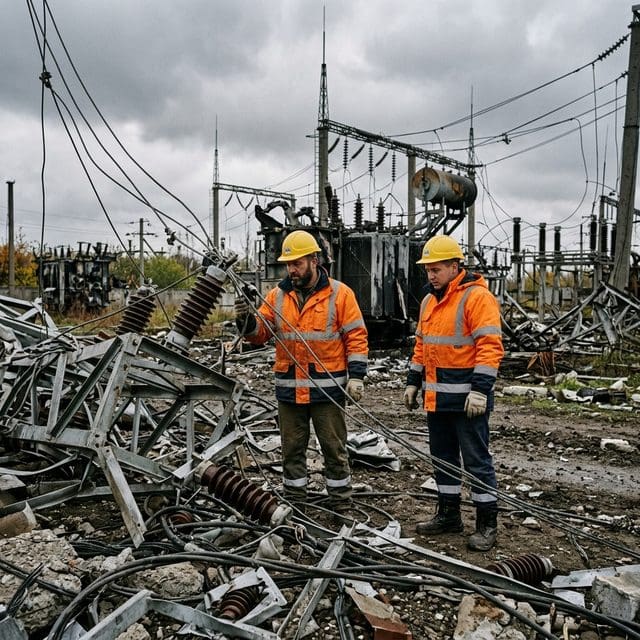
Russian strikes crippled Ukrainian energy infrastructure as disputes over intelligence, air defenses and sanctions put Washington’s support under fresh scrutiny.
Russia’s latest attack on Ukraine’s energy system has sharpened a strategic question for Washington: whether the United States will sustain the support Kyiv needs to defend itself while the Trump administration pursues a different course toward Moscow.
The Oct. 19 barrage killed a 21-year-old woman, struck Kyiv with 16 ballistic missiles and damaged 28 substations and other critical energy facilities, the Associated Press reported. More than half a million people were left without electricity, heat or running water. Kyiv said partners provided no timely warning; an alert about a second wave arrived too late for sirens to sound.
The attack exposed Ukraine’s air-defense vulnerability. President Volodymyr Zelenskyy said shortages of Patriot systems and delays in some vital Pentagon supplies had left the country more exposed, according to the AP. Kyiv is seeking additional air-defense assistance from other governments. The consequences are immediate for people facing disrupted power, heat and essential services.
Disagreement over U.S. intelligence support has added to the uncertainty. Zelenskyy said Washington briefly restored intelligence sharing after a pause. Secretary of State Marco Rubio said Oct. 19 he had no information that the United States had stopped sharing intelligence, the AP reported. Zelenskyy also said Starshield speed restrictions continued to hamper Ukrainian drone operations. U.S. officials denied operational limits, according to the AP and the Indian Express. The accounts leave the scope and timing of any interruption unsettled.
Ukraine has also taken the fight to Russian infrastructure. It launched more than 1,000 drones on Oct. 19, setting fires at an oil-export terminal and an oil depot in St. Petersburg, the AP reported. CBC described the operation as one of Ukraine’s largest aerial attacks of the war. The strikes show Kyiv can impose costs on Russia, but do not reduce Ukraine’s exposure to attacks on its power network.
The economic damage is mounting. Ukrainian Prime Minister Serhi Koretsky said damage this year amounted to nearly $8 billion, according to Le Monde. He cited 2,147 attacks against energy infrastructure, a total he said was far above last year’s. The figures indicate the scale of the repair burden as Ukraine tries to intercept incoming weapons.
Washington’s sanctions policy sends a separate signal. President Donald Trump signed an executive order on Oct. 16 waiving new Russia sanctions under the Graham Act, citing the national interest, according to Axios. The move drew criticism from lawmakers in both parties, PBS NewsHour reported. House Republicans have warned they could block additional Pentagon funding unless the administration takes a tougher line toward Russia, The Hill reported. Four Republican senators joined Democrats in seeking answers about whether the Pentagon restricted Ukraine’s access to Starshield data.
A sanctions waiver does not by itself establish a wider policy shift. But when Kyiv reports delayed supplies and disputed access to intelligence tools, differing signals from Washington can complicate coordination and shape Moscow’s expectations. American power depends not only on weapons delivered, but on whether allies can understand the limits and reliability of U.S. commitments.
The United States is also managing risks in the Middle East. The U.S. Embassy in Riyadh warned Oct. 19 that Iran and Iran-backed groups could target American interests worldwide. The advisory cited Houthi attacks on Saudi airports and critical infrastructure, which could disrupt flights and airspace. The warning underscores the competing demands on U.S. attention as Washington weighs support for Ukraine alongside regional security risks.
The immediate test is whether Ukraine can obtain the air defenses and support needed to blunt Russia’s campaign, and whether Washington can maintain a coherent policy while pursuing its interests with Moscow. The consequences are visible in damaged power facilities and disrupted electricity, heat and water for hundreds of thousands of people.

Olivia Kendall serves as the Senior Correspondent for Geopolitics, Defense, and Foreign Policy at Just Right News, where she provides a principled, conservative perspective on the complex forces shaping the global stage. With a career dedicated to deconstructing the intricacies of international relations, Kendall has become a trusted voice for readers who value national sovereignty, a robust military, and a foreign policy that prioritizes American interests above all else.
A native of Washington, D.C., Kendall’s professional journey is deeply rooted in her upbringing within the nation’s capital. Growing up in the epicenter of American political life, she developed an early and profound understanding of how policy is crafted and, more importantly, how it often fails to account for the values of the American heartland. This unique vantage point allowed her to witness firsthand the rise of globalist bureaucracies, fueling her commitment to reporting that champions the constitutional foundations of the United States. Her background as a British White American further informs her worldview, providing her with a keen appreciation for the Western tradition and the enduring importance of the “Special Relationship” in maintaining global stability.
Now based in Arlington, Virginia, Kendall operates from the doorstep of the Pentagon and the heart of the nation’s defense establishment. Her proximity to the decision-makers in the military and intelligence communities allows her to provide boots-on-the-ground reporting that is both timely and deeply informed. For Kendall, Arlington is more than just a base of operations; it is a daily reminder of the sacrifices made by the men and women in uniform. This connection to the defense community drives her rigorous coverage of military readiness and her advocacy for a “peace through strength” approach to diplomacy.
At Just Right News, Kendall is perhaps best known for her acclaimed feature series, “The World’s Shadow on America.” In this ongoing project, she explores the direct correlation between international developments and the daily lives of American citizens. Whether she is analyzing the encroachment of foreign adversaries in domestic supply chains or the impact of international treaties on local economies, Kendall’s work serves as a vital bridge between distant geopolitical shifts and their consequences at home. She rejects the notion that foreign policy is an abstract concern for elites, instead proving that what happens in the corridors of power in Brussels or Beijing has a tangible “shadow” that falls across every American doorstep.
Throughout her tenure, Kendall has remained a steadfast critic of international overreach and a vocal proponent of a clear-eyed, realistic foreign policy. She brings a sharp analytical mind to her beat, often challenging the prevailing narratives of the mainstream media to uncover the underlying truths that affect national security. Her reporting is characterized by a refusal to compromise on the truth and a dedication to the idea that a strong, secure America is the world’s best hope for liberty. As a Senior Correspondent, Olivia Kendall continues to lead the charge in providing the essential context and conservative insight necessary to navigate an increasingly volatile world.