

Ukraine says Starshield service remains constrained as Taiwan reports Chinese maritime pressure and the EU demands action over settler attacks in the West Bank.
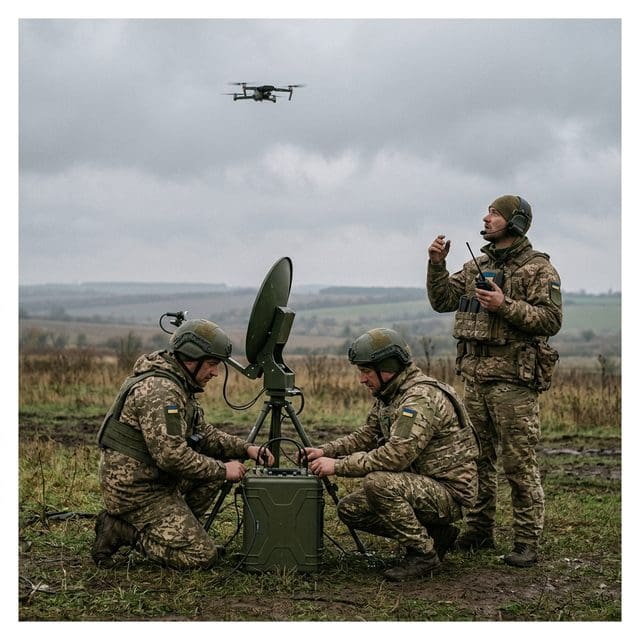
Ukraine’s access to a critical satellite communications network remains uncertain, Ukrainian officials said Sunday, leaving a practical question about wartime support unresolved between Kyiv, SpaceX and the Pentagon.
The New York Times reported October 18 that Ukrainian drones continued to experience Starshield disruptions when traveling above 100 miles per hour, and sometimes at lower speeds. Kyiv’s chargé d’affaires in Washington told Yahoo News that Ukraine was still waiting for an official response from SpaceX and the Pentagon. Ukrainian officials said neither had confirmed that unlimited speeds or the previous level of service had been restored.
The restrictions matter because Ukrainian forces use the terminals, including for drones that can move faster than the imposed limit. The Hindu reported that a cap introduced without warning cut the connection when a terminal moved faster than 160 kilometers per hour. The reports give different thresholds, but agree that Kyiv says service remains affected and that restoration has not been confirmed.
The Pentagon has not publicly explained the restrictions. NPR reported that the White House and Pentagon had not directly commented, while The Hill said senators had requested an inspector-general investigation into whether Pentagon or contractor decisions contributed to the disruption. Who set the restrictions, why, and what level of service Ukraine can expect remain unanswered.
For Kyiv, reliable communications are part of the infrastructure that allows a country under attack to coordinate military operations. For Washington, the episode illustrates the leverage that comes with dependence on privately operated systems—and the risks when responsibilities are split between government and contractor. A service dispute can become a strategic problem even without a change in formal U.S. policy.
Taiwan reported a separate test of regional security Sunday, saying it drove away 16 Chinese coast-guard, research and fishing vessels operating around the island and the Pratas Islands. The group included four fishing boats, according to Agence France-Presse. The report documents Taiwan’s account; it does not establish Beijing’s intent.
The mix of government-linked and civilian vessels matters because maritime encounters can apply pressure without crossing the unmistakable threshold of a military attack. Taiwan must respond while avoiding escalation, and its partners must weigh how to support the island’s security. The incident reflects a wider challenge for American power in the Indo-Pacific: whether partners can deter coercion through steady capacity and coordination, rather than declarations after each confrontation.
In the West Bank, the European Union on Sunday strongly condemned attacks by Israeli settlers, including attacks on European diplomats, and demanded full accountability and measures to prevent further violence against Palestinians, journalists and diplomats. The EU also urged Israel to comply with international law and stop settlement expansion, according to the European External Action Service.
The statement followed reported settler attacks on Palestinians gathering for the autumn olive harvest on October 16, when cars and trees were set ablaze. The violence has a diplomatic cost beyond Israel’s relations with Palestinians: European officials have also been affected. Whether the EU’s demands produce effective enforcement is a separate question.
These developments are distinct, but each tests whether commitments translate into predictable action. Ukraine is seeking clarity about a system on which its military depends; Taiwan is managing pressure at sea; and European governments are demanding accountability from a close U.S. partner. American influence depends not only on formal alliances, but on whether partners believe support, restraint and consequences will be applied consistently.

Olivia Kendall serves as the Senior Correspondent for Geopolitics, Defense, and Foreign Policy at Just Right News, where she provides a principled, conservative perspective on the complex forces shaping the global stage. With a career dedicated to deconstructing the intricacies of international relations, Kendall has become a trusted voice for readers who value national sovereignty, a robust military, and a foreign policy that prioritizes American interests above all else.
A native of Washington, D.C., Kendall’s professional journey is deeply rooted in her upbringing within the nation’s capital. Growing up in the epicenter of American political life, she developed an early and profound understanding of how policy is crafted and, more importantly, how it often fails to account for the values of the American heartland. This unique vantage point allowed her to witness firsthand the rise of globalist bureaucracies, fueling her commitment to reporting that champions the constitutional foundations of the United States. Her background as a British White American further informs her worldview, providing her with a keen appreciation for the Western tradition and the enduring importance of the “Special Relationship” in maintaining global stability.
Now based in Arlington, Virginia, Kendall operates from the doorstep of the Pentagon and the heart of the nation’s defense establishment. Her proximity to the decision-makers in the military and intelligence communities allows her to provide boots-on-the-ground reporting that is both timely and deeply informed. For Kendall, Arlington is more than just a base of operations; it is a daily reminder of the sacrifices made by the men and women in uniform. This connection to the defense community drives her rigorous coverage of military readiness and her advocacy for a “peace through strength” approach to diplomacy.
At Just Right News, Kendall is perhaps best known for her acclaimed feature series, “The World’s Shadow on America.” In this ongoing project, she explores the direct correlation between international developments and the daily lives of American citizens. Whether she is analyzing the encroachment of foreign adversaries in domestic supply chains or the impact of international treaties on local economies, Kendall’s work serves as a vital bridge between distant geopolitical shifts and their consequences at home. She rejects the notion that foreign policy is an abstract concern for elites, instead proving that what happens in the corridors of power in Brussels or Beijing has a tangible “shadow” that falls across every American doorstep.
Throughout her tenure, Kendall has remained a steadfast critic of international overreach and a vocal proponent of a clear-eyed, realistic foreign policy. She brings a sharp analytical mind to her beat, often challenging the prevailing narratives of the mainstream media to uncover the underlying truths that affect national security. Her reporting is characterized by a refusal to compromise on the truth and a dedication to the idea that a strong, secure America is the world’s best hope for liberty. As a Senior Correspondent, Olivia Kendall continues to lead the charge in providing the essential context and conservative insight necessary to navigate an increasingly volatile world.