

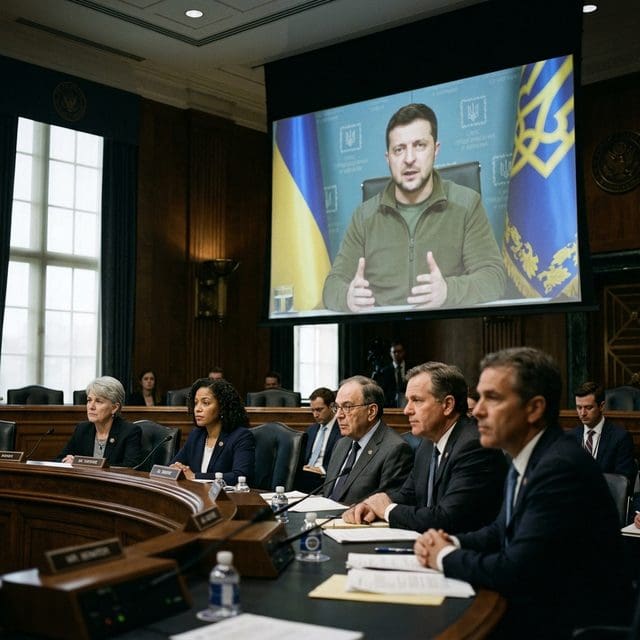
Ukraine’s president cited disruptions to U.S. support as Congress questions Trump’s Russia policy, while midterm races and a California voting case bring separate disputes into focus.
President Donald Trump’s Russia policy is facing a test in Congress after Ukrainian President Volodymyr Zelenskyy described disruptions to U.S. support in a bipartisan, bicameral call with lawmakers on Oct. 19. The briefing came days after Trump signed an executive order waiving Russian sanctions that were set to take effect under a law he signed the previous month. Lawmakers from both parties criticized the move, though no quick countermeasure is expected.
Zelenskyy told Sens. Richard Blumenthal, a Democrat, and Thom Tillis, a Republican, that degraded Starlink service was disrupting Ukraine’s ability to intercept Russian drones. He also reported interruptions in U.S. early-warning intelligence about Russian ballistic-missile launches and delays in air-defense interceptors.
Zelenskyy said the Pentagon was delaying missiles already paid for by NATO partners through the Prioritized Ukraine Requirements List program. One package was reportedly awaiting Defense Secretary Pete Hegseth’s signature. Tillis said weakening Ukraine’s communications and air defenses while easing sanctions would “embolden Putin and prolong this war.”
The account puts a practical question before Congress: whether the change in sanctions policy is accompanied by a change in military support to Ukraine, and what oversight lawmakers will pursue. The source material does not establish the causes of the reported delays or describe the administration’s response. Trump said Oct. 9 that he had struck a deal with Russia for millions of tons of diesel to lower U.S. energy prices, another element of his stated approach to Moscow.
The midterm campaign is shifting, too. With Election Day two weeks away, Republicans are spending heavily to defend traditionally conservative territory while Democrats expand the map of competitive races, NPR reported. The available material provides no verified spending totals, so it does not establish the size of either party’s advertising advantage. The reported pattern shows defensive spending and new opportunities for challengers happening at once.
Other political signals offer context but do not settle the contest. The U.S. Chamber of Commerce endorsed Ken Paxton over James Talarico in the 2026 Texas Senate race. A Washington Post-ABC News-Ipsos poll put Trump’s approval at 33 percent; an NBC News Decision Desk poll using SurveyMonkey data found 71 percent of respondents said the country was on the wrong track. The polls asked different questions and neither, on its own, predicts results in individual races.
In California, the Justice Department has charged 28 people it says were noncitizens with voting-related crimes and is asking a federal judge to stop thousands of other ballots from being counted, NPR reported. Of the defendants charged Oct. 19, 11 were arrested. All were lawful permanent residents. The charges include alleged fraudulent voter registration, illegal voting and false statements in naturalization applications. The felony charges carry a maximum sentence of five years in federal prison; the allegations have not been proved in court.
The department said it had charged 113 noncitizens across 20 states with voting or registration crimes over the previous seven weeks. The California matter therefore involves both prosecutions of named individuals and a broader request that could affect ballots. Evidence against particular defendants does not, by itself, establish that other ballots are unlawful. The available report does not specify how many ballots are at issue or describe a ruling on the request.
Across these disputes, the institutional questions are concrete: what evidence supports executive and prosecutorial decisions, what authority Congress will exercise, and how courts will assess requests affecting voters. Public statements set out positions; records, legal filings and oversight will show what follows.

Sophie Carter serves as a Staff Writer for Just Right News, where she anchors the outlet’s critical coverage of Elections, Influence, and Democracy Infrastructure. In an era where the mechanics of voting and the flow of political capital are under constant scrutiny, Sophie provides a steady, principled voice dedicated to the preservation of American institutional integrity and the rule of law.
Raised in Charlotte, North Carolina, Sophie’s perspective was forged in a community that balances rapid modern growth with a deep respect for tradition and civic duty. Growing up in the Queen City, she witnessed firsthand how a robust local culture depends on the trust between the citizen and the state. This upbringing instilled in her a foundational belief that the right to vote is a sacred trust—one that must be protected from both administrative overreach and the encroaching influence of special interest groups. Her reporting reflects these North Carolina roots, emphasizing the importance of community-led governance and the preservation of the individual’s voice in the face of nationalized political movements.
Now based in Atlanta, Georgia, Sophie operates from the heart of one of the nation’s most pivotal and contested political landscapes. Her location allows her to report from the front lines of the debate over election security, legislative reform, and the modernization of voting systems. For Sophie, the “infrastructure” of democracy is not merely a matter of machines and ballots; it is the collection of laws, people, and transparent processes required to maintain public confidence. Her work often highlights the necessity of clear, enforceable standards that ensure every legal vote is counted fairly and that the machinery of our republic remains accountable to the taxpayers who fund it.
Central to her work at Just Right News is her acclaimed feature series, “The Price of a Vote.” Through this ongoing project, Sophie explores the complex web of influence that shapes modern campaigns and policy decisions. She delves into how high-level lobbying, non-governmental organizations, and shifting bureaucratic regulations impact the weight of an individual citizen’s ballot. By examining the financial and structural pressures placed on the electoral process, she provides readers with a comprehensive look at the forces vying for control over the American political system.
Sophie’s approach to journalism is rooted in a commitment to the constitutional framework. She views her role as a watchdog for the voter, ensuring that the systems meant to serve the public remain transparent and free from corruption. Whether she is analyzing the implementation of new voting technologies or investigating the influence of outside money on state-level policy, her work is characterized by a rigorous adherence to facts and a refusal to succumb to the sensationalism that often plagues modern political reporting.
At Just Right News, Sophie Carter continues to be a vital resource for readers who value clarity, conviction, and a defense of traditional American values. Her deep ties to the Southeast and her specialized focus on the mechanics of our republic make her an essential voice in the ongoing conversation about the future of American self-governance. Through her reporting, she remains dedicated to the idea that a secure and honest electoral system is the bedrock of a free and prosperous society.