

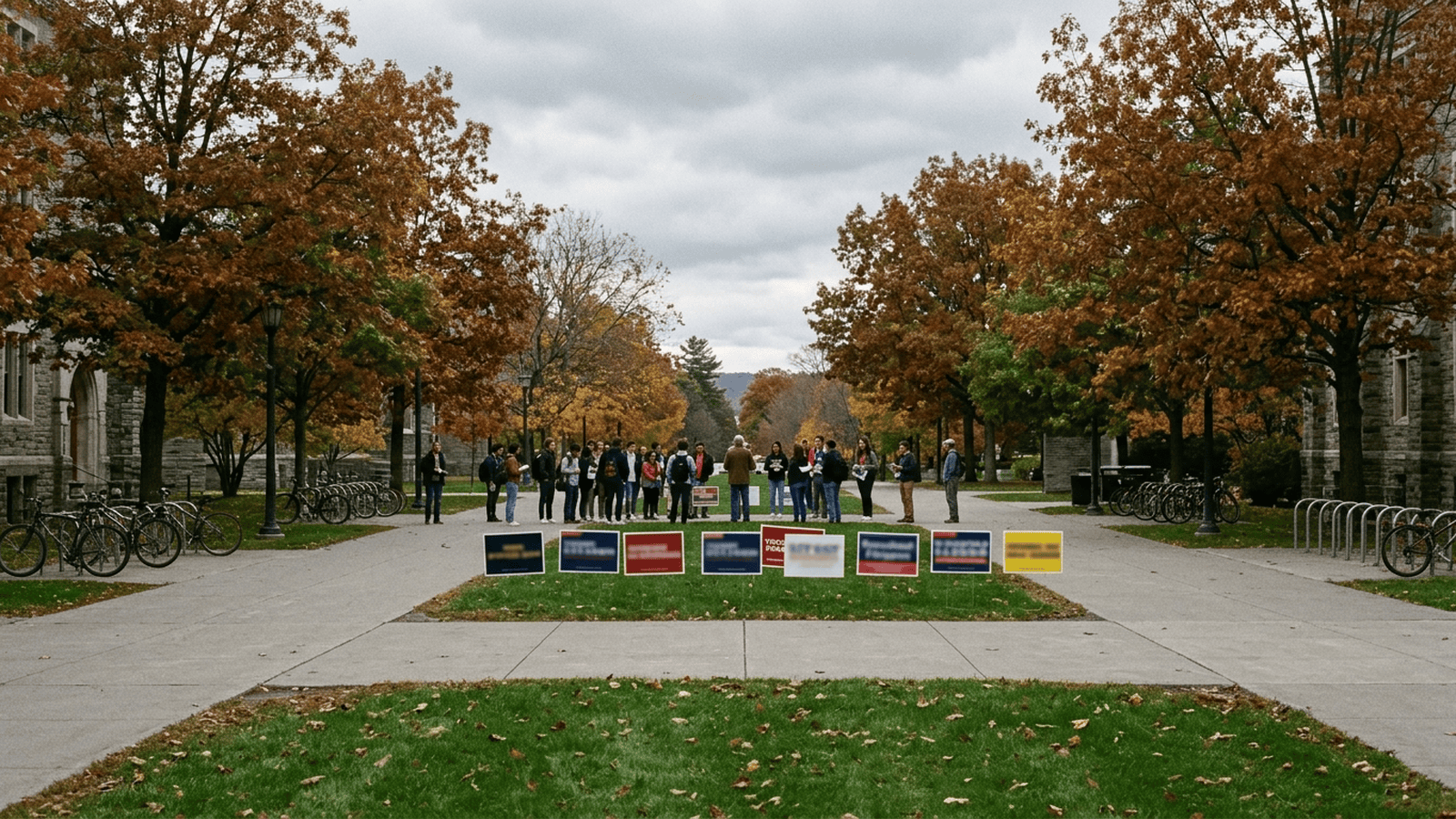
The Nation’s “Start Making Sense” episode features Harold Meyerson’s analysis of the November 3 midterms and Katha Pollitt’s comments on a sexual assault at Cornell. The episode description says Republicans are spending hundreds of millions of dollars, while citing affordability, disgust with Trump’s corruption, and Democratic candidate quality as factors that money has not overcome. It offers no polling figures or detailed forecast. Pollitt argues that the Cornell assault could have been stopped through intervention. The description also notes that hundreds of students rallied in Ithaca on October 5, 2026, over the university’s actions, but gives no account of those actions or the university’s response.
TLDR: A podcast episode presents Harold Meyerson’s view that major Republican midterm spending has not overcome affordability concerns, anger over Trump’s corruption, or Democratic candidate quality. It also features Katha Pollitt’s comments on a Cornell assault and the student rally over the university’s actions.
A new episode of The Nation’s “Start Making Sense” podcast considers two separate subjects: the 2026 midterm outlook and the aftermath of a sexual assault at Cornell. Harold Meyerson discusses the election, while Katha Pollitt comments on the Cornell case. The episode description presents their views and claims; it does not provide polling data, campaign records, or a detailed account of the university’s response.
Meyerson’s segment is described as an analysis of forces he believes could overwhelm President Donald Trump on November 3. The episode description identifies affordability, public disgust with Trump’s corruption, and the quality of Democratic candidates as factors that Republicans’ campaign spending has not overcome. That is the description’s summary of Meyerson’s analysis, not a reported election result or an official forecast.
Republicans, according to the description, are spending hundreds of millions of dollars on the midterms. The excerpt does not specify the source of that figure, how the money is divided, which races it covers, or how campaign spending is measured. It also provides no polling numbers or state-by-state projections. Meyerson is identified as editor at large of The American Prospect, but the excerpt does not quote his full analysis or show the evidence he uses to support it.
Those gaps matter when weighing the claim that spending has not changed the political outlook. The description does not say whether the money has already been spent, how voters have encountered the campaigns, or whether the spending has affected particular races. It does not establish how voters rank affordability, corruption, or candidate quality, or whether those concerns are changing their votes. The available material supports reporting what Meyerson argues, but not treating the argument as a measured result.
The phrase “coming Blue Wave” appears in the assignment headline, but the episode description does not report a forecast with specific numbers or define the scale of a possible Democratic gain. It gives no expected seat count, margin, or list of competitive districts. Readers therefore cannot use the excerpt alone to judge how large a shift Meyerson anticipates, or what evidence would confirm or weaken that view.
The election date named in the description is November 3. No further schedule, voting deadlines, campaign finance filing dates, or election administration details appear in the excerpt. The discussion is framed as Meyerson’s analysis of the forces facing Trump, rather than as an official forecast or a result certified by election authorities. Keeping the attribution attached to each claim helps separate commentary from confirmed outcomes.
The episode also includes Pollitt’s comments on a sexual assault at a Cornell fraternity party. The excerpt describes the assault as a gang rape and says it occurred in 2024. Pollitt argues that it could have been stopped if someone had intervened, and the description says no one did. The supplied material does not provide further details about the incident, identify those involved, or include findings from an investigation or court proceeding. Her comments are presented as her view of the case, not as a finding about responsibility by an investigative body or court.
Hundreds of Cornell students rallied in Ithaca, New York, on October 5, 2026, against the university’s actions following the assault. The excerpt establishes the date, location, and stated focus of the rally, but it does not explain what actions the university took or what changes students sought. It also does not report a university response to the protest. Those details cannot be filled in by inference from the rally alone.
The two subjects share the podcast episode but are not presented as one issue. Meyerson’s segment concerns political spending and the midterms. Pollitt’s concerns intervention and the aftermath of an assault at Cornell. The excerpt gives no basis for linking the campus case to campaign spending or to the election outlook.
The practical details available are limited. For the election segment, the description gives Republicans’ reported spending of hundreds of millions and the November 3 election date, but no costs by race, voter paperwork, enforcement actions, or specific deadlines. For Cornell, it records the assault in 2024 and the rally on October 5, 2026, but supplies no university deadline, oversight process, or stated policy change. The excerpt therefore does not establish practical effects such as new costs, paperwork, enforcement, or timelines. The election and campus events remain points to follow; further results and responses are not included in the episode description.

Eric Nolan serves as the Senior Correspondent for Food, Water, and Environmental Health at Just Right News, where he brings a principled, common-sense perspective to the most fundamental issues facing the American public. With a career dedicated to uncovering the truth behind the policies that govern our natural resources, Eric has become a trusted voice for readers who value traditional stewardship over bureaucratic overreach. His reporting is defined by a commitment to the idea that true environmentalism is rooted in the protection of the American family and the preservation of the nation’s agricultural heritage.
Raised in Fresno, California, Eric’s worldview was shaped in the heart of the San Joaquin Valley. Growing up in one of the world’s most productive agricultural hubs, he witnessed firsthand the vital connection between the land, the water, and the dinner table. In Fresno, he saw the resilience of farmers and the devastating impact that distant, top-down regulations can have on local communities. This upbringing instilled in him a deep respect for the producers who feed the country and a lifelong skepticism toward the alarmist narratives often pushed by mainstream media. For Eric, environmental health is not an abstract political talking point; it is a matter of ensuring that the people who work the land have the freedom and the resources to do so effectively.
Now based in Eugene, Oregon, Eric operates from a unique vantage point in the Pacific Northwest. Living in a region often defined by intense environmental debate, he provides a necessary counter-narrative to the prevailing trends of the area. From his base in Eugene, he monitors the shifting tides of federal and state policies, ensuring that the voices of rural citizens and property owners are not drowned out by urban activism. His reporting often bridges the gap between the rugged realities of the outdoors and the legislative halls where decisions are made, offering a grounded perspective that prioritizes local sovereignty and practical solutions.
As the lead for the acclaimed feature series “Earth on the Table,” Eric explores the intricate journey of the American food supply. He tackles critical issues such as water rights, soil health, and food security through a lens of national stability and individual liberty. He believes that a healthy environment and a thriving economy are not mutually exclusive, but rather two sides of the same coin of national prosperity. His work consistently highlights how innovation and private-sector ingenuity are the most effective tools for ensuring clean water and a safe food supply, rather than the expansion of the administrative state.
At Just Right News, Eric’s reporting serves as a vital resource for those who seek accountability and transparency. Whether he is investigating the impact of federal land management on local economies or examining the safety of the national food infrastructure, his work remains anchored in the values of heritage and hard work. Eric Nolan continues to be a leading voice in environmental journalism, championing the belief that the best way to protect our natural resources is to empower the people who live and work closest to them.