

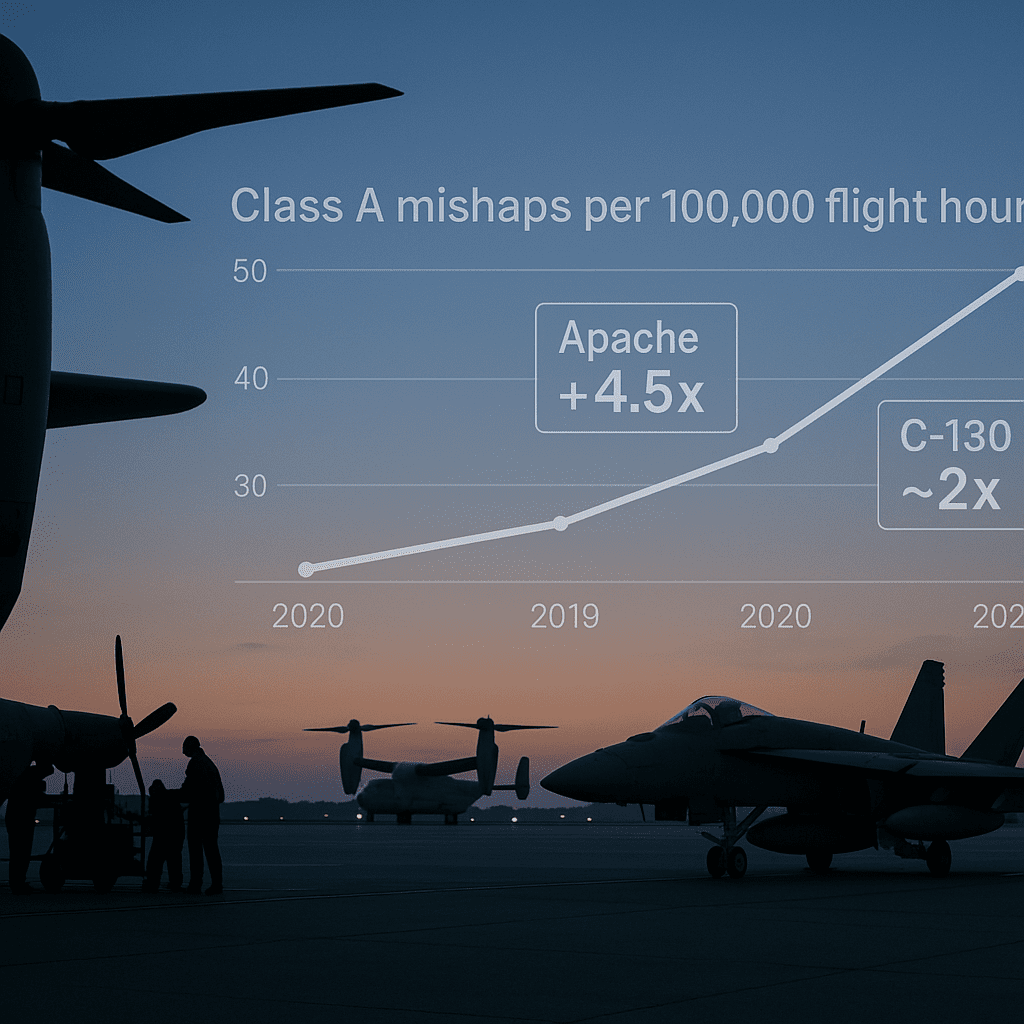
Pentagon figures reviewed by the AP show a 55% rise in Class A military aviation mishaps per 100,000 flight hours in 2024 versus four years earlier. The Marine Corps nearly tripled its rate; Apaches saw roughly 4.5 times the Class A rate and C-130 mishaps nearly doubled. Experts cite high operational tempo and lost pandemic flying time, and Congress has opened new oversight.
Internal Pentagon figures released to Congress and provided exclusively to The Associated Press show a sharp spike in the most serious military aviation accidents in the 2024 budget year. Across the services, the rate of Class A accidents — those that cause death or permanent total disability — rose 55% per 100,000 flight hours in 2024 compared with four years earlier, the Defense Department data indicates. The Marine Corps registered the largest increase, nearly tripling its rate over the same period.
The statistics cover full budget years 2020 through 2023 and the first 10 months of the 2024 budget year, through July 31. In those 10 months of 2024, the data show 25 service members and Defense Department civilians killed and 14 aircraft destroyed. The dataset was provided to Sen. Elizabeth Warren’s office in January and reviewed independently by the AP.
Aviation experts and service officials traced the rise to accumulated technical and operational pressures rather than to a single cause. The AP quoted aviation expert and former military pilot John Nance, who said growing operational tempo and deployments are likely increasing mishap risk. Nance described military flying as taking place in “incredibly complex conditions,” with commanders making rapid decisions amid high uncertainty.
Operational demand is only one component. The Defense Department data highlights particular airframes that contributed disproportionately to the rising Class A rate. The V-22 Osprey, a tilt-rotor aircraft that transitions between airplane and helicopter modes, has a historically elevated mishap profile, the AP reported. New Defense Department figures show the Apache attack helicopter experienced about 4.5 times the rate of Class A accidents in the 2024 budget year compared with four years earlier. The C-130 transport, a workhorse of military logistics, nearly doubled its Class A rate over the same interval.
The Pentagon, when asked about the trends, said the figures “underscore the importance of safety and readiness at every level” and stated that leaders “regularly review and improve our processes, share lessons learned from mishaps, and reduce safety risks.” The Navy separately acknowledged a marked increase in its aviation mishaps, noting the Naval Safety Command reported eight Class A aviation mishaps in 2024 and 14 in 2025.
High-profile 2025 mishaps have deepened scrutiny. Investigations into a January collision over Washington, D.C., found a broken altimeter gauge in a Black Hawk helicopter, problems with the military pilot’s night-vision goggles, and shortcomings in FAA responses to warnings about helicopter hazards near the airport; that accident killed 67 people. In the spring, the USS Harry S. Truman carrier lost two F/A-18 Super Hornets within weeks — one after a bad landing and another after sliding off the deck into the sea. In December 2024, the guided-missile cruiser USS Gettysburg mistakenly shot down an F/A-18. More recently, a Black Hawk training crash in Washington state in September killed four Army soldiers, and two Nimitz-based crashes in October sent a fighter and a helicopter into the South China Sea within 30 minutes of each other.
Those investigations and after-action reports have revealed a mix of hardware failures, human factors and procedural gaps. The AP coverage noted specific equipment failures in some probes and said the Navy has not released the results of its inquiries into multiple shipboard mishaps. Service statements and Nance’s comments underscore a systemic picture: a compounding of risk from demanding operations, aircraft with challenging flight envelopes, and pandemic-era disruptions that curtailed flying time.
Sen. Warren called the accident rates “incredibly troubling” and urged action to make accident reports more accessible so Congress can “understand the root causes of these accidents to save service member lives.” Her office is now requesting more detailed figures from the Pentagon covering 2019 through 2025, including Class B and C mishaps, and additional questions about how the military trains aircrews and maintenance personnel.
The data carry implications for safety and modernization planning. Higher Class A rates increase personnel risk and erode aircraft availability, complicating readiness for ongoing operations. Service leaders have framed immediate responses as training, procedural fixes and lessons-learning, while also facing pressure from lawmakers for greater transparency and longer-term investments in safer airframes and sustainment.
For reporters and policy analysts, the Defense Department figures point to specific metrics to monitor: Class A mishaps per 100,000 flight hours over time, service-by-service rate changes, and airframe-specific trend lines for the Osprey, Apache and C-130 families. Visualizing those trends alongside operational tempo and post-pandemic flying hours would help isolate drivers and assess how training and maintenance policies correlate with mishap rates.
Congressional oversight is already expanding and Warren’s request for expanded data through 2025 is pending with the Pentagon. Service investigations into the carrier and shipboard incidents remain incomplete, and the Navy has not released final findings for several episodes. Lawmakers seeking legislative or funding remedies will be watching the results of those probes, the additional Pentagon data sought by Warren, and whether the Defense Department can demonstrate measurable reductions in Class A rates as training, maintenance and procedural changes are implemented.

Lisa Grant serves as a Staff Writer for Just Right News, where she spearheads the publication’s coverage of Technology, Data Capitalism, and Surveillance. With a focus on the encroaching influence of Big Tech on the American way of life, Grant brings a critical, liberty-minded perspective to the most complex digital issues of the modern era. Her reporting is defined by a deep-seated skepticism of centralized power and a commitment to protecting the privacy and autonomy of the individual against the rising tide of what she calls the “Algorithmic State.”
Grant’s unique insight into the tech industry is rooted in her upbringing in Palo Alto, California. Growing up in the epicenter of Silicon Valley, she witnessed firsthand the transformation of the technology sector from a hub of scrappy, freedom-loving innovators into a landscape dominated by monolithic corporations. This proximity to the birth of the digital revolution provided her with an insider’s understanding of the culture and motivations driving the industry. For Grant, the shift toward data capitalism—where personal information is harvested as a primary commodity—is not just a market evolution, but a fundamental challenge to traditional American values of property rights and personal privacy. She saw the “garage startup” ethos replaced by a culture of data-mining and social engineering, a transition that informs her vigilant reporting today.
Now based in Seattle, Washington, Grant operates from another of the nation’s primary technological frontiers. Her location in the Pacific Northwest allows her to observe the real-world consequences of the tech industry’s expansion, from the implementation of invasive surveillance technologies in urban centers to the growing partnership between corporate entities and municipal governance. By reporting from the ground in Seattle, she bridges the gap between the abstract world of coding and the tangible impact it has on citizens’ daily lives, often highlighting how local policies serve as a testing ground for broader national surveillance initiatives.
At the heart of her work for Just Right News is her acclaimed feature series, “The Algorithmic State.” Through this series, Grant explores the ways in which automated systems and artificial intelligence are increasingly used to bypass traditional legislative processes and social norms. She argues that the reliance on opaque algorithms to manage society threatens to erode the transparency and accountability essential to a free republic. Her work meticulously documents how data-driven governance can lead to a “soft” surveillance state that penalizes traditional viewpoints and rewards digital conformity.
Grant’s reporting is a vital resource for readers who are wary of the “nanny state” and the unchecked power of digital gatekeepers. She views the defense of the digital frontier as the next great battle for constitutional conservatives. By exposing the mechanisms of data capitalism and the quiet expansion of surveillance networks, she empowers her audience to reclaim their digital sovereignty. In an era where information is often weaponized by those in power, Lisa Grant remains a steadfast advocate for the truth, ensuring that the principles of liberty and individual agency are not lost in the transition to an increasingly digital world.