

Kilmar Abrego Garcia’s mistaken March 2025 deportation, in defiance of a 2019 order protecting him from removal to El Salvador, has splintered into three overlapping legal battles. After the Supreme Court told the Trump administration to bring him back, federal officials pursued a human-smuggling case in Tennessee, a renewed deportation push, and fought his effort to reopen his asylum claim. A Maryland judge later blocked his removal to African countries and ordered his release while the litigation continues.
Kilmar Abrego Garcia’s case began as a routine immigration matter and has become a stress test for how the Trump administration’s enforcement system handles its own mistakes. In March 2025, Abrego Garcia was deported to El Salvador despite a prior court ruling that should have barred his removal. Since then, his situation has fractured into three overlapping legal tracks — a civil case in Maryland, a criminal prosecution in Tennessee, and a petition in immigration court — that together highlight how a single error can cascade through U.S. immigration enforcement.
The story traces back to around 2011, when Abrego Garcia fled El Salvador for the United States as a teenager. Years later, on March 28, 2019, he was arrested outside a Maryland hardware store. Police accused him of being a gang member and turned him over to U.S. Immigration and Customs Enforcement. That transfer pulled him fully into the machinery of federal immigration enforcement, with local allegations feeding federal custody and starting a process that would take years to unwind.
The first sign of the system correcting itself came in immigration court. On Oct. 10, 2019, a Maryland immigration judge ruled that Abrego Garcia could not be deported to El Salvador because a gang had threatened his family there. He received a work permit and was placed under federal supervision, a status that implied the government recognized both the danger he faced and his right to remain in the country. That status, however, did not prevent later enforcement actions from overriding the earlier protection.
On March 12, 2025, ICE officers detained Abrego Garcia in Baltimore while he was driving home with his 5‑year‑old son. Three days later, on March 15, 2025, he was mistakenly deported to El Salvador and held in what the Associated Press described as a notoriously brutal prison. The removal directly contradicted the 2019 immigration court ruling and showed how, in practice, data or communication failures can outpace legal safeguards. His mistaken deportation turned a resolved asylum-like protection into the starting point for a new, more complicated conflict.
The Supreme Court entered the picture less than a month later. On April 10, 2025, the U.S. Supreme Court said the Trump administration must work to bring Abrego Garcia back. That order underscored a basic expectation of error correction: when the system acknowledges a wrongful deportation, it must also be capable of reversing it. Yet the path back to the United States did not restore him to his prior legal footing. Instead, his return opened a second front — criminal prosecution — that raised questions about whether enforcement tools were being used defensively after the government’s initial mistake.
On June 6, 2025, Abrego Garcia was returned to the United States and charged with human smuggling, based on a Tennessee traffic stop from 2022. That case became the Tennessee criminal track, distinct from — but deeply intertwined with — his immigration status. He was held in a Tennessee jail from June until Aug. 22, 2025, when he was released to return to his family in Maryland and await trial there. Within minutes of his release, ICE sent notice that it intended to deport him again, this time to Uganda and, according to earlier plans, potentially to other African countries. The shift away from El Salvador, where a gang had threatened his family, pointed to the administration’s willingness to seek removal wherever it could secure acceptance, even for someone it had already deported once by mistake.
Civil litigation in Maryland emerged as the third track. In that case, the 30‑year‑old is challenging the Department of Homeland Security’s attempts to deport him again. A Maryland federal judge issued an injunction blocking ICE’s plan to remove him to a series of African countries. The injunction functioned as a real-time check on rapid enforcement decisions, suggesting that, without direct judicial oversight, the system’s default response might have been to press ahead with a second removal rather than pause to fully resolve the initial error.
Meanwhile, Abrego Garcia tried to rebuild a path to lawful protection. On Aug. 25, 2025, he reported to an immigration office in Baltimore and was taken into custody. He petitioned to reopen his immigration case so he could pursue asylum in the United States. That request was denied on Oct. 1, 2025, when a Baltimore immigration judge refused to reopen the case; his attorneys vowed to appeal. This immigration-court petition, layered on top of the civil challenge and the Tennessee prosecution, showed how the same factual history must be interpreted across three different legal forums with different standards and incentives.
Advocates and critics have both drawn on these events to advance broader arguments about Trump-era immigration policies. Supporters of aggressive enforcement can point to the 2022 traffic stop in Tennessee and the human-smuggling charge as evidence that the government is targeting serious conduct. Opponents highlight the March 15 mistaken deportation, the Supreme Court’s April 10 directive, and ICE’s rapid attempts at a second deportation as signs that the system struggles to acknowledge and remedy its own errors before imposing new, potentially life-threatening consequences.
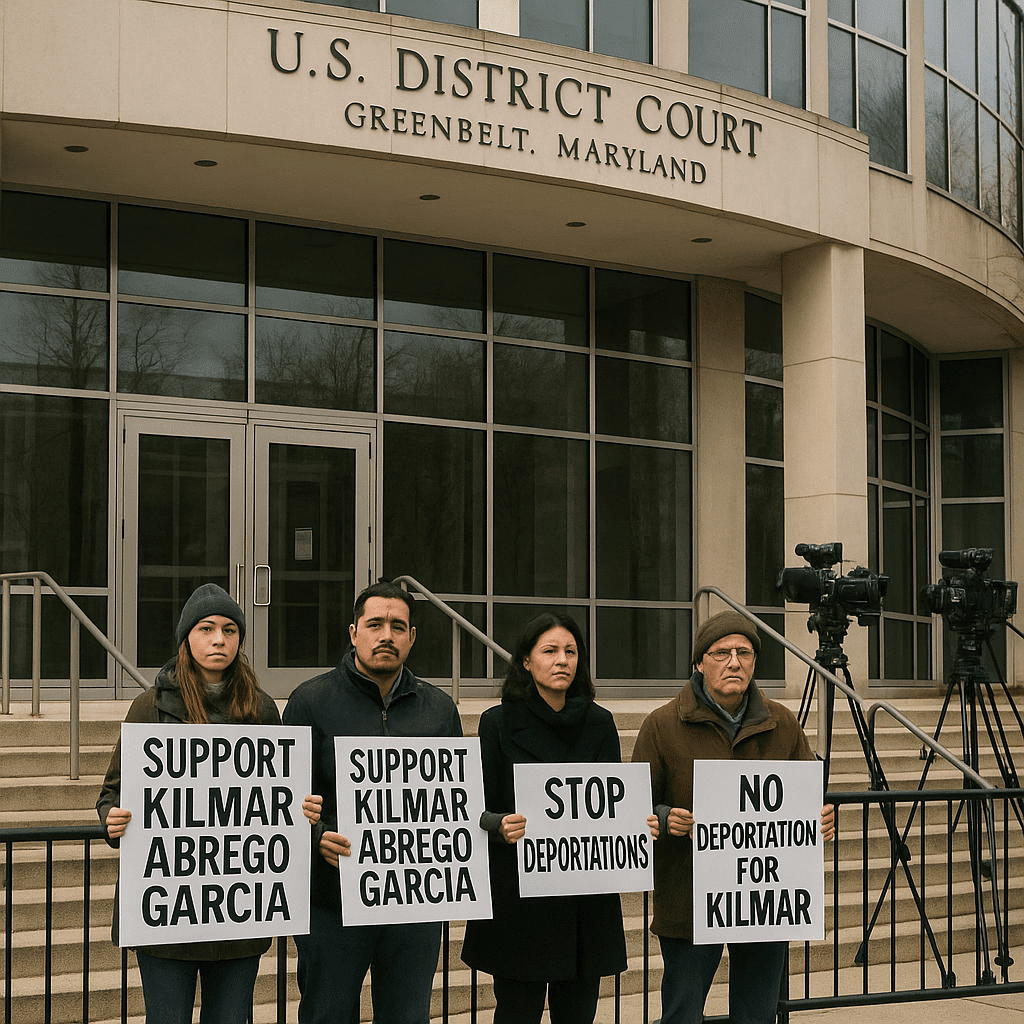
The most recent turn in the civil case sharpened those concerns. On Dec. 11, 2025, a federal judge in Maryland ordered ICE to immediately release Abrego Garcia while his legal challenge against deportation proceeds. That order followed weeks of filings and an Oct. 10, 2025, evidentiary hearing in Greenbelt, where protesters rallied outside the courthouse and his attorneys pressed for his release from immigration detention. The December ruling temporarily rebalanced the system in favor of due process, at least until his appeals and the Tennessee criminal case are resolved.
Abrego Garcia’s three-front fight remains unresolved. The civil case in Maryland, the human-smuggling prosecution in Tennessee, and the asylum petition in immigration court will continue to test how well U.S. immigration enforcement can reconcile court rulings, correct its own mistakes, and avoid punitive overreach. Upcoming hearings, appeals, and trial dates will determine not only his fate, but also how much discretion future officials have when a single deportation error spirals into multiple, overlapping legal battles.

Mason Reed serves as a Staff Writer for Just Right News, where he spearheads the Future Frontiers & Special Projects desk. In an era defined by rapid technological shifts and evolving social landscapes, Mason provides a steady, principled voice, examining the innovations of tomorrow through the lens of traditional American values. His work is most prominently featured in his signature series, “The Next Horizon,” where he explores the intersection of emerging technology, national sovereignty, and the preservation of individual liberty.
A native of San Diego, California, Mason’s worldview was shaped by the unique culture of his hometown. Growing up in a region defined by its strong military presence and its history of maritime industry, he developed a deep-seated respect for the institutions that provide national stability and the entrepreneurial spirit that drives the American economy. This upbringing instilled in him a belief that true progress is not found in discarding the past, but in building upon a foundation of proven principles. His reporting often reflects this San Diego influence, emphasizing the importance of a robust national defense and the necessity of maintaining a competitive edge in the global marketplace.
Now based in San Francisco, Mason operates from the heart of the world’s technological engine. Living and working in the Bay Area provides him with a front-row seat to the advancements—and the ideological challenges—emanating from Silicon Valley. While many in the region embrace a “move fast and break things” mentality, Mason’s reporting serves as a vital counterweight. He offers Just Right News readers a “boots on the ground” perspective, documenting how radical local policies and the concentration of tech power impact the everyday lives of citizens. His proximity to the industry allows him to cut through the marketing jargon of big tech to uncover the real-world implications for privacy, free speech, and the nuclear family.
In his “Future Frontiers” beat, Mason tackles complex subjects ranging from the ethics of artificial intelligence to the burgeoning private space race. He approaches these topics with a healthy skepticism toward centralized bureaucracy, championing instead the decentralized innovations that empower individuals. Through “The Next Horizon,” he highlights the pioneers and thinkers who are working to ensure that the future remains a place where human dignity and constitutional rights are protected. He believes that the rapid pace of change requires more than just technical expertise; it requires a moral compass rooted in the Western tradition.
Throughout his tenure at Just Right News, Mason has remained committed to the idea that the future is something to be shaped, not merely accepted. His writing is characterized by a rigorous defense of American exceptionalism and a belief that the country’s best days lie ahead, provided it remains true to its founding ideals. Whether he is investigating the impact of automation on the American workforce or profiling the next generation of aerospace engineers, Mason Reed ensures that his readers are equipped with the insights they need to navigate a changing world with confidence and clarity.