

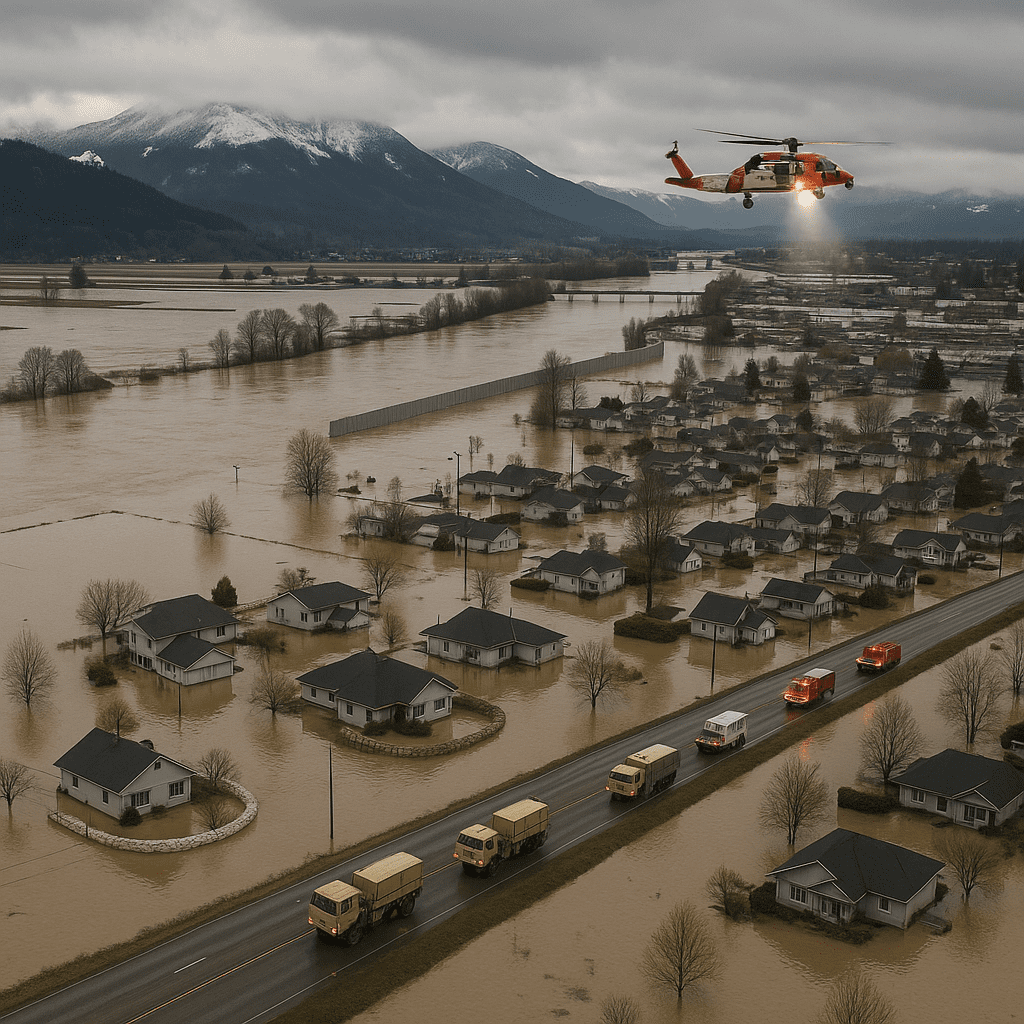
Relentless rain has pushed rivers in western Washington past historic levels, forcing mass evacuations, rooftop rescues, and major road closures from Mount Vernon to Sumas. Officials warn as many as 100,000 people could be told to leave as aging levees, saturated soils, and record crests collide. Scientists say a warming climate is raising the odds of such extreme floods, even as another storm system looms.
National Guard troops moved through Mount Vernon before sunrise, knocking on doors in a farming city that suddenly sat in the crosshairs of water. Days of torrential rain had turned the Skagit River and its tributaries into wide, fast-moving channels that stranded families on rooftops, washed over bridges and ripped homes from their foundations. By Friday morning, the warnings that had sounded abstract—about levees that might fail and dikes that might not hold—had become muddy water pushing through a slough and into people’s living rooms.
The order that followed left little room for doubt. “ALL RESIDENTS IN THE CITY OF BURLINGTON SHOULD EVACUATE IMMEDIATELY,” Skagit County officials wrote on social media as floodwaters spread across the Skagit River plain. Those messages came just two days after officials issued “go now” notices to tens of thousands of people living in low-lying areas, including Burlington, a city of nearly 10,000. Gov. Bob Ferguson warned that as many as 100,000 people could ultimately be asked to leave their homes statewide.
From the air, the scale of the disaster was stark. Coast Guard video showed helicopter crews plucking families from roofs in Sumas, near the U.S.-Canada border, where about 15 feet (4.6 meters) of water submerged some neighborhoods and left the fire station under 3 feet (91 centimeters). In nearby Welcome, erosion undercut riverbanks until at least two houses slid into the Nooksack River; officials said no one was inside at the time. Farther south in Snoqualmie, a herd of elk swam and waded through neck-high water on a flooded football field, another measure of just how high the rivers had risen.
This winter deluge, driven by what meteorologists describe as an atmospheric river, pushed multiple rivers past their recorded flood stages. At Mount Vernon, the Skagit crested at more than 37 feet (11.2 meters), according to weather service data, overtopping previous benchmarks. In Snohomish, the Snohomish River surged nearly a foot—about 30 centimeters—above its prior record. The National Water Prediction Service tracked those crests as they marched downstream, giving local leaders a narrow window to decide whether to defend, evacuate or both.
For people living right on the water, the numbers felt personal. In Concrete, upriver from Mount Vernon, Mariah Brosa watched the Skagit pound against her raised riverfront home. The water stopped just short of entering, but debris slammed against the house and totaled her fiancé’s work car. “I didn’t think it would come this high,” she said. Her disbelief echoed the broader tension running through the region: floods are familiar in this part of Washington, but records keep being broken.
Mount Vernon’s relationship with the Skagit captures that history. Flooding has long plagued the city of some 35,000 residents, and high water in 2003 displaced hundreds of people. A downtown floodwall built to shield the commercial core from the river faced a major test in 2021 and held as the Skagit approached previous records. This time, water again rose to the foot of the wall by late Thursday morning, Mayor Peter Donovan said, underscoring how often the city now finds itself within inches of disaster.
Elsewhere, there was no engineered barrier to fall back on. A landslide east of Seattle buried part of Interstate 90 in trees, mud and standing water, trapping vehicles and cutting a key corridor. State Route 410 also saw sections close with no estimated reopening time. Along Issaquah Creek, east of the city, residents scrambled with water pumps as floodwaters filled yards; yellow tape marked off hazardous banks as the channel chewed away at the land.
Near the U.S.-Canada border, Sumas, Nooksack and Everson faced a second calamity in less than a decade. The border crossing at Sumas was closed, and Amtrak suspended trains between Seattle and Vancouver, British Columbia, as water spread across the valley floor. Sumas Mayor Bruce Bosch said much of his city has been “devastated” by the flooding, just four years after a similar event. The repetition sharpened questions about whether rebuilding in the same way, in the same places, remains tenable.
Officials and residents alike are increasingly forced to think about atmospheric rivers as more than passing storms. Scientists quoted in the reporting emphasize that climate change has been linked to some intense rainfall and, in general, to more frequent and more severe extreme storms, droughts, floods and wildfires. They also note that tying any single event directly to climate change requires dedicated study. Even without that attribution work, the pattern is evident on the ground: rivers in Washington are topping their historical markers more often, while communities and infrastructure built for past extremes are repeatedly strained.
Emergency managers framed their decisions in that context. In Skagit County, the combination of saturated soils, aging levees and rising rivers left little margin for error, prompting the early “go now” orders for floodplain residents. Those included farmers whose fields, barns and livestock lie on some of the state’s most fertile land—and some of its most exposed. In Monroe, photos showed families like Joselyn Rosas, 7, hugging one another as they looked out over the flooded Three Rivers Mobile Home Park along the Snohomish River, unsure what they would return to when the water receded.
The immediate focus remains on getting people out of harm’s way and maintaining critical links. With rivers still high and ground saturated, Washington faces the prospect of yet another storm system bringing more rain starting Sunday, according to forecasters cited in the reporting. That looming front means the emergency orders, floodwalls, road closures and rooftop rescues are not yet the end of the story but part of an unfolding season. As the waters move downstream and the rain returns, state and local officials will have to revisit the same difficult choices—about evacuations, defenses, and, ultimately, how and where communities should rebuild on a landscape that is testing the old definitions of “historic” flood.

Ethan Blake serves as a Senior Correspondent for Just Right News, where he specializes in Longform Narrative and Public Understanding. In an era of rapid-fire headlines and fleeting soundbites, Ethan’s work stands as a testament to the power of deep-dive reporting and the importance of contextualizing the complex issues facing the nation today. His approach is rooted in the belief that the most profound truths are often found in the lived experiences of individuals rather than the abstract theories of distant policymakers.
Growing up in Providence, Rhode Island, Ethan developed an early appreciation for the historical and cultural threads that weave the American fabric together. Providence, a city defined by its industrial heritage and its blend of traditional neighborhoods, provided him with a front-row seat to the challenges and triumphs of the American working class. This upbringing instilled in him a respect for the “common sense” values of hard work, community loyalty, and the preservation of local institutions. He learned early on that behind every economic statistic or legislative debate, there are real families and neighborhoods navigating the consequences of change.
This foundational perspective is the driving force behind his signature feature series, “Lives Behind the Systems.” Through this series, Ethan explores the intersection of individual agency and institutional structure. Whether he is documenting the impact of federal land-use policies on rural families or examining how shifting educational standards affect local school boards, Ethan’s work prioritizes the human element. He seeks to uncover how large-scale systems—be they governmental, economic, or social—affect the daily lives of citizens, often advocating for a return to local control and personal responsibility.
Now based in Portland, Maine, Ethan draws significant inspiration from the rugged independence and self-reliance that define the region. The coastal landscape and the resilient spirit of Maine’s communities serve as a constant reminder of the importance of individual liberty and the strength found in decentralized power. Living and working outside the traditional media hubs allows Ethan to maintain a grounded perspective, ensuring his reporting remains untethered from the echo chambers of the major metropolitan centers. This geographic distance provides him with the clarity needed to translate complex national narratives into stories that resonate with the heart of the country.
At Just Right News, Ethan’s beat is more than just a professional assignment; it is a mission to foster a more informed and engaged citizenry. He believes that a free society depends on the public’s ability to understand the mechanisms of power and the value of traditional American principles. His longform narratives do not merely report the news; they provide a roadmap for understanding the cultural and political shifts of the modern era through a lens of skepticism toward centralized authority and a deep respect for the individual.
Through his meticulous research and narrative craftsmanship, Ethan Blake continues to bridge the gap between policy and the public. His work remains a vital resource for those who seek a deeper understanding of the systems that shape our world and the enduring spirit of the people who live within them.