

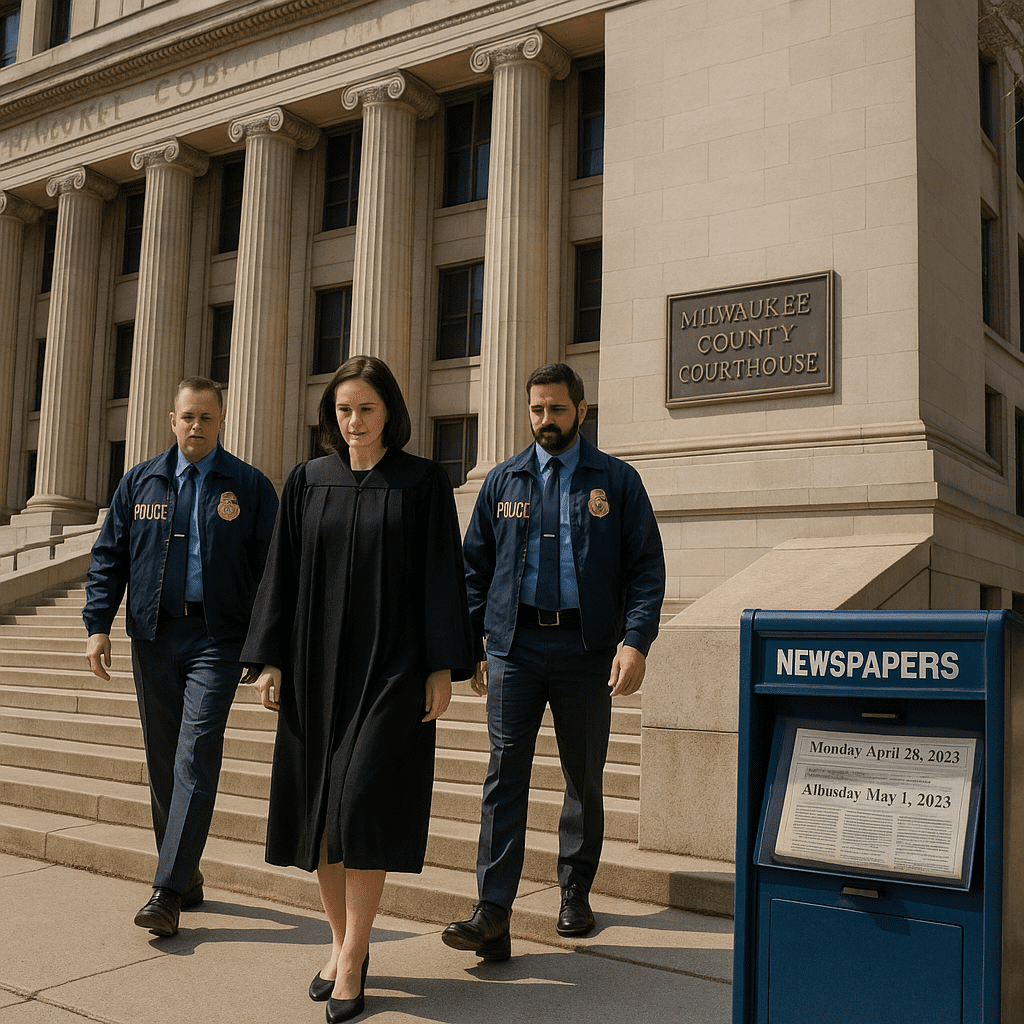
Interim U.S. Attorney Brad Schimel confirmed plea talks in the federal case against Milwaukee County Judge Hannah Dugan, indicted in May for obstruction and concealing an individual. The charges stem from an April courtroom incident involving Eduardo Flores-Ruiz, who was later deported. Dugan’s lawyers deny wrongdoing and are preparing for a Dec. 15 trial amid heightened political attention.
A newly appointed federal prosecutor confirmed that plea negotiations are underway in the case of Milwaukee County Judge Hannah Dugan, a development that could reshape a dispute that has become a national flashpoint in the Trump administration’s immigration enforcement campaign. Interim U.S. Attorney Brad Schimel told The Associated Press that attorneys are “discussing potential resolution” of the indictment even as Dugan’s team maintains she is innocent and is preparing for trial next month. Schimel framed the talks as routine, saying plea bargaining is a “normal process to resolve a case and eliminate risk for both sides, to find a resolution that makes sense. That’s all.”
The allegations stem from courtroom events in April. Court documents, as reported by AP, say federal agents learned an immigrant in the country illegally was scheduled to appear before Dugan in a state battery case. The agents went to the Milwaukee County Courthouse to apprehend the man, identified in filings as 31-year-old Eduardo Flores-Ruiz. According to the documents, Dugan showed Flores-Ruiz out of the courtroom through a private door, allowing him to reach the exterior before agents chased and captured him following a foot pursuit.
Dugan was arrested a week later and was indicted by a federal grand jury in May on charges that include obstruction and concealing an individual to prevent arrest. The indictment, prosecutors say, could carry penalties of up to six years in prison if Dugan is convicted. The U.S. Department of Homeland Security announced that Flores-Ruiz had been deported.
The case has escalated beyond the courthouse and into politics and social media. AP coverage notes that FBI Director Kash Patel posted a photo on the social platform X of Dugan being led out of the courthouse in handcuffs, and that the Department of Homeland Security posted on X last week that Dugan has taken the term “’activist judge’ to a whole new meaning.” Those posts have intensified partisan commentary and framed the prosecution as part of a broader enforcement posture under the Republican administration.
Legal observers cited in reporting offered mixed assessments of the current posture and the public handling of plea discussions. John Vaudreuil, a former U.S. attorney in Wisconsin’s Western District, said he was surprised that Schimel would comment publicly on plea negotiations, noting such discussions are typically private and that public announcements could be seen as pressure on a defendant. Vaudreuil nevertheless said he was not surprised negotiations were occurring. He warned that signals from higher levels of the Justice Department could limit the range of possible resolutions, saying, “If the attorney general of the United States says it has to be a felony and it has to be jail time, I don’t suspect that’s where the defense is starting from.”
Schimel’s own credentials and recent appointment have drawn attention. Attorney General Pamela Bondi appointed Schimel as the Eastern District of Wisconsin’s interim U.S. attorney, and reporting notes his prior service as Wisconsin attorney general from 2015 to 2019. Those background facts have figured in debate among lawyers and observers about local prosecutorial discretion and political influence.
Beyond the immediate legal mechanics, lawyers and observers say how the plea talks are publicly framed could matter as much as their substance. Public references to ongoing negotiations, they say, can constrain both sides’ room to maneuver and shape expectations in ways that complicate a negotiated settlement. Some defense attorneys worry that high-profile rhetoric will narrow options, while prosecutors say a negotiated resolution can avoid the uncertainty and expense of a trial and can reflect the practicalities of the evidence and witnesses.
Dugan’s defense has repeatedly asserted her innocence and argued she had authority over movement in her courtroom. Defense attorneys told the AP they are preparing for a trial that, as reported, is set to begin Dec. 15. A plea agreement, if reached, would represent a notable de-escalation by prosecutors in a matter that has drawn national scrutiny and political commentary. Schimel emphasized the routine nature of negotiations and declined to expand on specific terms under discussion.
As the case moves forward, court filings and scheduled proceedings will be watched for signs of resolution or escalation. The timeline in public reporting shows a May indictment, an April courtroom encounter underlying the charges, and a Dec. 15 trial date. Oversight of the prosecution and possible public statements from Justice Department leadership were cited by legal figures as influential factors in whether the case proceeds to trial or is resolved by plea. Whatever the outcome, the dispute is likely to continue to serve as a focal point in debates over local resistance to federal immigration enforcement and the public role of judges in criminal and civil-immigration entanglements.

Greg Sanders serves as the Senior Correspondent for Corporate Power and Antitrust at Just Right News, where he brings a principled, conservative perspective to the complex intersection of big business, government regulation, and the American consumer. With a career dedicated to investigative depth and economic clarity, Greg has become a leading voice in examining how the consolidation of industry power impacts the foundational values of the free market and individual liberty.
Raised in Denver, Colorado, Greg’s reporting is deeply informed by the Western spirit of independence and a healthy skepticism of centralized authority. Growing up in the shadows of the Rockies, he witnessed firsthand the importance of local entrepreneurship and the vital role that small-medium enterprises play in sustaining vibrant communities. This upbringing instilled in him a belief that the American Dream is best preserved when the playing field remains level and when competition—rather than backroom deals between corporate lobbyists and federal regulators—dictates success. For Greg, the rugged individualism of his home state serves as a constant reminder that the economy should serve the people, not the other way around.
Now based in Chicago, Illinois, Greg operates from the heart of the nation’s industrial and financial crossroads. His location in the Midwest provides him with a unique vantage point to observe the real-world consequences of corporate overreach. From the boardrooms of the Loop to the manufacturing hubs that define the region, he tracks the movement of capital and the shifting tides of market influence. Chicago’s history as a center of trade and labor offers a rich backdrop for his work, allowing him to bridge the gap between high-level economic theory and the lived experiences of hardworking Americans who feel the squeeze of monopolistic practices.
At Just Right News, Greg’s beat focuses on the “new monopolies” and the rise of “woke” corporate culture. He argues that when corporations become too large, they often abandon their fiduciary duties to shareholders in favor of social engineering and political posturing. His reporting seeks to hold these “Titans” accountable, ensuring that the power of the purse is not used to silence dissent or bypass the democratic process. He is a firm advocate for the idea that true conservatism requires a vigilant defense of competition, preventing any single entity—public or private—from exerting undue control over the lives of citizens.
This mission is most clearly seen in his acclaimed feature series, “The Titans and the Toll.” In this ongoing project, Greg explores the human cost of market consolidation, from the erosion of consumer choice to the decline of local economies. Through rigorous analysis and boots-on-the-ground reporting, he documents how the concentration of power in sectors like tech, agriculture, and finance creates a “toll” paid by the average family.
Greg Sanders remains committed to the idea that a transparent, competitive market is the greatest engine for prosperity ever devised. Through his work at Just Right News, he continues to provide the essential oversight necessary to protect that engine from the encroaching influence of corporate giants and the bureaucratic structures that enable them.