

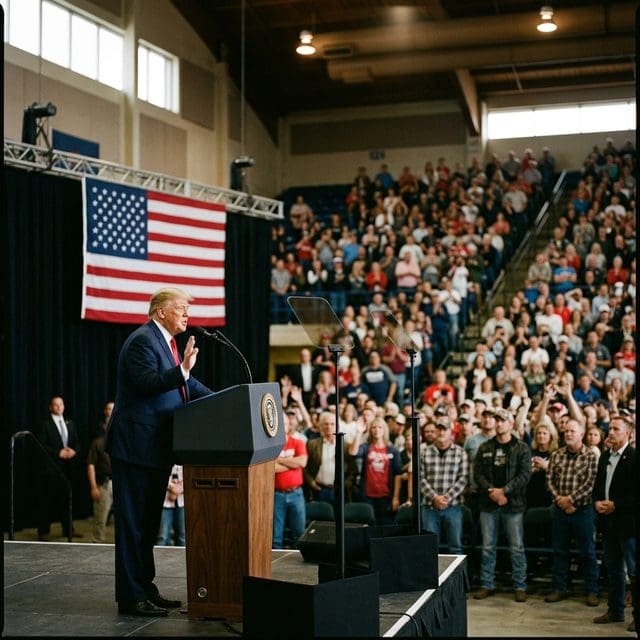
Trump’s Montana rally paired campaign appeals with a proposed military range as Democrats prepared a conditional House agenda and election officials faced voter-roll disputes and security threats.
President Donald Trump’s Kalispell rally Wednesday offered a snapshot of the political argument taking shape three weeks before the midterms: Republicans are urging voters to treat the contests as a referendum on Trump, while Democrats are promising an affordability agenda and expanded oversight if they win the House.
Trump said he was helping Republicans despite not being on the ballot: “I’m not running, but I feel like I’m running.” The White House has called his hour-plus appearances a “midterm blitz.” The Associated Press reported that Republicans are retreating from some battleground House races as Democrats direct money toward candidates once considered long shots—a shift toward a more defensive GOP posture.
In Kalispell, Trump promoted Aaron Flint, the Republican House candidate in Montana’s 1st District, and Senate candidate Kurt Alme. He warned that the Second Amendment would be “under siege” if Democrats win and cited National Rifle Association ratings. The NRA gave Democratic Senate candidate Alani Bankhead an F and assigned Democratic House candidate Sam Forstag a question mark after he declined to complete its questionnaire. Those ratings are advocacy-group judgments, not a substitute for examining candidates’ records or proposed laws.
Trump also announced a new Pentagon testing range in Montana for advanced weapons and technologies, saying the state would help ensure the military “always reigns supreme.” Montana Republicans had sought the range. The announcement stated the administration’s intention, but the supplied reporting offered no details on cost, site, timeline or congressional authorization. Those details will determine what the proposal means beyond the rally pledge.
Democrats are preparing for a possible change in House control. Minority Leader Hakeem Jeffries says a 100-day agenda would focus on affordability and oversight, including votes on the Iran war, restoring Affordable Care Act tax breaks, reversing Republican Medicaid cuts and undoing Trump’s tariffs. Five working groups are developing proposals on health care, housing, groceries and goods, energy costs and caregiving, pairing progressive and centrist lawmakers.
The plan remains conditional. Its scope would depend on the size of any Democratic majority and whether the Senate also changes hands. Even with House control, Democrats could pass legislation Trump might veto; they could not enact the agenda alone. Jeffries has assigned committee Democrats to prepare investigations of the administration. He has said impeachment is neither on nor off the table, but the party has not made it a settled plank of the proposed agenda.
Election administration is another point of contention. The Justice Department threatened California with possible legal action over names it says may include noncitizens who received mail ballots. It gave the state 48 hours to check whether citizens appear on its list and said ballots for people whose citizenship cannot be verified should be segregated while their status is determined. The supplied reporting does not establish that those identified are noncitizens. A previous federal claim in Nevada underscores the need for verification: after the administration identified people it said were noncitizens on voter rolls, the state found no registered noncitizens among them.
At least two state election offices, in Louisiana and Oklahoma, were evacuated after receiving envelopes containing white powder; authorities had not immediately identified harmful substances. Election-administration associations condemned threats against staff. Protecting workers and investigating credible evidence without amplifying unverified claims are both essential to public confidence.
The competing campaign messages have practical institutional consequences. A proposed military facility raises questions of funding and oversight; a party’s agenda faces legislative and constitutional checks; and claims about voter eligibility require verifiable evidence and due process. With Election Day approaching, those mechanics—not campaign labels alone—will determine what government can do and whether voters can trust how it is done.

Sophie Carter serves as a Staff Writer for Just Right News, where she anchors the outlet’s critical coverage of Elections, Influence, and Democracy Infrastructure. In an era where the mechanics of voting and the flow of political capital are under constant scrutiny, Sophie provides a steady, principled voice dedicated to the preservation of American institutional integrity and the rule of law.
Raised in Charlotte, North Carolina, Sophie’s perspective was forged in a community that balances rapid modern growth with a deep respect for tradition and civic duty. Growing up in the Queen City, she witnessed firsthand how a robust local culture depends on the trust between the citizen and the state. This upbringing instilled in her a foundational belief that the right to vote is a sacred trust—one that must be protected from both administrative overreach and the encroaching influence of special interest groups. Her reporting reflects these North Carolina roots, emphasizing the importance of community-led governance and the preservation of the individual’s voice in the face of nationalized political movements.
Now based in Atlanta, Georgia, Sophie operates from the heart of one of the nation’s most pivotal and contested political landscapes. Her location allows her to report from the front lines of the debate over election security, legislative reform, and the modernization of voting systems. For Sophie, the “infrastructure” of democracy is not merely a matter of machines and ballots; it is the collection of laws, people, and transparent processes required to maintain public confidence. Her work often highlights the necessity of clear, enforceable standards that ensure every legal vote is counted fairly and that the machinery of our republic remains accountable to the taxpayers who fund it.
Central to her work at Just Right News is her acclaimed feature series, “The Price of a Vote.” Through this ongoing project, Sophie explores the complex web of influence that shapes modern campaigns and policy decisions. She delves into how high-level lobbying, non-governmental organizations, and shifting bureaucratic regulations impact the weight of an individual citizen’s ballot. By examining the financial and structural pressures placed on the electoral process, she provides readers with a comprehensive look at the forces vying for control over the American political system.
Sophie’s approach to journalism is rooted in a commitment to the constitutional framework. She views her role as a watchdog for the voter, ensuring that the systems meant to serve the public remain transparent and free from corruption. Whether she is analyzing the implementation of new voting technologies or investigating the influence of outside money on state-level policy, her work is characterized by a rigorous adherence to facts and a refusal to succumb to the sensationalism that often plagues modern political reporting.
At Just Right News, Sophie Carter continues to be a vital resource for readers who value clarity, conviction, and a defense of traditional American values. Her deep ties to the Southeast and her specialized focus on the mechanics of our republic make her an essential voice in the ongoing conversation about the future of American self-governance. Through her reporting, she remains dedicated to the idea that a secure and honest electoral system is the bedrock of a free and prosperous society.