

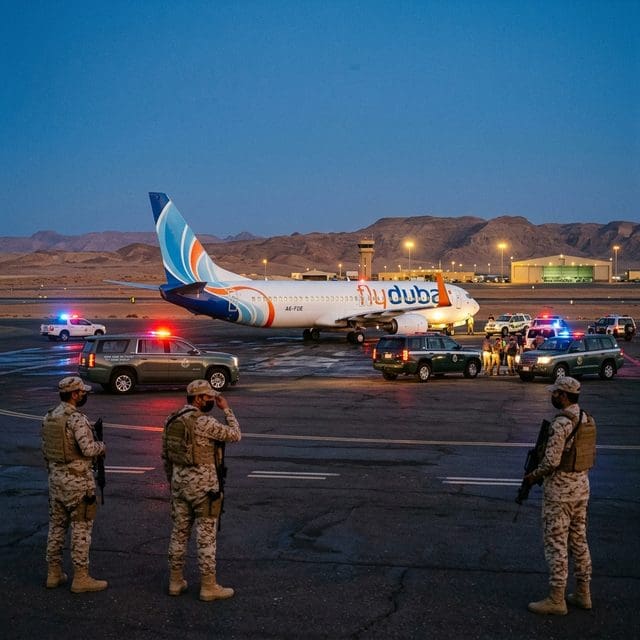
A violent cockpit confrontation aboard a Tel Aviv-bound flight forced an emergency landing in Saudi Arabia, testing regional security cooperation and the resilience of Abraham Accords-era aviation links.
A violent cockpit confrontation aboard FlyDubai flight FZ1073 forced an emergency landing in Saudi Arabia on Wednesday, sparking high-stakes security coordination between Tel Aviv and Riyadh. The Boeing 737, carrying 150 mostly Israeli passengers from Dubai, diverted while over Jordanian airspace and landed at Tabuk airport. The incident places a significant number of Israeli citizens in a country with which Israel maintains no formal diplomatic ties.
Israeli security officials identified the suspect as an Omani co-pilot who allegedly stabbed the captain during the flight. Flight tracking data recorded a harrowing sequence where the aircraft underwent a rapid descent of nearly 14,000 feet in under 30 seconds. The plane fell from 34,000 feet to 16,000 feet in roughly three minutes as the struggle for control unfolded. During the crisis, the aircraft broadcast a signal indicating “unlawful interference.” Israeli officials confirmed that cabin crew members eventually entered the cockpit to regain control.
Saudi authorities reported that both pilots were hospitalized with injuries, while the passengers remain safe and accounted for on the ground. Prime Minister Benjamin Netanyahu has cleared his schedule for security consultations, stating that measures are being taken to return the passengers. The IDF has recommended sending a military aircraft for the repatriation mission, a move requiring unprecedented coordination with Saudi aviation authorities.
This disruption occurs as the Trump administration manages complex shifts elsewhere. On September 22, the administration signed a Greenland agreement with Denmark to bolster the U.S. military presence in the Arctic. Simultaneously, the White House announced an AI self-regulation accord with tech companies to prevent models from losing control, a concern that mirrors the physical loss of control witnessed in the FlyDubai cockpit.
In Europe, security remains fraught. Polish leaders warned this week that Russia is planning attacks to test NATO defenses, while Estonia accused Moscow of an arson attack on a robotics firm. These acts of sabotage suggest a coordinated effort to destabilize the Western alliance. Meanwhile, the U.S. continues to navigate its relationship with China; President Trump and President Xi Jinping recently agreed to cut tariffs on $30 billion worth of goods and established a new channel for AI incident coordination.
FlyDubai has confirmed only an onboard “incident,” and the UAE has not issued a formal comment. The motive behind the co-pilot’s alleged attack remains under investigation. For the United States, the event serves as a reminder that even as diplomatic ties expand through the Abraham Accords, the threat of non-state interference remains a volatile variable in regional stability.

Olivia Kendall serves as the Senior Correspondent for Geopolitics, Defense, and Foreign Policy at Just Right News, where she provides a principled, conservative perspective on the complex forces shaping the global stage. With a career dedicated to deconstructing the intricacies of international relations, Kendall has become a trusted voice for readers who value national sovereignty, a robust military, and a foreign policy that prioritizes American interests above all else.
A native of Washington, D.C., Kendall’s professional journey is deeply rooted in her upbringing within the nation’s capital. Growing up in the epicenter of American political life, she developed an early and profound understanding of how policy is crafted and, more importantly, how it often fails to account for the values of the American heartland. This unique vantage point allowed her to witness firsthand the rise of globalist bureaucracies, fueling her commitment to reporting that champions the constitutional foundations of the United States. Her background as a British White American further informs her worldview, providing her with a keen appreciation for the Western tradition and the enduring importance of the “Special Relationship” in maintaining global stability.
Now based in Arlington, Virginia, Kendall operates from the doorstep of the Pentagon and the heart of the nation’s defense establishment. Her proximity to the decision-makers in the military and intelligence communities allows her to provide boots-on-the-ground reporting that is both timely and deeply informed. For Kendall, Arlington is more than just a base of operations; it is a daily reminder of the sacrifices made by the men and women in uniform. This connection to the defense community drives her rigorous coverage of military readiness and her advocacy for a “peace through strength” approach to diplomacy.
At Just Right News, Kendall is perhaps best known for her acclaimed feature series, “The World’s Shadow on America.” In this ongoing project, she explores the direct correlation between international developments and the daily lives of American citizens. Whether she is analyzing the encroachment of foreign adversaries in domestic supply chains or the impact of international treaties on local economies, Kendall’s work serves as a vital bridge between distant geopolitical shifts and their consequences at home. She rejects the notion that foreign policy is an abstract concern for elites, instead proving that what happens in the corridors of power in Brussels or Beijing has a tangible “shadow” that falls across every American doorstep.
Throughout her tenure, Kendall has remained a steadfast critic of international overreach and a vocal proponent of a clear-eyed, realistic foreign policy. She brings a sharp analytical mind to her beat, often challenging the prevailing narratives of the mainstream media to uncover the underlying truths that affect national security. Her reporting is characterized by a refusal to compromise on the truth and a dedication to the idea that a strong, secure America is the world’s best hope for liberty. As a Senior Correspondent, Olivia Kendall continues to lead the charge in providing the essential context and conservative insight necessary to navigate an increasingly volatile world.