

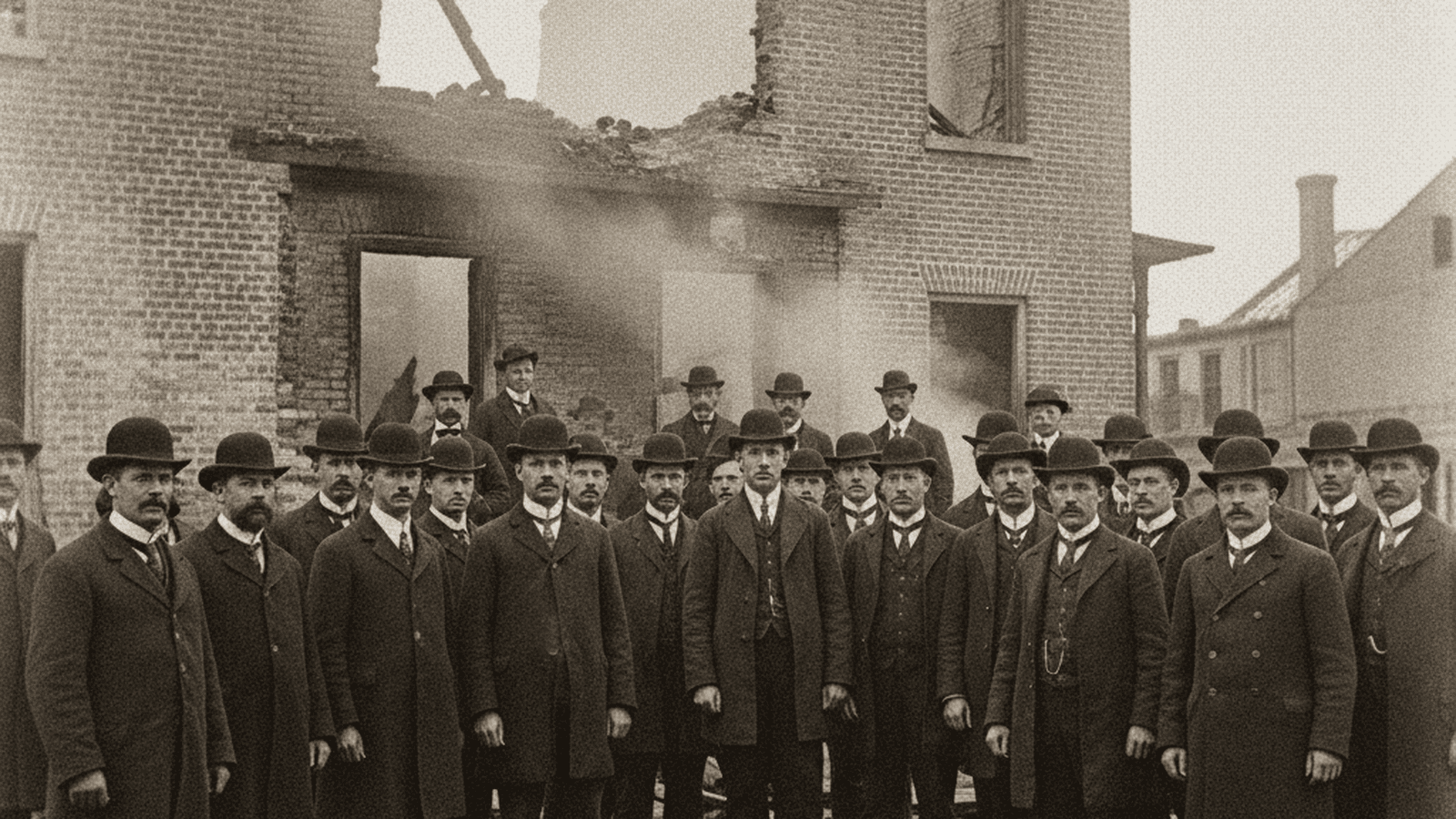
The Wilmington Insurrection of 1898 was a violent coup d’état in North Carolina where white supremacists overthrew a democratically elected biracial government. This event in the United States marked a turning point that led to the systematic disenfranchisement of Black citizens and the solidification of Jim Crow laws.
TLDR: In 1898, white supremacist paramilitaries in Wilmington, North Carolina, executed the only successful coup in United States history. By violently ousting a biracial Fusionist government and murdering dozens of Black residents, the conspirators established a template for total Democratic Party dominance and racial segregation across the American South.
In the late 1890s, Wilmington, North Carolina, was a rare example of a thriving, biracial urban center in the post-Reconstruction South. As the state’s largest city and a major port, it featured a burgeoning Black middle class, with Black citizens serving as lawyers, doctors, and entrepreneurs. Politically, the city was governed by the “Fusion” movement—an alliance between the pro-Black Republican Party and the agrarian Populist Party. This coalition had successfully broken the Democratic Party’s monopoly on power, electing a biracial slate of local officials and challenging the racial hierarchy that had defined the region since the end of the Civil War.
The Democratic Party, then the primary vehicle for white supremacy, viewed this biracial governance as an existential threat. In preparation for the 1898 elections, Democratic leaders like Furnifold Simmons, Charles Aycock, and Alfred Moore Waddell launched a sophisticated “White Supremacy Campaign.” They utilized propaganda, including inflammatory cartoons in newspapers like the Raleigh News & Observer, to depict Black political participation as a danger to white womanhood and social order. To enforce their agenda, they organized the “Red Shirts,” a paramilitary group that used open intimidation, violence, and the disruption of political rallies to suppress the Black and Fusionist vote.
The tension peaked following an editorial by Alex Manly in the Daily Record, Wilmington’s Black-owned newspaper. Manly challenged prevailing white narratives regarding interracial relationships, providing the Democrats with a pretext for escalation. Although the Democrats won the state legislature through fraud and intimidation in the November 8 election, the local Fusionist government in Wilmington remained in power. On November 9, a group of white businessmen and politicians issued the “White Declaration of Independence,” demanding that the city’s elected officials resign and that Alex Manly be expelled from the city.
On the morning of November 10, 1898, Alfred Moore Waddell led a mob of approximately 2,000 armed white men to the offices of the Daily Record. The mob set the building ablaze, destroying the press and forcing Manly to flee for his life. The violence quickly spilled into the streets. Armed with a rapid-fire Colt machine gun mounted on a wagon, the rioters moved into Black neighborhoods, firing indiscriminately. While the official death toll was initially reported as low, modern historians estimate that between 60 and 300 Black residents were murdered. Thousands more fled into the surrounding pine forests and swamps, where many died from exposure.
While the massacre unfolded, the coup was formalized at City Hall. Waddell and his associates forced the legally elected mayor, the board of aldermen, and the chief of police to resign at gunpoint. In a scripted transition, the conspirators installed Waddell as the new mayor and appointed a new board of white Democrats. This was the only successful coup d’état in United States history. Neither the state governor nor President William McKinley intervened, effectively signaling that the federal government would not protect Black citizens or democratic institutions from white supremacist violence.
The aftermath of the Wilmington Insurrection was catastrophic. The city’s Black majority was broken as thousands of residents never returned. In 1900, the Democratic-controlled legislature passed a constitutional amendment implementing literacy tests and poll taxes, which systematically disenfranchised Black voters for decades. The Wilmington model of violent overthrow and legal disenfranchisement became the blueprint for the Jim Crow era across the American South. It was not until the late 20th century that the state officially acknowledged the event as a planned coup, beginning a long process of historical correction and reconciliation.

Sophie Carter serves as a Staff Writer for Just Right News, where she anchors the outlet’s critical coverage of Elections, Influence, and Democracy Infrastructure. In an era where the mechanics of voting and the flow of political capital are under constant scrutiny, Sophie provides a steady, principled voice dedicated to the preservation of American institutional integrity and the rule of law.
Raised in Charlotte, North Carolina, Sophie’s perspective was forged in a community that balances rapid modern growth with a deep respect for tradition and civic duty. Growing up in the Queen City, she witnessed firsthand how a robust local culture depends on the trust between the citizen and the state. This upbringing instilled in her a foundational belief that the right to vote is a sacred trust—one that must be protected from both administrative overreach and the encroaching influence of special interest groups. Her reporting reflects these North Carolina roots, emphasizing the importance of community-led governance and the preservation of the individual’s voice in the face of nationalized political movements.
Now based in Atlanta, Georgia, Sophie operates from the heart of one of the nation’s most pivotal and contested political landscapes. Her location allows her to report from the front lines of the debate over election security, legislative reform, and the modernization of voting systems. For Sophie, the “infrastructure” of democracy is not merely a matter of machines and ballots; it is the collection of laws, people, and transparent processes required to maintain public confidence. Her work often highlights the necessity of clear, enforceable standards that ensure every legal vote is counted fairly and that the machinery of our republic remains accountable to the taxpayers who fund it.
Central to her work at Just Right News is her acclaimed feature series, “The Price of a Vote.” Through this ongoing project, Sophie explores the complex web of influence that shapes modern campaigns and policy decisions. She delves into how high-level lobbying, non-governmental organizations, and shifting bureaucratic regulations impact the weight of an individual citizen’s ballot. By examining the financial and structural pressures placed on the electoral process, she provides readers with a comprehensive look at the forces vying for control over the American political system.
Sophie’s approach to journalism is rooted in a commitment to the constitutional framework. She views her role as a watchdog for the voter, ensuring that the systems meant to serve the public remain transparent and free from corruption. Whether she is analyzing the implementation of new voting technologies or investigating the influence of outside money on state-level policy, her work is characterized by a rigorous adherence to facts and a refusal to succumb to the sensationalism that often plagues modern political reporting.
At Just Right News, Sophie Carter continues to be a vital resource for readers who value clarity, conviction, and a defense of traditional American values. Her deep ties to the Southeast and her specialized focus on the mechanics of our republic make her an essential voice in the ongoing conversation about the future of American self-governance. Through her reporting, she remains dedicated to the idea that a secure and honest electoral system is the bedrock of a free and prosperous society.