

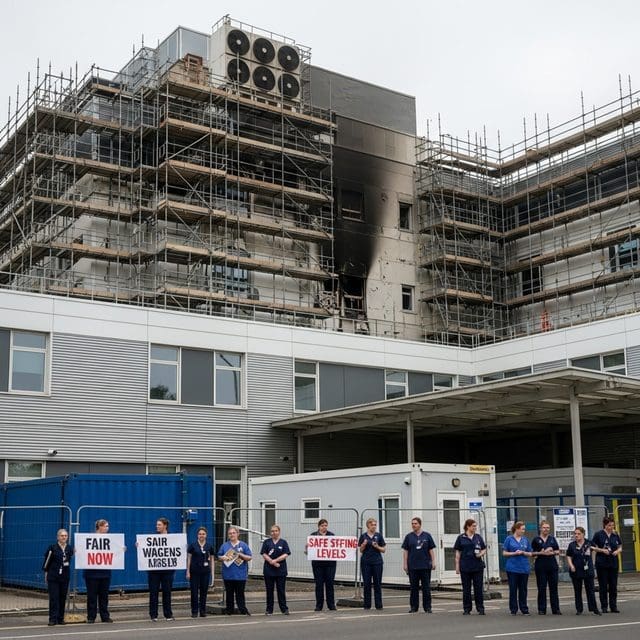
Recent fires in new medical facilities and prolonged nursing strikes highlight the fragility of healthcare systems struggling with safety oversight and fiscal instability.
The promise of modern healthcare is often undermined not by a lack of medical science, but by the failure of the institutions tasked with delivering it. Recent events in Kerala, India, and Kaduna, Nigeria, serve as a stark reminder that without rigorous oversight and fiscal responsibility, the physical and human infrastructure of medicine can collapse, leaving patients at risk. When hospital management and government authorities fail to maintain the basic integrity of their facilities or the stability of their workforce, the sacred doctor-patient relationship is the first casualty.
At Thrissur Medical College Hospital, a fire recently gutted portions of the under-construction Mother and Child Block. While the facility was not yet in clinical use, the blaze—suspected to have originated in an air-conditioning duct during electrical or welding work—exposes a critical gap in construction-phase safety management. Thick smoke and significant ceiling damage on the upper floors suggest that oversight during the expansion of critical care blocks is severely lacking. When public funds are funneled into expansive new wings without stringent fire-risk protocols, the result is a waste of taxpayer resources and a dangerous delay in essential services for vulnerable mothers and infants.
Labor instability further compounds these infrastructure failures, particularly when government price controls and wage mandates stall. At Jubilee Mission Hospital in Thrissur, a grueling 141-day nurses’ strike only reached a tentative resolution on August 4. The dispute, centered on wage hikes and service conditions, saw emergency gates blocked and ambulances rerouted in late July, prioritizing administrative leverage over immediate patient access. While management has agreed to reinstate staff by August 30, the underlying fiscal tension remains. The hospital management has deferred substantial hikes until the government issues revised minimum-wage notifications, illustrating how centralized bureaucratic delays paralyze private healthcare providers and disrupt the continuity of care.
These institutional failures are not localized to one region. In Nigeria, the Army Hospital in Kaduna is currently battling a surge in cholera and tuberculosis risks within barracks communities. The facility has been forced to pivot toward aggressive hygiene campaigns to mitigate the fallout of poor sanitation and environmental neglect in military housing. It is a clear example of how public health policy must prioritize basic preventative infrastructure and personal accountability to avoid the high costs and human suffering associated with emergency outbreak management.
Even when clinical outcomes are successful, the system remains under immense strain. Kozhikode Medical College Hospital (MCH) recently celebrated the discharge of a Nipah virus patient after a two-month stay, underscoring the facility’s role as a high-risk infectious disease hub. However, this success is overshadowed by ongoing scrutiny regarding patient safety, including a June report of an alleged surgery performed on the wrong kidney and a July case of amoebic meningoencephalitis. These contradictions suggest that expanding hospital capacity without a corresponding investment in administrative accountability and staff security is a recipe for systemic failure.
Furthermore, the regional health ministry in Kerala has been forced into “full disaster mode” following a fireworks-factory blast that flooded Thrissur Medical College with dozens of casualties. While the system demonstrated surge capacity in that instance, the simultaneous threat of infrastructure fires and labor strikes at neighboring facilities like Jubilee and Amala creates a precarious environment. For the American observer, these developments offer a cautionary tale. Whether it is the settlement of hospital claims under the Ex-Servicemen Contributory Health Scheme (ECHS) or the management of regional medical centers, the lesson is clear: healthcare excellence requires more than just funding. It demands transparency, the protection of the labor market from bureaucratic stagnation, and a relentless focus on the safety of the physical environment.

Susan Carter serves as a Senior Correspondent for Just Right News, where she leads the network’s comprehensive coverage of Health, Medicine, and Public Policy. With a career dedicated to dissecting the complexities of the American healthcare system, Susan brings a principled perspective to the most pressing debates of the day. Her reporting is characterized by a commitment to individual liberty, fiscal responsibility, and a healthy skepticism of government overreach, making her a vital voice for audiences seeking clarity in an increasingly regulated landscape.
Raised in Minneapolis, Minnesota, Susan’s professional outlook is deeply informed by the values of the American heartland. Growing up in the Twin Cities, she witnessed firsthand the importance of community-driven solutions and the resilience of the individual. This Midwestern foundation instilled in her a firm belief that the best answers to public policy challenges often come from local innovation and personal responsibility rather than top-down federal mandates. Her background allows her to translate complex legislative jargon into stories that resonate with families who value common sense and local autonomy.
Now based in Baltimore, Maryland, Susan operates from a unique vantage point at the intersection of medical innovation and urban policy. Living and working in a city renowned for its world-class medical institutions and significant public health challenges, she has a front-row seat to the realities of the modern healthcare landscape. Her proximity to these hubs of research and policy allows her to scrutinize how government intervention affects the quality of care and the freedom of medical professionals. In Baltimore, she sees the tangible results of policy decisions, using the city as a lens through which to examine the broader national health debate and the impact of federal spending on local communities.
As the lead for the acclaimed feature series “The Cost of Care,” Susan dives deep into the economic realities facing patients and providers alike. Her work focuses on the necessity of price transparency, the benefits of market competition, and the preservation of the sacred doctor-patient relationship. She is a staunch advocate for the idea that a well-informed public is the best defense against bureaucratic inefficiency. Through this series, she has exposed the hidden drivers of rising medical expenses, always seeking to empower the individual consumer over the massive institution.
Susan’s reporting on public policy is characterized by a commitment to rigorous inquiry and a focus on constitutional limits. Whether she is analyzing new pharmaceutical regulations, investigating the impact of federal health mandates, or exploring the future of medical technology, her goal remains the same: to provide Just Right News audiences with the facts they need to navigate a complex world. By blending her Midwestern sensibilities with the insights gained from her base in Maryland, Susan Carter has become a trusted authority for those who believe that personal freedom and public health are inextricably linked. Her work continues to challenge the status quo, advocating for a system that respects the taxpayer and prioritizes the patient.