

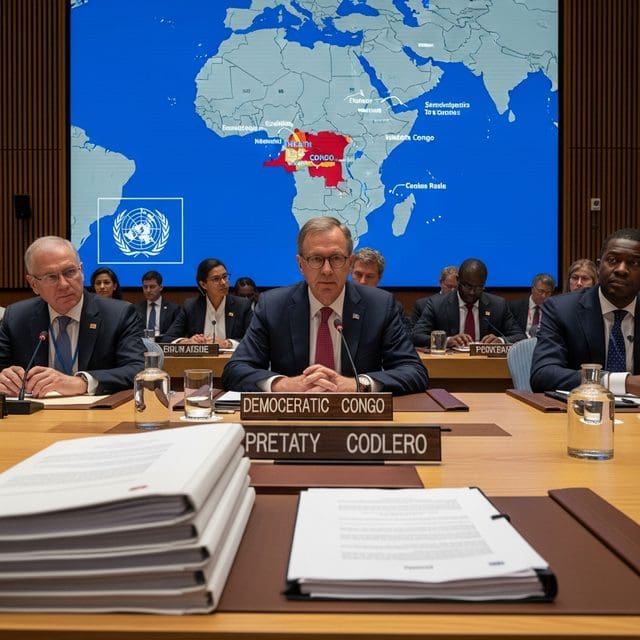
As the Democratic Republic of Congo battles its largest Ebola outbreak on record, Washington faces criticism for tying global health assistance to controversial surveillance and pathogen data-sharing requirements.
The World Health Organization has confirmed that the ongoing Ebola outbreak in the Democratic Republic of Congo has officially become the largest ever recorded in the nation’s history. As of late July 2026, the virus has reached 49 health zones across five provinces, resulting in 3,605 confirmed cases and 1,587 deaths. The current case fatality rate stands at a staggering 44 percent, with epidemiological week 30 alone recording record-breaking totals of 567 cases and 296 deaths. This surge represents a significant escalation in a region already grappling with fragile infrastructure and limited medical resources.
This public health crisis coincides with a period of intense diplomatic friction over the architecture of global health financing and the limits of international cooperation. While the Pandemic Fund—a joint venture between the WHO and the World Bank—has successfully disbursed over $1.2 billion and catalyzed an additional $11 billion for 67 projects in 98 countries, the strings attached to bilateral U.S. aid are drawing sharp rebukes from human rights observers. Reports from Human Rights Watch indicate that Washington has tied health assistance to extensive surveillance access and rights to pathogen samples, a move that critics argue prioritizes Western security interests over local health equity and national sovereignty.
The tension has already resulted in tangible fiscal consequences for American foreign policy and African development. The U.S. has reportedly cut over $800 million in health assistance to several African nations, including Ethiopia, Kenya, Mozambique, Nigeria, Rwanda, Liberia, and Uganda, after disagreements over these conditionality terms. This withdrawal of support comes at a precarious moment, as the WHO notes that while 121 countries have established national public health agencies, the global readiness to handle concurrent crises—ranging from Ebola to climate-driven health shocks and air pollution—remains fragile and unevenly distributed. Currently, air pollution alone exposes 6.5 billion people and contributes to 6.7 million premature deaths annually, further straining these already overextended health systems.
In Geneva, Member States are currently negotiating the Pathogen Access and Benefit-Sharing (PABS) annex to the WHO Pandemic Agreement. These talks, which will culminate at the World Health Assembly in 2026, seek to formalize how biological samples are shared during emergencies and how the benefits of resulting medical products are distributed. For American taxpayers and policymakers, the debate centers on a difficult balance: ensuring rapid access to data for vaccine development and national security while respecting the sovereignty of partner nations who increasingly view their biological data as a strategic national resource rather than a global public good.
To manage these threats, the WHO has deployed its EIOS AI system and the International Pathogen Surveillance Network to support over 110 countries in threat detection. However, technological solutions cannot bridge the gap left by political and financial disputes. Adding to the complexity, the UN Economic Commission for Africa is preparing for the Fourteenth Conference on Climate Change and Development in Africa (CCDA-XIV) in Addis Ababa. The summit aims to shift the regional agenda from broad commitments to concrete delivery, signaling a push for African-led climate and health diplomacy ahead of COP31 and a proposed African-led COP32.
As global health systems face the dual pressures of emerging pathogens and environmental shifts, the current Ebola surge serves as a grim reminder of the stakes involved in these bureaucratic negotiations. The outcome of the PABS annex and the resolution of U.S. aid disputes will likely determine whether the next pandemic is met with a unified global response or a fragmented system of competing national interests. With record deaths in the Congo, the time for diplomatic maneuvering is rapidly shrinking against the reality of biological spread.

Rachel Vaughn serves as a Senior Correspondent for Just Right News, where she leads the network’s coverage of Global Health, Climate, and Development. With a career defined by intellectual rigor and a commitment to principled reporting, Rachel provides a vital conservative perspective on some of the most complex and high-stakes issues facing the world today. Her work is characterized by a refusal to accept bureaucratic narratives at face value, focusing instead on how international policies impact national sovereignty, individual liberty, and the American taxpayer.
Raised in New Haven, Connecticut, Rachel grew up in an environment dominated by elite academic discourse. This upbringing provided her with a front-row seat to the inner workings of the American establishment, but it also instilled in her a healthy skepticism of the “ivory tower” consensus. She learned early on that while academic theories may sound promising in a lecture hall, they often fail to account for the practical realities of the working class. This background drives her to bridge the gap between high-level policy discussions and the common-sense concerns of everyday citizens, ensuring that her reporting remains grounded and accessible.
Now based in Burlington, Vermont, Rachel operates from a unique vantage point within one of the nation’s most progressive political landscapes. Living and working in a region that often serves as a testing ground for radical social and environmental experiments allows her to witness the real-world consequences of these policies firsthand. From her base in the Green Mountain State, she provides Just Right News readers with essential “boots on the ground” reporting, documenting the friction between local mandates and the constitutional freedoms of the individual. Her presence in Burlington ensures that her critiques of globalist agendas are informed by a direct understanding of how those ideologies manifest at the local level.
In her acclaimed feature series, “Planetary Stakes,” Rachel explores the intersection of international development and environmental stewardship. She rejects the alarmism often found in mainstream media, opting instead for a sober analysis of the economic and geopolitical costs of global climate agreements. Her reporting frequently highlights the importance of market-driven innovation and the role of American leadership in fostering global health without ceding authority to unelected international bodies. Through “Planetary Stakes,” she has become a leading voice for those who believe that true conservation and public health are best achieved through transparency, accountability, and the protection of private property rights.
Throughout her tenure at Just Right News, Rachel has distinguished herself as a journalist who is unafraid to ask difficult questions of global institutions. Whether she is investigating the influence of non-governmental organizations on domestic policy or analyzing the fiscal transparency of international health initiatives, her goal remains the same: to provide her audience with the facts necessary to navigate an increasingly interconnected world. Her blend of East Coast intellectual heritage and her current immersion in the political heart of the Northeast makes her an indispensable asset to the newsroom and a trusted source for readers seeking a principled, conservative take on the issues that define our era.