

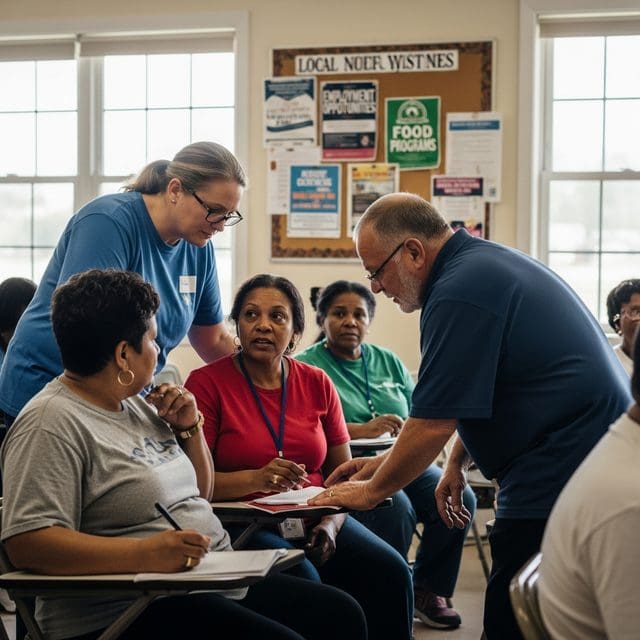
Expanded age limits for work requirements and stagnant benefit levels are reshaping the social safety net for millions of low-income households.
The American social safety net is undergoing its most significant structural shift in a generation as new work requirements for the Supplemental Nutrition Assistance Program (SNAP) reach full implementation this August. For the first time, able-bodied adults without dependents are required to document 80 hours of work or training per month to maintain benefits up to the age of 64, a decade-long increase from the previous threshold of 54. This policy evolution reflects a principled commitment to the idea that the dignity of work is the most effective ladder out of poverty, yet the transition is testing the resilience of local communities.
As of August 2026, benefits are being distributed across a fragmented window. While states like Alaska and Vermont issued all funds on the first of the month, others stagger payments through August 23. This uneven timing creates cash-flow volatility for households living on the edge of the federal poverty level, particularly as food prices remain elevated. Recent reports have also debunked social media rumors regarding a nationwide SNAP increase; in reality, there is no new federal boost beyond existing cost-of-living adjustments. Any extra payments currently circulating are localized state-level supplements, highlighting a persistent communications gap between the bureaucracy and the citizens it serves.
Data from the U.S. Census Bureau, refreshed on July 29, 2026, suggests that while the broader economy shows signs of stabilization, the gap between the working poor and true self-sufficiency remains wide. The maximum monthly allotment for a four-person household is anchored at $994. With net monthly income eligibility for a single person set at $1,305, many recipients find themselves caught in a “benefits cliff” where modest wage increases lead to a total loss of support. This creates a perverse incentive that can stifle the very upward mobility the system is intended to foster.
Asset limits also remain a point of friction for those attempting to build the kind of local resilience that prevents future dependency. Currently, SNAP recipients are restricted to $3,000 in countable assets, or $4,500 for households with elderly or disabled members. These parameters shape how limited savings interact with food insecurity. Critics argue these caps discourage the fiscal responsibility necessary for long-term mobility. When a family cannot save for a reliable vehicle without risking their nutritional support, the springboard of the safety net begins to feel like a trap.
As global energy markets stabilize—evidenced by the 10% drop in oil prices following the reopening of the Strait of Hormuz in April 2026—domestic focus has turned to the adequacy of the current poverty line. The July 2026 update to the World Bank’s Gini index highlights persistent inequality, yet the solution favored by local civic institutions isn’t necessarily more federal spending, but rather better-integrated work programs. The challenge for the remainder of 2026 will be ensuring that the shift toward work-based welfare doesn’t leave vulnerable older workers behind.
Ultimately, the success of these 2026 reforms will not be measured by how many people are removed from the rolls, but by how many are successfully transitioned into the workforce. True compassion lies in providing a path to independence, but that path must be navigable. As the nation watches these older workers navigate the new 80-hour requirement, the focus must remain on the restorative power of hard work and the strength of the local institutions that support them.

James Foster serves as the Senior Correspondent for Inequality and the Social Safety Net at Just Right News, where he brings a principled and nuanced perspective to the most pressing economic challenges facing the nation. With a career dedicated to exploring the intersection of policy and personal responsibility, Foster has become a leading voice in documenting how government programs and economic shifts impact the American family. His reporting is characterized by a commitment to the “human element,” moving beyond cold statistics to highlight the stories of resilience, work, and community that define the modern American experience.
Foster’s perspective is deeply rooted in his upbringing in Birmingham, Alabama. Growing up in a city with a rich industrial heritage and a history of economic transformation, he witnessed firsthand the importance of the dignity of work and the strength of local institutions. In Birmingham, he saw how the most effective safety nets were often those woven by neighbors, faith-based organizations, and local civic groups. This background instilled in him a lifelong skepticism of “one-size-fits-all” solutions from distant bureaucracies, favoring instead the localized, community-driven support systems that he frequently champions in his writing.
Now based in Atlanta, Georgia, Foster operates from one of the most dynamic and rapidly evolving metropolitan hubs in the South. His location provides a front-row seat to the stark contrasts of the modern economy. From the gleaming towers of Atlanta’s financial districts to the struggling neighborhoods on the city’s periphery, Foster finds the stories that illustrate the complexities of upward mobility. His reporting from the Sun Belt serves as a microcosm for the national debate on poverty, highlighting how inflation, housing costs, and labor market shifts affect the working class in real-time.
As the lead for the acclaimed feature series “America’s Balancing Act,” Foster explores the delicate tension between providing a necessary hand up and fostering long-term independence. The series has become a cornerstone of Just Right News, offering a deep dive into the unintended consequences of social welfare policies. Foster’s work often focuses on the “cliff effect” and other systemic hurdles that can inadvertently discourage employment, arguing that true compassion is measured by how many people are empowered to leave the safety net, rather than how many are added to it.
Throughout his tenure, Foster has remained dedicated to the mission of Just Right News, providing a clear-eyed, conservative analysis of social issues. He believes that a free society thrives when individuals are empowered and the private sector is allowed to innovate. Whether he is interviewing small business owners about the challenges of a changing workforce or documenting the success of private charitable initiatives, Foster’s goal is to provide readers with the truth about the state of the American Dream. His work serves as a vital reminder that while the challenges of inequality are great, the solutions are often found in the strength of the American spirit and the preservation of traditional values.