

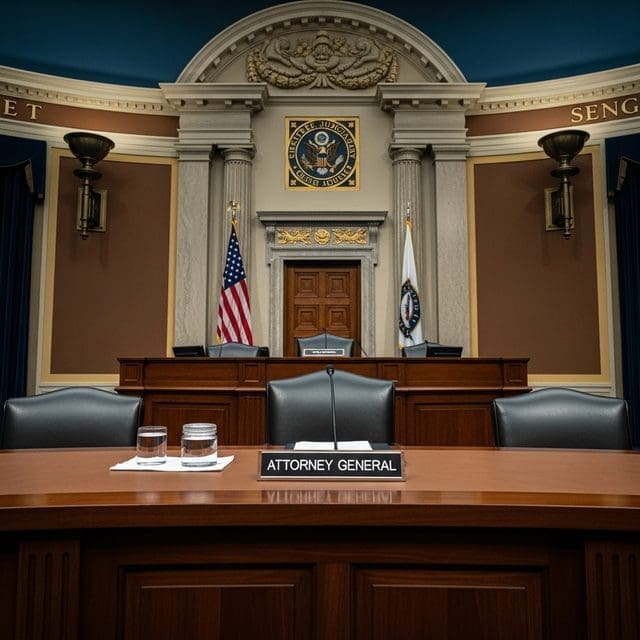
Acting Attorney General Todd Blanche terminated a controversial fund for Trump allies to secure his confirmation, following a deal with Senators John Cornyn and Thom Tillis to protect the Justice Department from political overreach.
The constitutional tension between executive prerogative and legislative oversight reached a critical inflection point this week as Acting Attorney General Todd Blanche formally rescinded President Trump’s $1.776 billion “anti-weaponization” fund. The move, finalized on August 3, 2026, was not a voluntary shift in policy but a calculated concession required to break a weeks-long stalemate in the Senate Judiciary Committee regarding Blanche’s permanent confirmation. The agreement, brokered primarily with Senators John Cornyn (R-TX) and Thom Tillis (R-NC), marks a significant moment where the Senate GOP establishment asserted institutional boundaries against the White House, prioritizing the impartial application of the law over executive-led efforts to litigate past grievances through the administrative state.
Senators Cornyn and Tillis had maintained a disciplined hold on the nomination, demanding written proof that the Department of Justice would not administer the billion-dollar program. The fund, ostensibly designed to compensate individuals claiming unfair prosecution by the federal government, drew sharp criticism for its broad eligibility criteria. Analysts noted that the language of the fund was sufficiently vague to potentially include those convicted of assaulting law enforcement during the January 6 Capitol breach. By leveraging the confirmation process, the two Republican senators have effectively checked an executive attempt to utilize federal coffers for what critics labeled a political slush fund. Cornyn’s office confirmed the deal ahead of a Tuesday Senate Judiciary Committee vote, potentially clearing the way for Blanche’s confirmation before the summer recess begins later this week.
Simultaneously, the White House is navigating a volatile diplomatic landscape regarding the five-month-old conflict with Iran. President Trump announced a halt to planned “massive” military strikes as of August 2, 2026, citing a tentative deal outline. While the President indicated that talks to secure the Strait of Hormuz—a vital artery carrying one-fifth of the world’s traded oil and natural gas—would commence immediately, Iranian state media has denied the existence of active negotiations. This discrepancy highlights the ongoing challenge of verifying executive claims against the ground reality of international diplomacy. The President had previously warned he was losing faith in negotiations, threatening to “obliterate” Iranian infrastructure, only to pivot toward diplomacy as a primary tool for reviving stalled cargo traffic.
In the halls of the Capitol, Senate appropriators reached a separate agreement on August 3 to fund the government through mid-December, narrowly avoiding a shutdown with a procedural vote scheduled for August 4. This fiscal stability is contrasted by the somber news of the passing of former Representative Kay Granger of Texas. As the first Republican woman to chair the House Appropriations Committee, Granger was a formidable steward of the federal purse, and her death at age 83 marks the end of a significant chapter in the history of congressional fiscal management. Her legacy of disciplined spending remains a touchstone for constitutionalists concerned with the current trajectory of federal debt.
Finally, the administrative state continues to face scrutiny over its handling of the COVID-19 pandemic. Dr. Anthony Fauci invoked his Fifth Amendment right more than 100 times during Senate testimony on July 29, 2026, before the Homeland Security and Governmental Affairs Committee. Chaired by Senator Rand Paul, the hearing underscored the persistent demand for transparency regarding the origins of the virus and the federal response. These overlapping events at the Justice Department, the White House, and the Senate committees illustrate a broader struggle to restore accountability to a federal system that many Americans believe has drifted far from its constitutional moorings.

Miles Harrington serves as the Senior Correspondent for Federal Systems & Executive Power at Just Right News, where he brings a disciplined, constitutionalist lens to the inner workings of the American government. With a focus on the mechanics of the federal bureaucracy and the limits of executive authority, Harrington has established himself as a vital voice for readers who value transparency, accountability, and the preservation of the separation of powers.
A native of Richmond, Virginia, Harrington’s perspective is deeply rooted in the traditions of the Old Dominion. Growing up in a city defined by its historical significance and its role as a center of American jurisprudence, he developed an early appreciation for the foundational principles of the Republic. His upbringing in Richmond—a place where the legacy of the Founding Fathers is woven into the landscape—instilled in him a belief that the federal government should remain within its constitutional bounds. This background informs his skepticism of centralized overreach and his commitment to reporting on the ways in which the administrative state impacts the lives of everyday citizens.
In his current role, Harrington specializes in the complexities of federal systems. He doesn’t just report on the headlines of the day; he digs into the structural shifts within the executive branch that often go unnoticed by the mainstream press. Whether he is analyzing the implications of a new federal regulation or investigating the expansion of agency jurisdiction, his work is characterized by a rigorous adherence to the facts and a dedication to the rule of law.
Harrington is perhaps best known for his signature feature series, “How Washington Works.” Through this ongoing project, he demystifies the often-opaque processes of the nation’s capital, pulling back the curtain on the “Deep State” and the unelected officials who wield significant influence over national policy. By breaking down complex legislative maneuvers and executive orders, he empowers Just Right News readers to understand the true levers of power in Washington. His reporting serves as a necessary check on the federal government, ensuring that the actions of those in power are held up to the light of public scrutiny.
Now based in Washington, D.C., Harrington operates at the epicenter of the political world, yet he remains intentionally distanced from the “Beltway bubble.” His proximity to the halls of power allows him to maintain a robust network of sources across the federal landscape, but his heart remains in the principled conservatism of his Virginia roots. He views his role not merely as a reporter, but as a steward of the public trust, dedicated to providing the clarity and context that conservative voters need to navigate an increasingly complex political environment.
Through his sharp analysis and unwavering commitment to the truth, Miles Harrington continues to be a cornerstone of the Just Right News team. His work ensures that the principles of limited government and executive restraint remain at the forefront of the national conversation, providing a crucial service to those who believe in a government that is truly of, by, and for the people.