

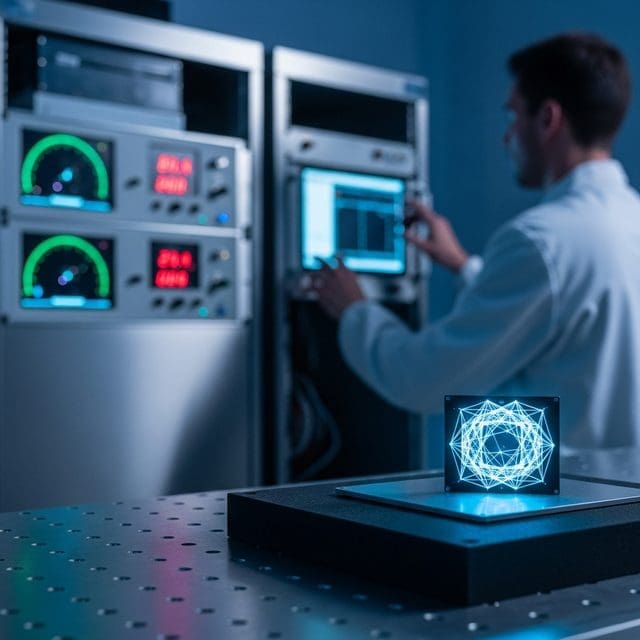
Recent breakthroughs in quantum sensing and topological light structures are bridging the gap between theoretical physics and practical, sovereign technology applications.
The pursuit of scientific discovery often moves in two directions: toward the vast reaches of the cosmos and into the infinitesimal world of the quantum. This week, the field of physics saw significant movement on both fronts, as researchers from Singapore to the International Space Station (ISS) unveiled breakthroughs that could redefine the future of technological sovereignty and data security. These findings suggest that the next era of innovation will be defined by the mastery of the fundamental laws of nature.
At Nanyang Technological University in Singapore, a team led by Assistant Professor Yijie Shen has revived a 200-year-old optical effect to solve a modern computing challenge. By shining a laser on a micron-scale disc—a classic experiment known as the Poisson spot—the team successfully generated “optical skyrmions.” These are complex, swirling structures of light that are topologically protected, meaning they are remarkably resistant to external interference. Because these structures can carry data in a robust, decentralized manner, they represent a potential leap forward for secure communications and high-density data storage that remains immune to the vulnerabilities of current silicon-based systems.
While researchers on Earth simplify the creation of exotic light, NASA is pushing the boundaries of matter in orbit. The agency recently completed upgrades to the Cold Atom Lab (CAL) aboard the ISS, installing redesigned magnetic traps and new metal atom sources. These improvements allow scientists to create quantum gas clouds at temperatures below -459 degrees Fahrenheit, colder than any natural environment in the known universe. By observing these atoms in microgravity, researchers are developing space-based quantum gravity gradiometers. Such precision instruments could eventually allow for the detection of underground resources or the navigation of vessels without the need for vulnerable, centralized GPS satellite networks.
Furthering the reach of quantum sensing, a new prototype detector utilizing two clouds of ultracold atoms has demonstrated the ability to probe for dark matter and primordial gravitational waves. This multi-cloud architecture complements the work being done on the ISS, suggesting a future where quantum sensors act as a new kind of infrastructure, providing high-fidelity measurements of the physical world. This research aligns with recent advancements in programmable optical chips, such as those reported on July 21, which can slow light on demand. By using reconfigurable waveguides and phase shifters, these chips provide the tunable delays and synchronization necessary for integrated optical circuits.
In the realm of particle physics, the PLATON detector is poised to streamline how we observe the fundamental building blocks of reality. By replacing millions of individual optical fibers or phototubes with a single scintillating block and an AI-driven light-field camera, PLATON offers a more efficient path for facilities like the JUNO neutrino observatory. This shift toward high-granularity, integrated detection systems mirrors the broader trend in condensed matter physics, where researchers are now achieving quantum entanglement in centimeter-scale crystals. Even magnons—tiny magnetic waves once thought too short-lived for practical use—have seen their lifetimes extended by nearly 100 times, turning them into promising carriers of quantum information.
These developments signal a transition from the purely theoretical to the applied. As quantum technologies move from massive, state-funded laboratories into programmable chips and compact sensors, the opportunity for decentralized innovation grows. For those concerned with maintaining a competitive edge, these findings offer a blueprint for a future where American ingenuity is anchored in the immutable laws of physics. The integration of AI in track reconstruction and the development of native WinUI charting libraries capable of rendering 100 million data points in milliseconds further underscore that the tools for analyzing this new frontier are already arriving.

Mason Reed serves as a Staff Writer for Just Right News, where he spearheads the Future Frontiers & Special Projects desk. In an era defined by rapid technological shifts and evolving social landscapes, Mason provides a steady, principled voice, examining the innovations of tomorrow through the lens of traditional American values. His work is most prominently featured in his signature series, “The Next Horizon,” where he explores the intersection of emerging technology, national sovereignty, and the preservation of individual liberty.
A native of San Diego, California, Mason’s worldview was shaped by the unique culture of his hometown. Growing up in a region defined by its strong military presence and its history of maritime industry, he developed a deep-seated respect for the institutions that provide national stability and the entrepreneurial spirit that drives the American economy. This upbringing instilled in him a belief that true progress is not found in discarding the past, but in building upon a foundation of proven principles. His reporting often reflects this San Diego influence, emphasizing the importance of a robust national defense and the necessity of maintaining a competitive edge in the global marketplace.
Now based in San Francisco, Mason operates from the heart of the world’s technological engine. Living and working in the Bay Area provides him with a front-row seat to the advancements—and the ideological challenges—emanating from Silicon Valley. While many in the region embrace a “move fast and break things” mentality, Mason’s reporting serves as a vital counterweight. He offers Just Right News readers a “boots on the ground” perspective, documenting how radical local policies and the concentration of tech power impact the everyday lives of citizens. His proximity to the industry allows him to cut through the marketing jargon of big tech to uncover the real-world implications for privacy, free speech, and the nuclear family.
In his “Future Frontiers” beat, Mason tackles complex subjects ranging from the ethics of artificial intelligence to the burgeoning private space race. He approaches these topics with a healthy skepticism toward centralized bureaucracy, championing instead the decentralized innovations that empower individuals. Through “The Next Horizon,” he highlights the pioneers and thinkers who are working to ensure that the future remains a place where human dignity and constitutional rights are protected. He believes that the rapid pace of change requires more than just technical expertise; it requires a moral compass rooted in the Western tradition.
Throughout his tenure at Just Right News, Mason has remained committed to the idea that the future is something to be shaped, not merely accepted. His writing is characterized by a rigorous defense of American exceptionalism and a belief that the country’s best days lie ahead, provided it remains true to its founding ideals. Whether he is investigating the impact of automation on the American workforce or profiling the next generation of aerospace engineers, Mason Reed ensures that his readers are equipped with the insights they need to navigate a changing world with confidence and clarity.