

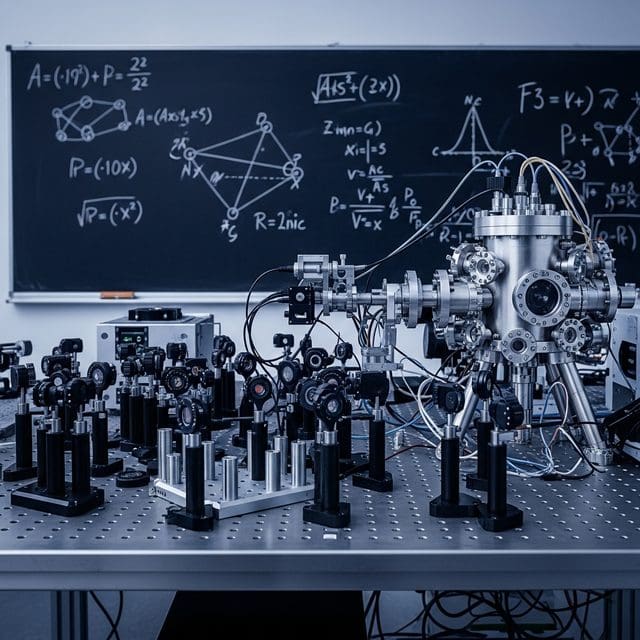
Researchers at Heidelberg University have unified two competing models of quantum impurity physics, resolving a 58-year-old puzzle regarding how single particles move through dense quantum environments known as Fermi seas.
A long-standing contradiction in quantum many-body theory has been resolved as physicists at Heidelberg University announced a unified framework for understanding quantum impurities. The discovery addresses a theoretical puzzle dating back fifty-eight years, providing a singular explanation for how a single particle—an impurity—interacts within a ‘Fermi sea,’ a dense collection of fermions such as electrons. This breakthrough, recently highlighted in Physical Review Letters, offers clarity in a field often defined by competing mathematical abstractions.
For decades, the scientific community remained divided between two rival models of impurity behavior. One model suggested impurities move through a quantum environment with relative ease, while the other posited they remain nearly stationary. The new research bridges these states by demonstrating how ‘quasiparticles’ emerge. These are not fundamental particles, but collective behaviors of an impurity and its environment acting as a single unit. The team utilized a mass-gap formula derived by combining the Lee–Low–Pines transformation with operator reordering, proving that quasiparticle weight survives even for heavy impurities.
This theoretical unification arrives at a pivotal moment for the technology sector. As researchers push toward the next generation of semiconductors and quantum simulators, understanding how impurities influence many-body behavior is essential. Impurities often cause decoherence—the loss of quantum information—which remains the primary obstacle to building reliable quantum computers. By providing a clear roadmap for these interactions, the Heidelberg framework offers engineers a precise set of rules for designing stable quantum hardware.
The implications extend into experimental validation. Recent work with ultracold cesium atoms has explored ‘fractional Fermi seas,’ a novel phase of matter that goes beyond traditional liquid theory. These experiments provide a current counterpoint to the Heidelberg theoretical work. Furthermore, the development of programmable light chips now allows researchers to control the speed of light in real time. These photonic structures serve as a platform for simulating the many-body dynamics and quasiparticle transport described by the new unified theory.
To support these advancements, new simulation tools for quantum plasmas emerged this month, allowing for the design of next-generation photonic devices. These tools enable the emulation of Fermi-sea physics in programmable light environments, turning theoretical physics into a practical engineering discipline. While centralized bureaucracies often favor massive scaling projects, this discovery highlights the value of fundamental theory. By resolving old contradictions, researchers provide the innovation community with the tools to build more efficient, error-resistant technologies.
The path forward lies in applying this mass-gap description to real-world materials like twisted molybdenum ditelluride, where fractional topological insulators host robust edge modes. These could serve as primitives for fault-tolerant quantum bits. Grounding these exotic states in a unified theory moves the industry closer to a future where quantum technology is a reliable pillar of infrastructure. This resolution of a 58-year-old debate reminds us that even in complex frontiers, truth is found in the unification of seemingly opposing forces.

Mason Reed serves as a Staff Writer for Just Right News, where he spearheads the Future Frontiers & Special Projects desk. In an era defined by rapid technological shifts and evolving social landscapes, Mason provides a steady, principled voice, examining the innovations of tomorrow through the lens of traditional American values. His work is most prominently featured in his signature series, “The Next Horizon,” where he explores the intersection of emerging technology, national sovereignty, and the preservation of individual liberty.
A native of San Diego, California, Mason’s worldview was shaped by the unique culture of his hometown. Growing up in a region defined by its strong military presence and its history of maritime industry, he developed a deep-seated respect for the institutions that provide national stability and the entrepreneurial spirit that drives the American economy. This upbringing instilled in him a belief that true progress is not found in discarding the past, but in building upon a foundation of proven principles. His reporting often reflects this San Diego influence, emphasizing the importance of a robust national defense and the necessity of maintaining a competitive edge in the global marketplace.
Now based in San Francisco, Mason operates from the heart of the world’s technological engine. Living and working in the Bay Area provides him with a front-row seat to the advancements—and the ideological challenges—emanating from Silicon Valley. While many in the region embrace a “move fast and break things” mentality, Mason’s reporting serves as a vital counterweight. He offers Just Right News readers a “boots on the ground” perspective, documenting how radical local policies and the concentration of tech power impact the everyday lives of citizens. His proximity to the industry allows him to cut through the marketing jargon of big tech to uncover the real-world implications for privacy, free speech, and the nuclear family.
In his “Future Frontiers” beat, Mason tackles complex subjects ranging from the ethics of artificial intelligence to the burgeoning private space race. He approaches these topics with a healthy skepticism toward centralized bureaucracy, championing instead the decentralized innovations that empower individuals. Through “The Next Horizon,” he highlights the pioneers and thinkers who are working to ensure that the future remains a place where human dignity and constitutional rights are protected. He believes that the rapid pace of change requires more than just technical expertise; it requires a moral compass rooted in the Western tradition.
Throughout his tenure at Just Right News, Mason has remained committed to the idea that the future is something to be shaped, not merely accepted. His writing is characterized by a rigorous defense of American exceptionalism and a belief that the country’s best days lie ahead, provided it remains true to its founding ideals. Whether he is investigating the impact of automation on the American workforce or profiling the next generation of aerospace engineers, Mason Reed ensures that his readers are equipped with the insights they need to navigate a changing world with confidence and clarity.