

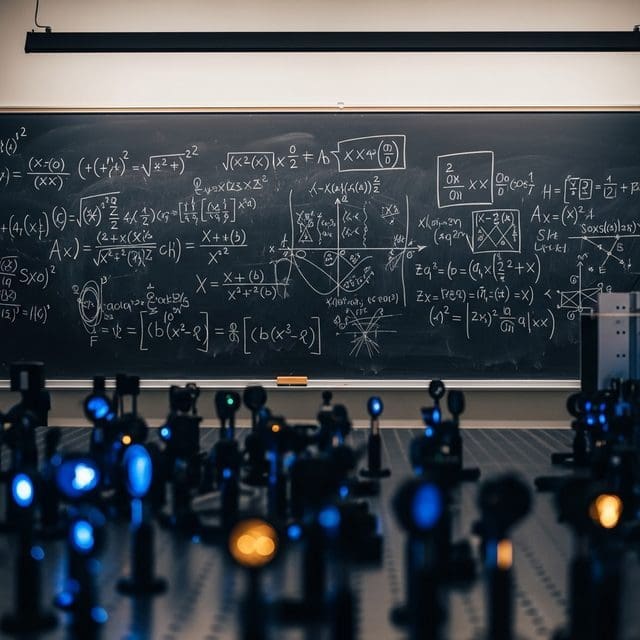
Researchers at NYU and Caltech have developed a mathematical algorithm to identify undiscovered high-energy particles by analyzing low-energy data from the Large Hadron Collider like musical notes.
In a significant leap for particle physics, researchers have unveiled a mathematical breakthrough that allows scientists to “hear” the presence of undiscovered particles within the existing data streams of the Large Hadron Collider. The method, described as an inverse problem in effective field theory, provides a systematic way to map low-energy observations to high-energy physical realities. This discovery, led by Grant Remmen of New York University and Clifford Cheung of Caltech, offers a principled path forward for American high-energy physics, emphasizing the power of rigorous analysis over the mere expansion of centralized bureaucracy.
The algorithm addresses a long-standing bottleneck in theoretical physics: the gap between what we can measure at current energy levels and the massive particles that may exist just beyond our reach. By treating measured deviations in particle behavior—known as Wilson coefficients—as the “notes” of a piano, the team can now deduce the mechanical structure of the “instrument” that produced them. Remmen notes that just as one can deduce the shape and mechanism of a piano from the sound of its notes, this breakthrough provides the means to use collider measurements to deduce the details of hidden particles at high energies.
Technically, the underlying paper, “On the Inverse Problem in Effective Field Theory,” introduces a concrete matrix-based algorithm. By building Hankel-type matrices from Effective Field Theory (EFT) amplitude coefficients, physicists can use the rank of these matrices to count the number of poles and zeros in a particle spectrum. They then solve a characteristic equation whose roots map directly to heavy-particle masses and couplings. This “fully solves” the classic EFT inverse problem at the tree level for a finite number of resonances, positioning CERN’s current data as a ready-to-use input for reconstructing hidden spectra.
This development comes at a critical time for American scientific leadership. As the Large Hadron Collider at CERN continues its mission, the ability to extract more information from existing data reduces the immediate need for exponentially larger infrastructure. It empowers researchers to find “new physics” using the tools already at their disposal, ensuring that the pursuit of knowledge remains efficient and grounded in rigorous mathematical proof. The work signals a strong institutional backing from Caltech’s Leinweber Forum and NYU, suggesting a new era of data-driven discovery that bypasses the need for immediate, multi-billion dollar collider upgrades.
Beyond the realm of subatomic particles, the week saw further progress in American laboratories that mirrors this spirit of innovation. Researchers at Columbia University reported the first experimental evidence of a fractional topological insulator in twisted molybdenum ditelluride (MoTe2). This long-predicted state hosts robust helical edge modes, which are essential for developing error-resistant quantum information processing. By utilizing moiré material engineering, these scientists are laying the groundwork for a future where quantum computing is both stable and decentralized, free from the fragility that currently plagues the field.
Complementing these material breakthroughs, engineers at Northwestern University successfully distributed quantum entanglement over 24.4 kilometers of live commercial fiber between Evanston and Chicago. Crucially, the quantum signals coexisted with 800 Gbps of classical internet traffic. This proves that the next generation of secure, sovereign communication can be built upon existing American telecommunications infrastructure without disrupting the flow of information.
From the theoretical halls of Caltech to the fiber-optic cables of Chicago, these advancements reinforce the importance of principled innovation. By refining the mathematical and physical tools used to interpret the universe, American scientists are ensuring that the next frontier of discovery is reached through ingenuity and the defense of individual liberty, rather than the unchecked growth of international administrative bodies.

Mason Reed serves as a Staff Writer for Just Right News, where he spearheads the Future Frontiers & Special Projects desk. In an era defined by rapid technological shifts and evolving social landscapes, Mason provides a steady, principled voice, examining the innovations of tomorrow through the lens of traditional American values. His work is most prominently featured in his signature series, “The Next Horizon,” where he explores the intersection of emerging technology, national sovereignty, and the preservation of individual liberty.
A native of San Diego, California, Mason’s worldview was shaped by the unique culture of his hometown. Growing up in a region defined by its strong military presence and its history of maritime industry, he developed a deep-seated respect for the institutions that provide national stability and the entrepreneurial spirit that drives the American economy. This upbringing instilled in him a belief that true progress is not found in discarding the past, but in building upon a foundation of proven principles. His reporting often reflects this San Diego influence, emphasizing the importance of a robust national defense and the necessity of maintaining a competitive edge in the global marketplace.
Now based in San Francisco, Mason operates from the heart of the world’s technological engine. Living and working in the Bay Area provides him with a front-row seat to the advancements—and the ideological challenges—emanating from Silicon Valley. While many in the region embrace a “move fast and break things” mentality, Mason’s reporting serves as a vital counterweight. He offers Just Right News readers a “boots on the ground” perspective, documenting how radical local policies and the concentration of tech power impact the everyday lives of citizens. His proximity to the industry allows him to cut through the marketing jargon of big tech to uncover the real-world implications for privacy, free speech, and the nuclear family.
In his “Future Frontiers” beat, Mason tackles complex subjects ranging from the ethics of artificial intelligence to the burgeoning private space race. He approaches these topics with a healthy skepticism toward centralized bureaucracy, championing instead the decentralized innovations that empower individuals. Through “The Next Horizon,” he highlights the pioneers and thinkers who are working to ensure that the future remains a place where human dignity and constitutional rights are protected. He believes that the rapid pace of change requires more than just technical expertise; it requires a moral compass rooted in the Western tradition.
Throughout his tenure at Just Right News, Mason has remained committed to the idea that the future is something to be shaped, not merely accepted. His writing is characterized by a rigorous defense of American exceptionalism and a belief that the country’s best days lie ahead, provided it remains true to its founding ideals. Whether he is investigating the impact of automation on the American workforce or profiling the next generation of aerospace engineers, Mason Reed ensures that his readers are equipped with the insights they need to navigate a changing world with confidence and clarity.