

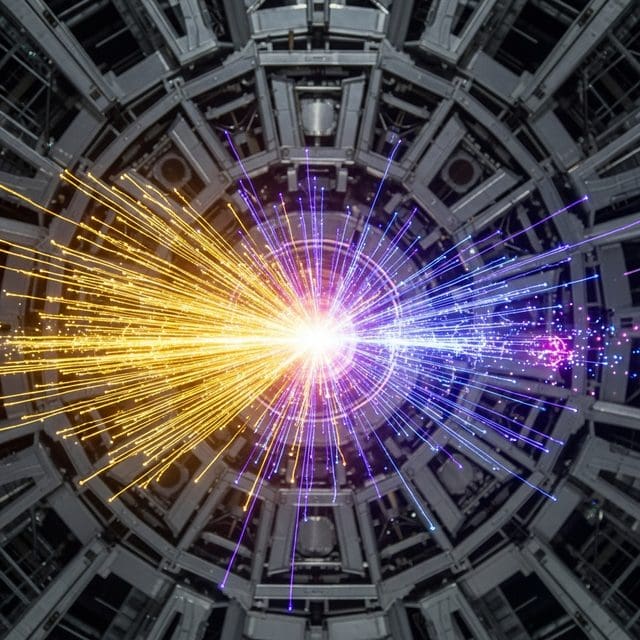
All four major LHC experiments have confirmed that oxygen and neon collisions create quark-gluon plasma, the extreme state of matter from the early universe.
In a landmark series of findings released this week, the four primary experiments at the Large Hadron Collider—ALICE, ATLAS, CMS, and LHCb—have collectively confirmed the creation of quark-gluon plasma (QGP) in collisions of oxygen and neon ions. This substance, often described as a “perfect fluid,” is an extreme state of matter that existed during the first microseconds after the Big Bang, occurring only at temperatures exceeding 100,000 times the heat found at the center of the sun. Under these staggering conditions, the traditional boundaries of matter dissolve, and the subatomic particles known as hadrons break apart into a free-flowing soup of quarks and gluons.
Historically, the physics community believed that generating this primordial soup required the massive, high-energy impact of heavy ions, such as lead. However, the new data establishes that even “light” ions like oxygen and neon can trigger this transition. This discovery effectively turns the LHC into a high-precision laboratory for the conditions of the early universe, providing a clearer window into the fundamental building blocks of reality without the overwhelming complexity and “clutter” associated with heavier atomic nuclei. By using lighter ions, researchers can achieve higher collision rates and finer control over the system size, which is critical for mapping the phase diagram of nuclear matter.
The evidence for this transition is robust and multifaceted, emerging from a unified effort across the CERN complex. The ATLAS experiment reported a definitive 5-sigma observation of “jet quenching” in central oxygen–oxygen and neon–neon collisions. Jet quenching occurs when high-energy particles are suppressed as they plow through the dense, sticky plasma, effectively serving as a probe for the medium’s density. Simultaneously, the CMS collaboration reported that the nuclear modification factor for charged particles dipped significantly, favoring theoretical models that include parton energy loss over those that do not. This tightening of constraints allows for more accurate effective field theory descriptions of how small-system QGP behaves.
Further confirmation came from the ALICE and LHCb detectors. ALICE researchers observed “anisotropic flow,” where particles emerge from the collision in specific, non-random patterns driven by the internal pressure and initial geometry of the plasma. Interestingly, the data showed stronger flow for three-quark baryons than for two-quark mesons, a signature characteristic of a fluid-like state. Meanwhile, LHCb utilized charm and bottom quark probes to show that suppression is dependent on the size of the system, providing a flavor-tagged analysis that confirms the plasma’s impact on even the heaviest subatomic particles.
Beyond the immediate results at CERN, this week also saw a theoretical breakthrough from an international team of physicists who proposed a new method to detect “hidden” high-energy particles. Using an analogy of “piano notes,” the team suggests that new laws of physics can be identified by mapping how heavy, unknown particles subtly alter known low-energy interactions. This “effective field theory” approach provides a systematic way to invert collider data to find hidden particles that have so far eluded direct detection. When combined with the light-ion results, it signals a new era of precision in particle physics where subtle deviations in known systems lead to the discovery of the unknown.
As the LHC moves forward with its Run-3 and High-Luminosity phases, these oxygen and neon campaigns are being repositioned as foundational benchmarks. Not only do they advance our understanding of the Big Bang, but they also serve as a “cosmic-ray laboratory” for modeling high-energy air showers in the Earth’s atmosphere. For the principled observer, these advancements represent the best of decentralized scientific inquiry—multiple independent experiments verifying a single, profound truth about the sovereignty of natural laws and the origins of our physical world.

Mason Reed serves as a Staff Writer for Just Right News, where he spearheads the Future Frontiers & Special Projects desk. In an era defined by rapid technological shifts and evolving social landscapes, Mason provides a steady, principled voice, examining the innovations of tomorrow through the lens of traditional American values. His work is most prominently featured in his signature series, “The Next Horizon,” where he explores the intersection of emerging technology, national sovereignty, and the preservation of individual liberty.
A native of San Diego, California, Mason’s worldview was shaped by the unique culture of his hometown. Growing up in a region defined by its strong military presence and its history of maritime industry, he developed a deep-seated respect for the institutions that provide national stability and the entrepreneurial spirit that drives the American economy. This upbringing instilled in him a belief that true progress is not found in discarding the past, but in building upon a foundation of proven principles. His reporting often reflects this San Diego influence, emphasizing the importance of a robust national defense and the necessity of maintaining a competitive edge in the global marketplace.
Now based in San Francisco, Mason operates from the heart of the world’s technological engine. Living and working in the Bay Area provides him with a front-row seat to the advancements—and the ideological challenges—emanating from Silicon Valley. While many in the region embrace a “move fast and break things” mentality, Mason’s reporting serves as a vital counterweight. He offers Just Right News readers a “boots on the ground” perspective, documenting how radical local policies and the concentration of tech power impact the everyday lives of citizens. His proximity to the industry allows him to cut through the marketing jargon of big tech to uncover the real-world implications for privacy, free speech, and the nuclear family.
In his “Future Frontiers” beat, Mason tackles complex subjects ranging from the ethics of artificial intelligence to the burgeoning private space race. He approaches these topics with a healthy skepticism toward centralized bureaucracy, championing instead the decentralized innovations that empower individuals. Through “The Next Horizon,” he highlights the pioneers and thinkers who are working to ensure that the future remains a place where human dignity and constitutional rights are protected. He believes that the rapid pace of change requires more than just technical expertise; it requires a moral compass rooted in the Western tradition.
Throughout his tenure at Just Right News, Mason has remained committed to the idea that the future is something to be shaped, not merely accepted. His writing is characterized by a rigorous defense of American exceptionalism and a belief that the country’s best days lie ahead, provided it remains true to its founding ideals. Whether he is investigating the impact of automation on the American workforce or profiling the next generation of aerospace engineers, Mason Reed ensures that his readers are equipped with the insights they need to navigate a changing world with confidence and clarity.