

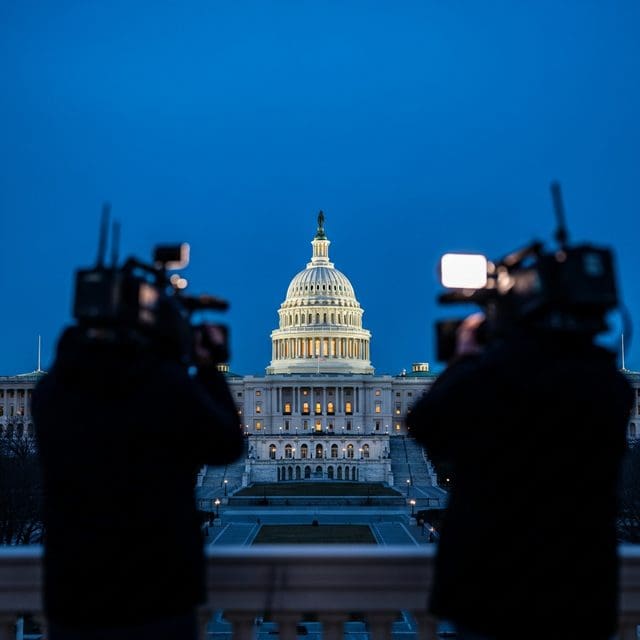
With 100 days until the midterms, President Trump’s legislative agenda faces a critical bottleneck in the Senate as tensions rise over the SAVE America Act and emergency military funding.
The second term of the Trump administration has reached a pivotal juncture as the 100-day countdown to the 2026 midterm elections begins. Despite high-stakes diplomacy in the Middle East, the President’s domestic legislative priorities are stalled in a divided Congress, creating a volatile environment for Republican incumbents. Constitutional tension has sharpened as the President expresses growing frustration with Senate Majority Leader John Thune over the pace of the administrative agenda.
Friction centers on the Senate, where Thune struggles to navigate the President’s demands against the reality of a 60-vote threshold. Trump has identified the SAVE America Act as his primary legislative vehicle, framing it as a prerequisite for Republican success in November. However, the bill faces unified Democratic opposition and skepticism regarding its viability. With the Senate returning July 27 for a brief window before the August 10 recess, the administration has little time to secure a floor vote. Trump stated on July 23 that his patience with current leadership is running out, signaling a potential fracture within the party.
Adding to the logjam is a pressing requirement for emergency Pentagon funding. This follows a period of military escalation with Iran, which saw the House pass a bipartisan resolution on July 23 to halt further U.S. military action. This marked the second such warning from Congress as the conflict intensified. While the administration points to the June 12 memorandum of understanding—which reopened the Strait of Hormuz without tolls and established a 60-day ceasefire—as proof of stability, the cost of the conflict remains a point of contention. Voters express dissatisfaction with the economic toll, a sentiment reflected in polling that places GOP House control at risk.
Decision Desk HQ currently projects a Democratic shift in the House, with a forecasted 224–211 majority. Conversely, Republicans are narrowly favored to retain the Senate, potentially resulting in a 50–50 split where Vice President JD Vance would serve as the tie-breaker. This projected divided government would likely trigger oversight investigations into the administration’s maneuvers, including the nomination of Jay Clayton as Director of National Intelligence and the $75 billion SpaceX IPO. Critics argue the administration’s focus on election rules over cost-of-living relief has left the party vulnerable with swing voters.
The White House is also managing complex diplomatic scheduling. Prime Minister Benjamin Netanyahu meets with the President on July 28, a visit coinciding with the funeral of Senator Lindsey Graham. These events underscore the focus on international alliances even as domestic polling suggests voters are preoccupied with the long-term implications of interventionist policies. Furthermore, the President’s assertion that Venezuela is not ready for elections following the U.S. ouster of Maduro adds complexity to the foreign policy record.
As the August 10 recess approaches, the ability to move the SAVE America Act will serve as a bellwether for executive influence over the legislature. Should the bill fail to progress, the President may head into the final campaign stretch without the legislative victory he has deemed essential. With Democrats promising aggressive investigations if they capture either chamber, the stakes for the remaining days in July are critical for the future of the administrative state.

Miles Harrington serves as the Senior Correspondent for Federal Systems & Executive Power at Just Right News, where he brings a disciplined, constitutionalist lens to the inner workings of the American government. With a focus on the mechanics of the federal bureaucracy and the limits of executive authority, Harrington has established himself as a vital voice for readers who value transparency, accountability, and the preservation of the separation of powers.
A native of Richmond, Virginia, Harrington’s perspective is deeply rooted in the traditions of the Old Dominion. Growing up in a city defined by its historical significance and its role as a center of American jurisprudence, he developed an early appreciation for the foundational principles of the Republic. His upbringing in Richmond—a place where the legacy of the Founding Fathers is woven into the landscape—instilled in him a belief that the federal government should remain within its constitutional bounds. This background informs his skepticism of centralized overreach and his commitment to reporting on the ways in which the administrative state impacts the lives of everyday citizens.
In his current role, Harrington specializes in the complexities of federal systems. He doesn’t just report on the headlines of the day; he digs into the structural shifts within the executive branch that often go unnoticed by the mainstream press. Whether he is analyzing the implications of a new federal regulation or investigating the expansion of agency jurisdiction, his work is characterized by a rigorous adherence to the facts and a dedication to the rule of law.
Harrington is perhaps best known for his signature feature series, “How Washington Works.” Through this ongoing project, he demystifies the often-opaque processes of the nation’s capital, pulling back the curtain on the “Deep State” and the unelected officials who wield significant influence over national policy. By breaking down complex legislative maneuvers and executive orders, he empowers Just Right News readers to understand the true levers of power in Washington. His reporting serves as a necessary check on the federal government, ensuring that the actions of those in power are held up to the light of public scrutiny.
Now based in Washington, D.C., Harrington operates at the epicenter of the political world, yet he remains intentionally distanced from the “Beltway bubble.” His proximity to the halls of power allows him to maintain a robust network of sources across the federal landscape, but his heart remains in the principled conservatism of his Virginia roots. He views his role not merely as a reporter, but as a steward of the public trust, dedicated to providing the clarity and context that conservative voters need to navigate an increasingly complex political environment.
Through his sharp analysis and unwavering commitment to the truth, Miles Harrington continues to be a cornerstone of the Just Right News team. His work ensures that the principles of limited government and executive restraint remain at the forefront of the national conversation, providing a crucial service to those who believe in a government that is truly of, by, and for the people.