

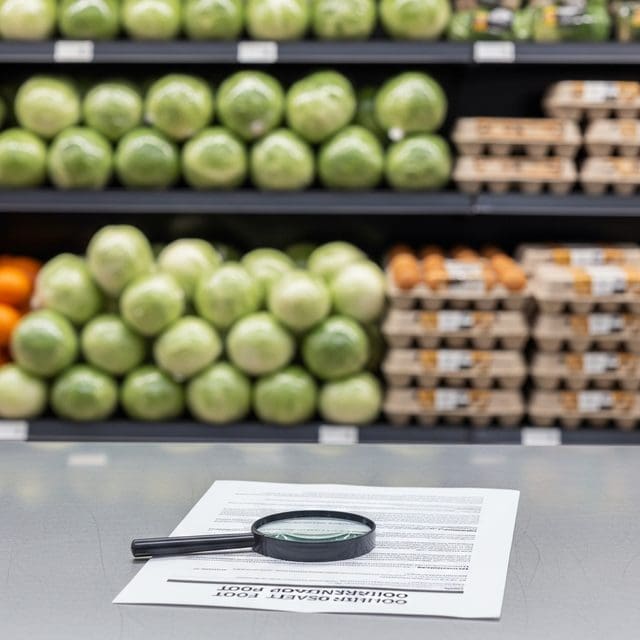
Federal regulators ramp up enforcement as Salmonella risks in eggs and illegal pesticide use in California threaten the integrity of the American food supply.
The American kitchen table is facing a renewed wave of scrutiny as federal regulators issue a flurry of safety alerts and infrastructure proposals. As of late July 2026, the Food and Drug Administration (FDA) has flagged several staples for immediate recall, citing risks ranging from bacterial contamination to basic labeling failures. These actions underscore the persistent vulnerabilities in the national food supply chain, even as the private sector strives for greater transparency and safety innovation.
Among the most concerning updates is a recall of white shell eggs and brown cage-free eggs due to potential Salmonella Enteritidis contamination. The risk extends beyond the dairy aisle, with iceberg lettuce now under recall for Cyclospora and moringa leaf powder capsules flagged for Salmonella. These microbial threats are joined by a significant labeling failure involving spicy breakfast burritos. In that instance, sausage was inadvertently included in products marketed as vegetarian, creating a severe risk for consumers with undeclared soy allergens. For families relying on accurate labeling for health and dietary reasons, such oversights represent a breakdown in the fundamental trust between producers and the public.
While the FDA manages the immediate fallout of contaminated goods, the Environmental Protection Agency (EPA) is moving to tighten the reins on the agricultural inputs that precede the harvest. On July 23, the EPA finalized new afidopyropen tolerances for lettuce, following a July 16 decision regarding acetamiprid tolerances on spice commodities. These technical adjustments are intended to balance crop protection with consumer safety, though they often place additional compliance burdens on family-run operations that are already navigating a complex regulatory environment. The agency also recently proposed a registration-review decision for 4-CPA, further signaling an active summer for chemical oversight.
Enforcement remains a primary focus for the EPA, particularly in the West. The agency recently issued a statement regarding an ongoing crisis in Siskiyou County, California, involving the use of illegal pesticides. This regional crackdown is paired with national-level litigation, including a recent settlement with Hospeco Brands Group over the alleged sale of unregistered pesticide products. Such actions signal a shift toward more aggressive oversight of chemical distributors and farm-input providers, aiming to ensure that only approved, tested substances reach the soil.
Infrastructure and local sovereignty are also at the forefront of the current regulatory landscape. In Missouri, the state is seeking primacy over the permitting of anhydrous ammonia fertilizer facilities. This move toward local control would allow the state to manage its own agricultural infrastructure rather than deferring to federal bureaus in Washington. This push for state-level authority is a critical development for farmers who argue that local officials better understand the specific needs and safety requirements of their own communities.
Furthermore, the EPA is currently soliciting feedback on its Clean Water Act Financial Capability Assessment, a move that will directly impact how farming communities plan for wastewater infrastructure and water affordability. This guidance is essential for determining how much local taxpayers can be expected to pay for federal water mandates. As these regulatory gears turn, the focus remains on whether federal oversight provides genuine safety or merely adds layers of bureaucracy. For the American farmer and the families they feed, the priority is clear: a safe, reliable food supply managed with common-sense stewardship rather than heavy-handed federal overreach. Protecting the heritage of the San Joaquin Valley and similar agricultural hubs requires a balance between necessary safety standards and the freedom for the private sector to innovate without constant interference.

Eric Nolan serves as the Senior Correspondent for Food, Water, and Environmental Health at Just Right News, where he brings a principled, common-sense perspective to the most fundamental issues facing the American public. With a career dedicated to uncovering the truth behind the policies that govern our natural resources, Eric has become a trusted voice for readers who value traditional stewardship over bureaucratic overreach. His reporting is defined by a commitment to the idea that true environmentalism is rooted in the protection of the American family and the preservation of the nation’s agricultural heritage.
Raised in Fresno, California, Eric’s worldview was shaped in the heart of the San Joaquin Valley. Growing up in one of the world’s most productive agricultural hubs, he witnessed firsthand the vital connection between the land, the water, and the dinner table. In Fresno, he saw the resilience of farmers and the devastating impact that distant, top-down regulations can have on local communities. This upbringing instilled in him a deep respect for the producers who feed the country and a lifelong skepticism toward the alarmist narratives often pushed by mainstream media. For Eric, environmental health is not an abstract political talking point; it is a matter of ensuring that the people who work the land have the freedom and the resources to do so effectively.
Now based in Eugene, Oregon, Eric operates from a unique vantage point in the Pacific Northwest. Living in a region often defined by intense environmental debate, he provides a necessary counter-narrative to the prevailing trends of the area. From his base in Eugene, he monitors the shifting tides of federal and state policies, ensuring that the voices of rural citizens and property owners are not drowned out by urban activism. His reporting often bridges the gap between the rugged realities of the outdoors and the legislative halls where decisions are made, offering a grounded perspective that prioritizes local sovereignty and practical solutions.
As the lead for the acclaimed feature series “Earth on the Table,” Eric explores the intricate journey of the American food supply. He tackles critical issues such as water rights, soil health, and food security through a lens of national stability and individual liberty. He believes that a healthy environment and a thriving economy are not mutually exclusive, but rather two sides of the same coin of national prosperity. His work consistently highlights how innovation and private-sector ingenuity are the most effective tools for ensuring clean water and a safe food supply, rather than the expansion of the administrative state.
At Just Right News, Eric’s reporting serves as a vital resource for those who seek accountability and transparency. Whether he is investigating the impact of federal land management on local economies or examining the safety of the national food infrastructure, his work remains anchored in the values of heritage and hard work. Eric Nolan continues to be a leading voice in environmental journalism, championing the belief that the best way to protect our natural resources is to empower the people who live and work closest to them.