

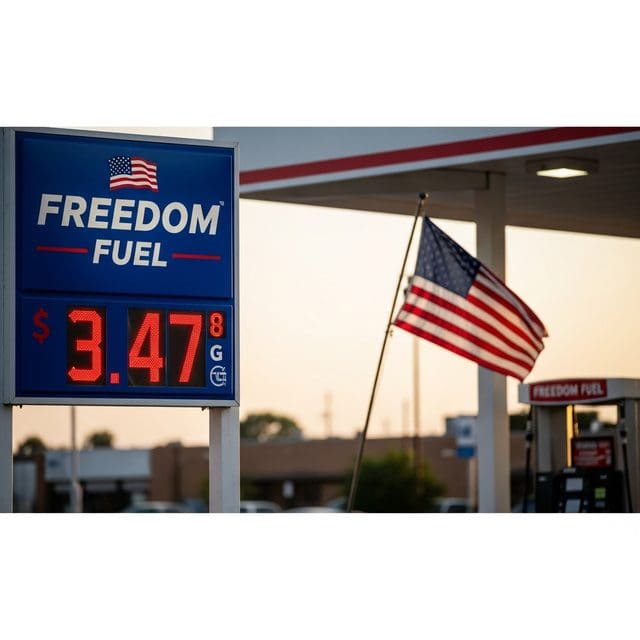
President Trump launched a branded retail fuel initiative in Philadelphia as U.S. military strikes against Iranian targets drove crude prices higher during his diplomatic mission to Ankara.
The White House unveiled a targeted retail energy initiative this week, rebranding 25 gas stations in the greater Philadelphia area as the “Freedom Fuel Network.” The stations offer fuel at a fixed price of $3.47 per gallon, a figure explicitly chosen to honor Donald Trump’s tenure as the 47th president. While promotional materials frame the move as significant economic relief, market data suggests the initiative functions primarily as a communications vehicle. According to AAA data from July 7, 2026, the national average for gasoline stood at $3.79 per gallon. The Freedom Fuel price represents a 32-cent discount, yet its reach is currently limited to a single metropolitan region. The rollout is a partnership with a private Northeast retailer, raising questions regarding the propriety of using official executive branch channels to promote specific commercial entities for political branding.
This domestic branding effort arrives during significant geopolitical volatility. On July 7, the U.S. military launched strikes against Iranian targets following attacks on three commercial vessels in the Strait of Hormuz. These hostilities impacted global energy markets; West Texas Intermediate crude rose 2.6 percent to $72.29 a barrel following subsequent U.S. strikes on July 8. The administration’s attempt to project a narrative of lower costs at the pump stands in tension with upward pressure on global oil prices caused by the escalating conflict. As the administration reimposes sanctions on Iranian oil sales, the White House is managing a complex diplomatic calendar. President Trump arrived in Ankara, Turkey, on July 7 for the NATO summit, where he is scheduled to meet with Ukrainian President Volodymyr Zelensky and Syrian President Ahmed al-Sharaa on July 9.
Beyond energy and foreign policy, the administrative state is grappling with internal dissent. More than 1,200 former Department of Justice employees have formally called on the Senate to reject acting Attorney General Todd Blanche’s nomination, signaling a rift between the career bureaucracy and the executive branch. This tension is further complicated by the health of the legislative branch; emergency dispatch audio recently indicated that Senator Mitch McConnell suffered cardiac arrest at his Washington, D.C. home earlier this month. The incident has raised urgent questions regarding his return to the Senate and the stability of Republican leadership during a period of active military engagement.
Domestic labor and healthcare sectors are also seeing disruption. On July 8, 2026, Mass General Brigham Home Care clinicians and approximately 4,500 MNA nurses initiated strikes following a breakdown in contract negotiations. While the administration focuses on retail fuel prices, these labor actions highlight broader economic anxieties regarding healthcare costs. In contrast, some industrial sectors reported stability, such as the Bazooka Teamsters Local 229 workers in Pennsylvania who ratified a three-year contract delivering a 15 percent wage increase.
In the regulatory sphere, the FDA issued several Rare Pediatric Disease Designations this week, including one for Grünenthal’s Duchenne muscular dystrophy treatment and another for Vanda Pharmaceuticals’ investigational therapy for Charcot-Marie-Tooth Disease. The administration has also engaged in a sharp rhetorical clash with the Smithsonian Institution, accusing its leadership of adopting a “radical ideology” in a recent July Fourth report. This multifaceted approach—combining retail price signaling, military force, and cultural critique—defines the current executive posture as the nation moves toward the fall election cycle.

Miles Harrington serves as the Senior Correspondent for Federal Systems & Executive Power at Just Right News, where he brings a disciplined, constitutionalist lens to the inner workings of the American government. With a focus on the mechanics of the federal bureaucracy and the limits of executive authority, Harrington has established himself as a vital voice for readers who value transparency, accountability, and the preservation of the separation of powers.
A native of Richmond, Virginia, Harrington’s perspective is deeply rooted in the traditions of the Old Dominion. Growing up in a city defined by its historical significance and its role as a center of American jurisprudence, he developed an early appreciation for the foundational principles of the Republic. His upbringing in Richmond—a place where the legacy of the Founding Fathers is woven into the landscape—instilled in him a belief that the federal government should remain within its constitutional bounds. This background informs his skepticism of centralized overreach and his commitment to reporting on the ways in which the administrative state impacts the lives of everyday citizens.
In his current role, Harrington specializes in the complexities of federal systems. He doesn’t just report on the headlines of the day; he digs into the structural shifts within the executive branch that often go unnoticed by the mainstream press. Whether he is analyzing the implications of a new federal regulation or investigating the expansion of agency jurisdiction, his work is characterized by a rigorous adherence to the facts and a dedication to the rule of law.
Harrington is perhaps best known for his signature feature series, “How Washington Works.” Through this ongoing project, he demystifies the often-opaque processes of the nation’s capital, pulling back the curtain on the “Deep State” and the unelected officials who wield significant influence over national policy. By breaking down complex legislative maneuvers and executive orders, he empowers Just Right News readers to understand the true levers of power in Washington. His reporting serves as a necessary check on the federal government, ensuring that the actions of those in power are held up to the light of public scrutiny.
Now based in Washington, D.C., Harrington operates at the epicenter of the political world, yet he remains intentionally distanced from the “Beltway bubble.” His proximity to the halls of power allows him to maintain a robust network of sources across the federal landscape, but his heart remains in the principled conservatism of his Virginia roots. He views his role not merely as a reporter, but as a steward of the public trust, dedicated to providing the clarity and context that conservative voters need to navigate an increasingly complex political environment.
Through his sharp analysis and unwavering commitment to the truth, Miles Harrington continues to be a cornerstone of the Just Right News team. His work ensures that the principles of limited government and executive restraint remain at the forefront of the national conversation, providing a crucial service to those who believe in a government that is truly of, by, and for the people.