

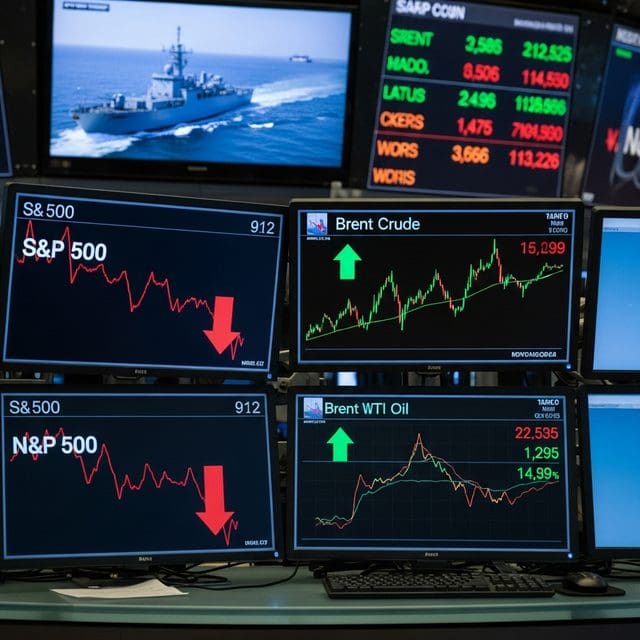
Escalating tensions in the Strait of Hormuz have sent crude prices climbing, pressuring the S&P 500 while forcing a sharp divergence between energy-linked industrials and underperforming health care sectors.
Global financial markets are navigating heightened volatility as geopolitical instability in the Middle East disrupts the international economy. The S&P 500, tracked via the SPY, traded down 0.41% on the session, continuing a risk-off trend established by a previous 0.5% retreat. Market sentiment is dictated by an escalation in the Strait of Hormuz, where Iranian forces targeted commercial vessels with missile fire, prompting a decisive U.S. military response and the revocation of Iranian oil export licenses. This breakdown followed the collapse of an OPEC+ agreement, leading President Trump to declare further negotiations a waste of time.
This friction has sent immediate shockwaves through the commodities complex, creating a direct impact on the American taxpayer. West Texas Intermediate (WTI) futures climbed 3% to $70.44, while Brent crude reached $74.16, with after-hours trading pushing benchmarks to $76.04. For the working household, this surge represents a threat to purchasing power, as the oil shock has lifted prices roughly 60% from war-start levels. Energy majors Chevron and ExxonMobil outperformed the broader market, gaining 3.5% and 3.9% respectively, as investors rotated into value-oriented cyclicals tied to the oil spike.
In contrast, the health care sector has emerged as a notable laggard. The Health Care Select Sector SPDR (XLV) fell 1.1%, significantly underperforming the benchmark SPY. This decline suggests that traditional defensive sectors are failing to provide haven status. Instead, capital is fleeing rate-sensitive areas as rising energy costs raise fears that the Federal Reserve may maintain a restrictive monetary stance to combat inflation. The underperformance of health care, alongside utilities and consumer staples, indicates that the market is prioritizing energy security over defensive growth.
The technology sector, particularly companies at the forefront of the artificial intelligence trade, is also facing a reckoning. Bellwethers like Micron Technology and AMD saw declines of 4.7% and 6.5%. This de-rating reflects a consensus that the AI semiconductor trade has become overextended and “highly overstretched.” Without fresh catalysts to support current multiples, these high-growth names are increasingly vulnerable to the rising discount rates associated with a volatile energy market and the broader Nasdaq decline of 1.2%.
Industrial sectors remain mixed, caught between the tailwinds of higher energy prices and the headwinds of increased operational costs for fuel-intensive manufacturing. While the U.S. trade deficit showed marginal improvement in May—narrowing to $77.6 billion—the macro picture remains clouded by the resumption of hostilities. Specific corporate developments, such as Skanska’s SEK 570 million divestment and AEON’s expansion into Zambia, show that global commerce continues, yet these moves are overshadowed by the threat to the Strait of Hormuz.
As national sovereignty and energy security return to the forefront, the era of stable, low-cost energy that fueled the previous decade’s growth appears to be receding. The current market breadth, where decliners led advancers on the Nasdaq by a 1.55-to-1 margin, underscores a fragile environment. For the principled investor, the focus remains on fiscal responsibility and the stability of the monetary system as the “Invisible Economy” reacts to centralized conflict and resulting price shocks. The path for the S&P 500 will depend on whether industrial strength can offset the drag from a cooling tech sector and a struggling health care vertical.

Jordan Lee serves as the Senior Correspondent for Wall Street, Finance, and Monetary Systems at Just Right News. Based in the heart of the world’s financial capital, New York City, Lee brings a sharp, principled eye to the complex mechanisms that drive the global economy. His reporting is defined by a commitment to fiscal responsibility, the defense of the free market, and a deep-seated belief that a transparent monetary system is the bedrock of a free society.
Raised in Portland, Oregon, Lee’s perspective was forged in a city that has undergone significant cultural and economic shifts. His upbringing in the Pacific Northwest instilled in him a profound appreciation for the industriousness of small business owners and the importance of local economic stability. Watching the evolution of his hometown’s landscape sparked an early interest in how federal fiscal policy and large-scale financial trends eventually trickle down to the average citizen. This background provides him with a unique vantage point; he understands the growing disconnect between the policy-making elite and the reality of Main Street, a theme that frequently resonates throughout his work.
Now operating from his base in New York City, Lee bridges the gap between the high-stakes trading floors of Manhattan and the households of everyday Americans. He views the financial sector not merely as a collection of numbers and tickers, but as a vital engine of American prosperity that requires constant vigilance and accountability. His reporting often highlights the dangers of centralized financial control and the necessity of maintaining a system that rewards merit, risk-taking, and innovation.
As the creator and lead of the featured series, “The Invisible Economy,” Lee pulls back the curtain on the often-opaque world of monetary systems. He specializes in translating the dense jargon of central banking and international finance into actionable insights for the Just Right News audience. His work explores the “invisible” forces—such as inflationary pressures, regulatory creep, and the expansion of the administrative state—that erode the purchasing power of American families. By focusing on these systemic issues, Lee empowers readers to understand the hidden forces shaping their financial independence.
Lee’s journalistic philosophy is rooted in a steadfast commitment to traditional American values. As an Asian American professional who has navigated the competitive corridors of the financial world, he is a vocal advocate for meritocracy and the preservation of the American Dream. He believes that a stable currency and a predictable regulatory environment are essential for national sovereignty and individual liberty. His reporting frequently warns against the risks of government overreach in the private sector, arguing that the most effective solutions to economic challenges arise from competition and individual enterprise rather than bureaucratic mandates.
At Just Right News, Jordan Lee remains dedicated to providing a clear-eyed defense of the taxpayer. Whether he is analyzing market volatility or investigating the long-term implications of national debt, his mission is to provide the truth about where the money is going and what it means for the future of the country. Through his rigorous analysis and principled stance, Lee has become a trusted voice for those who value a strong, sovereign, and fiscally sound America.