

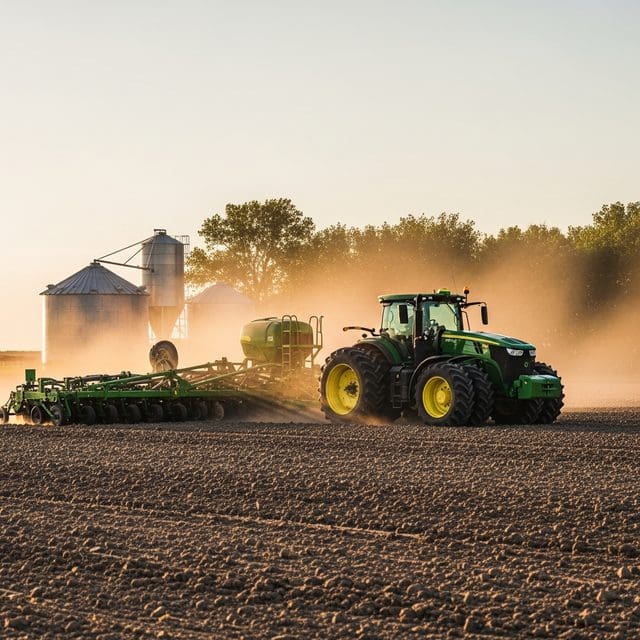
Rising fertilizer costs and regulatory hurdles push U.S. corn planting expenses toward record highs, threatening the competitiveness of domestic growers against Brazilian counterparts.
American corn farmers are entering the 2026 season under a heavy financial cloud as input costs surge toward record levels. Data from the National Corn Growers Association (NCGA) reveals that the average cost to plant an acre of corn is projected at $917. This figure represents a $27 increase over 2025 and sits just one percent below the all-time high set in 2022. While these costs climb, the market price for corn has plummeted roughly 37 percent since that same peak, squeezing the margins of family operations across the heartland and raising serious questions about the long-term viability of current agricultural economics.
The NCGA Input Cost Task Force is currently investigating the drivers behind these stubbornly high prices, specifically focusing on the fertilizer and pesticide markets. Fertilizer alone is expected to account for 36 percent of a farmer’s operating costs this year. Over the last decade, phosphate prices have climbed 60 percent, while UAN (urea ammonium nitrate) has risen 37 percent since early 2025. These increases are not merely market fluctuations; they represent a fundamental challenge to the economic sovereignty of the American farmer. The task force is currently exploring regulatory and policy options to expand competition in these markets, aiming to re-examine supply chain economics that many feel have become lopsided against the producer.
Global competition adds another layer of complexity to this domestic struggle. Recent Purdue University analysis shows that while total corn production costs on a typical Iowa farm rose 22 percent between 2020 and 2024—climbing from $160 to $195 per ton—costs for Brazilian farmers in Mato Grosso more than doubled, jumping from $69 to $147 per ton. However, the structure of these costs differs significantly. Brazilian growers face much higher direct input spending, particularly on fertilizer, which accounted for an 8 percent rise in their production costs between October 2025 and February 2026. In July 2026, Brazilian operational costs reached approximately R$3,280 per hectare, reflecting a 2.4 percent jump in fertilizer costs in a single month. While Brazil deals with direct price spikes, American farmers are increasingly burdened by higher fixed overhead and the creeping costs of regulatory compliance.
Environmental stewardship and regional safety remain localized priorities that further complicate the seasonal outlook. In Florida, the UF/IFAS Extension and the USDA are urging growers to finalize hurricane preparedness plans as the Atlantic season enters its most active phase. This includes securing backup power for water management systems, reviewing crop insurance, and establishing livestock evacuation routes. These practical, ground-level measures highlight the resilience of local producers who must manage both the economic pressures from international markets and the immediate, physical threats of the natural environment. For these growers, environmental health is not a theoretical policy debate but a matter of protecting their soil, water, and livelihoods from the next storm surge.
The disparity in input costs suggests a pressing need for greater transparency in the domestic fertilizer and pesticide supply chains. As the NCGA explores policy options to expand market competition, the focus remains on ensuring that American agriculture is not regulated into a corner by federal overreach or monopolistic pricing. Protecting the American family farm requires a common-sense approach that balances environmental health with the economic reality of feeding the nation. Without a shift in how input markets are monitored and how domestic producers are supported against global cost volatility, the 2026 season may mark a turning point for many independent operations struggling to keep their heads above water in a high-cost, low-return environment.

Eric Nolan serves as the Senior Correspondent for Food, Water, and Environmental Health at Just Right News, where he brings a principled, common-sense perspective to the most fundamental issues facing the American public. With a career dedicated to uncovering the truth behind the policies that govern our natural resources, Eric has become a trusted voice for readers who value traditional stewardship over bureaucratic overreach. His reporting is defined by a commitment to the idea that true environmentalism is rooted in the protection of the American family and the preservation of the nation’s agricultural heritage.
Raised in Fresno, California, Eric’s worldview was shaped in the heart of the San Joaquin Valley. Growing up in one of the world’s most productive agricultural hubs, he witnessed firsthand the vital connection between the land, the water, and the dinner table. In Fresno, he saw the resilience of farmers and the devastating impact that distant, top-down regulations can have on local communities. This upbringing instilled in him a deep respect for the producers who feed the country and a lifelong skepticism toward the alarmist narratives often pushed by mainstream media. For Eric, environmental health is not an abstract political talking point; it is a matter of ensuring that the people who work the land have the freedom and the resources to do so effectively.
Now based in Eugene, Oregon, Eric operates from a unique vantage point in the Pacific Northwest. Living in a region often defined by intense environmental debate, he provides a necessary counter-narrative to the prevailing trends of the area. From his base in Eugene, he monitors the shifting tides of federal and state policies, ensuring that the voices of rural citizens and property owners are not drowned out by urban activism. His reporting often bridges the gap between the rugged realities of the outdoors and the legislative halls where decisions are made, offering a grounded perspective that prioritizes local sovereignty and practical solutions.
As the lead for the acclaimed feature series “Earth on the Table,” Eric explores the intricate journey of the American food supply. He tackles critical issues such as water rights, soil health, and food security through a lens of national stability and individual liberty. He believes that a healthy environment and a thriving economy are not mutually exclusive, but rather two sides of the same coin of national prosperity. His work consistently highlights how innovation and private-sector ingenuity are the most effective tools for ensuring clean water and a safe food supply, rather than the expansion of the administrative state.
At Just Right News, Eric’s reporting serves as a vital resource for those who seek accountability and transparency. Whether he is investigating the impact of federal land management on local economies or examining the safety of the national food infrastructure, his work remains anchored in the values of heritage and hard work. Eric Nolan continues to be a leading voice in environmental journalism, championing the belief that the best way to protect our natural resources is to empower the people who live and work closest to them.