

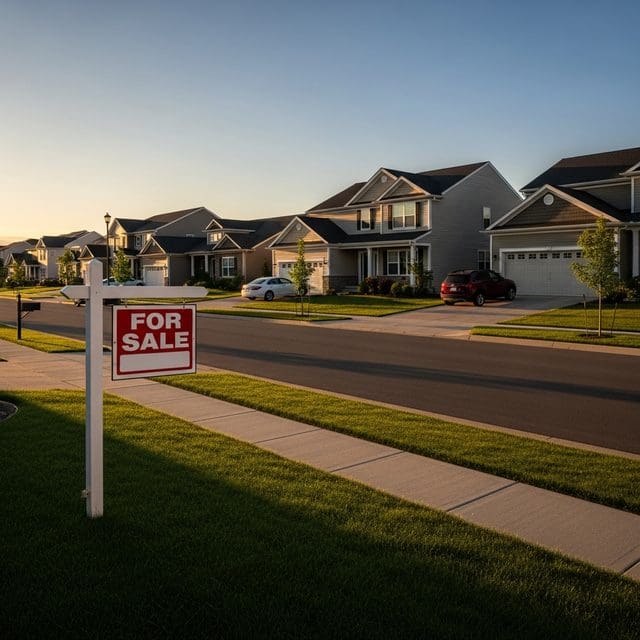
American housing costs reached an all-time peak in June as high mortgage rates and a persistent inventory shortage continue to squeeze prospective buyers out of the market.
The American housing market reached a point of historic friction this summer, as median home prices climbed to an all-time high in June even as sales volume continued to retreat. Data from the National Association of Realtors and recent market reports indicate a housing landscape defined by a persistent supply-demand imbalance that favors existing equity holders while increasingly marginalizing the average taxpayer. This trend of rising costs paired with falling activity suggests that the traditional levers of market correction are being hampered by high borrowing costs and a chronic lack of inventory.
June existing-home sales fell on a month-over-month basis, a decline largely attributed to mortgage rates that have remained stubbornly elevated. The 30-year fixed mortgage rate, which has fluctuated between 6.48% and 6.53% throughout the late spring and early summer, continues to act as a significant headwind. For many families, these rates represent a doubling of the monthly interest carry compared to just a few years ago, effectively neutralizing the purchasing power bolstered by a strong labor market. This rate environment has also created a ‘lock-in’ effect, where current homeowners are reluctant to list their properties and forfeit lower historical rates, further constricting supply.
Supply remains the primary driver of the price surge. With only approximately 1.32 million existing homes on the market nationwide, the scarcity of options pushed the national median sales price well beyond the $429,300 mark recorded in May. This trend marks 35 consecutive months of annual price gains, a streak that underscores the resilience of property values in the face of decreased affordability. While some listing prices showed a slight 2.4% year-over-year decline in specific segments, final closing prices continue to set records, indicating that the few buyers remaining are engaged in competitive bidding for a dwindling pool of assets.
Regional data reveals a lopsided recovery across major metropolitan areas. In a recent Case-Shiller snapshot of 20 major cities, Chicago stood out as a notable outlier, being the only city in that group not currently sitting at a record price high. This suggests that while coastal and Sun Belt markets have seen explosive appreciation, some Midwestern hubs are experiencing a different set of economic pressures. However, for the vast majority of urban centers, the cost of entry has never been higher, placing immense pressure on local infrastructure as workers are forced further from city centers in search of affordable square footage.
The broader economic context further complicates the housing outlook. While the domestic market struggles with internal supply issues, global instability threatens the cost of living. Recent escalations in the Strait of Hormuz, including Iranian attacks on commercial vessels and subsequent U.S. military strikes on July 8 and 9, 2026, have led to a collapse in OPEC+ production agreements. These geopolitical tensions often translate to higher energy and material costs at home, which can stall new construction and further exacerbate the housing shortage. As the Trump administration revokes oil waivers and declares ceasefires over, the resulting inflationary pressure on building materials could keep the supply of new homes low.
For the American taxpayer, the current housing climate represents a significant barrier to the preservation of private property rights. When the cost of a median home reaches record levels while mortgage rates remain high, the dream of ownership is replaced by a cycle of perpetual renting. As the ‘Where We Live’ series continues to monitor these developments, the focus remains on whether local and federal authorities will prioritize fiscal responsibility and deregulation to unlock the inventory needed to stabilize prices, or if the current stagnation will become the new national baseline.

Deborah Cole serves as a Senior Correspondent for Just Right News, where she spearheads the network’s coverage of Housing, Infrastructure, and Mobility. With a career defined by a commitment to rigorous reporting and a focus on the fundamental pillars of American community life, Deborah brings a principled perspective to the complex issues that dictate how and where we live. Her work is grounded in the belief that sound policy, fiscal responsibility, and respect for private property are the essential foundations of a prosperous society.
Originally from Boston, Massachusetts, Deborah’s upbringing in one of the nation’s oldest and most historically significant cities deeply influenced her professional trajectory. Growing up amidst the architectural legacy and dense urban planning of New England, she developed an early appreciation for the importance of durable infrastructure and the role of local tradition in shaping neighborhoods. Her perspective is informed by the classic American values of her hometown—hard work, community cohesion, and a healthy skepticism of top-down bureaucratic mandates that often overlook the unique needs of individual citizens.
Today, Deborah operates from her base in Austin, Texas, a city that serves as a primary laboratory for her reporting. Austin’s rapid expansion and its status as a hub for innovation and migration provide her with a front-row seat to the most pressing challenges in modern infrastructure and housing. From the Lone Star State, she chronicles the tensions between rapid growth and the preservation of the American Dream, often highlighting how market-driven solutions and deregulation can address the housing shortages that plague many of the country’s metropolitan areas.
At Just Right News, Deborah is perhaps best known for her signature feature series, “Where We Live.” Through this platform, she explores the intersection of public policy and private life, moving beyond mere statistics to tell the stories of families, small business owners, and local developers. Her reporting frequently highlights the importance of mobility—not just in terms of transportation and transit, but as a vehicle for economic opportunity and social stability. She remains a staunch advocate for the taxpayer, consistently scrutinizing government spending on large-scale projects and advocating for transparency in how infrastructure dollars are allocated.
Deborah’s beat is more than just a collection of policy topics; it is an investigation into the physical and legal structures that allow families to flourish. Whether she is reporting on the impact of zoning laws on suburban development or the necessity of maintaining the nation’s highway systems, her work is characterized by a dedication to the facts and a respect for the constitutional principles that protect the rights of homeowners.
As a Senior Correspondent, Deborah Cole continues to be a vital voice for Just Right News, providing the audience with the clarity and context needed to navigate an ever-changing landscape. Her reporting ensures that the values of individual liberty and local sovereignty remain at the forefront of the national conversation regarding the future of our cities and towns. Through her tireless efforts, she remains committed to informing the public on the issues that hit closest to home.