

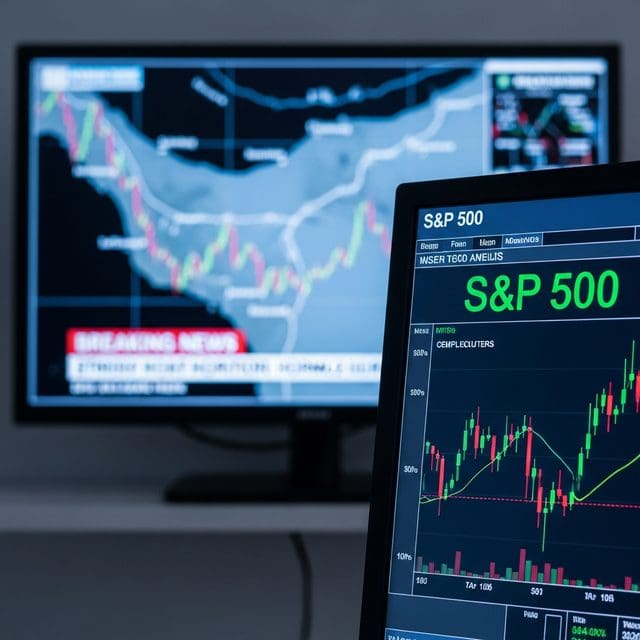
Technology and semiconductor stocks led a market rebound today, offsetting downward pressure from rising energy costs and Treasury yields following renewed military strikes in the Strait of Hormuz.
Global financial markets are navigating a sharply bifurcated landscape today as a resurgence in technology and semiconductor equities provides a necessary buffer against heightening geopolitical risks. While the S&P 500 (SPY) showed resilience with a 0.68% gain, the broader market remains caught between a tech-led recovery and the harsh realities of a deteriorating security situation in the Middle East. Tech-heavy indices like the Nasdaq Composite are leading the charge, while the Dow Jones Industrial Average has struggled, weighed down by industrial and cyclical sectors sensitive to energy costs and interest rates.
The primary catalyst for market anxiety is the collapse of the U.S.-Iran ceasefire and the subsequent impact on global energy supplies. Following renewed Iranian attacks on commercial vessels in the Strait of Hormuz, the Trump administration revoked temporary oil waivers on July 7, 2026. This policy shift was followed by two consecutive days of U.S. military strikes against Iranian targets, including strategic railway bridges in northeastern Iran. Consequently, U.S. crude futures have surged approximately 9% over the last five sessions, trading near $74 per barrel. For the American household, this energy spike acts as an invisible tax, threatening to squeeze disposable income and increase logistics costs for everyday consumer goods.
In the bond market, Treasury yields have ticked higher, reflecting what Charles Schwab analysts describe as a more temperamental macroeconomic backdrop defined by supply shocks and geopolitical instability. The rise in yields alongside oil prices has notably capped the rally for non-tech segments, with consumer-facing companies like PepsiCo facing earnings disappointments. This environment creates a challenging paradox for the American taxpayer: while their retirement accounts may benefit from the AI-driven tech boom, the underlying economy is facing the headwinds of centralized financial control and rising costs of living driven by sovereign conflict.
Despite these macro pressures, the semiconductor sector has emerged as the primary engine of market growth. The PHLX Semiconductor Index (SOX) is attempting a recovery after recently falling 16% from its intraday highs, a correction that left many mega-cap tech names in defensive territory. While technical analysts from Reuters warn that the AI-driven trade remains vulnerable after a blistering multi-month rally, today’s rebound suggests that institutional appetite for high-growth tech remains the dominant market force. This tech-led tone is mirrored in European markets, where the Stoxx 600 also saw gains driven by a rebound in software and hardware equities, as investors look for growth that can outpace inflation.
Institutional activity elsewhere highlights a trend toward consolidation and digital expansion despite the volatility. OCI N.V. recently recommended an unsolicited all-cash offer from NNS, while AEON expanded its digital payment footprint into Zambia, integrating mobile money for digital asset settlement. These moves underscore a global shift toward digital financial systems even as physical trade routes face disruption. Meanwhile, in the domestic sphere, partnerships like the one between Reins and ProfitWorks are emerging to provide alternative equity programs for independent business owners, reflecting a grassroots effort to maintain meritocracy in a volatile economy.
For the working household, the takeaway from today’s session is one of cautious observation. While the headline growth in the S&P 500 suggests stability, the underlying drivers are concentrated in a few high-performing tech names. The broader economy remains tethered to the stability of global trade routes and the cost of capital. As long as the Strait of Hormuz remains a flashpoint and Treasury yields remain elevated, the volatility in energy and debt markets will likely continue to challenge the sustainability of this tech-driven rally, reminding us that national sovereignty and stable monetary systems are the true foundations of a healthy market.

Jordan Lee serves as the Senior Correspondent for Wall Street, Finance, and Monetary Systems at Just Right News. Based in the heart of the world’s financial capital, New York City, Lee brings a sharp, principled eye to the complex mechanisms that drive the global economy. His reporting is defined by a commitment to fiscal responsibility, the defense of the free market, and a deep-seated belief that a transparent monetary system is the bedrock of a free society.
Raised in Portland, Oregon, Lee’s perspective was forged in a city that has undergone significant cultural and economic shifts. His upbringing in the Pacific Northwest instilled in him a profound appreciation for the industriousness of small business owners and the importance of local economic stability. Watching the evolution of his hometown’s landscape sparked an early interest in how federal fiscal policy and large-scale financial trends eventually trickle down to the average citizen. This background provides him with a unique vantage point; he understands the growing disconnect between the policy-making elite and the reality of Main Street, a theme that frequently resonates throughout his work.
Now operating from his base in New York City, Lee bridges the gap between the high-stakes trading floors of Manhattan and the households of everyday Americans. He views the financial sector not merely as a collection of numbers and tickers, but as a vital engine of American prosperity that requires constant vigilance and accountability. His reporting often highlights the dangers of centralized financial control and the necessity of maintaining a system that rewards merit, risk-taking, and innovation.
As the creator and lead of the featured series, “The Invisible Economy,” Lee pulls back the curtain on the often-opaque world of monetary systems. He specializes in translating the dense jargon of central banking and international finance into actionable insights for the Just Right News audience. His work explores the “invisible” forces—such as inflationary pressures, regulatory creep, and the expansion of the administrative state—that erode the purchasing power of American families. By focusing on these systemic issues, Lee empowers readers to understand the hidden forces shaping their financial independence.
Lee’s journalistic philosophy is rooted in a steadfast commitment to traditional American values. As an Asian American professional who has navigated the competitive corridors of the financial world, he is a vocal advocate for meritocracy and the preservation of the American Dream. He believes that a stable currency and a predictable regulatory environment are essential for national sovereignty and individual liberty. His reporting frequently warns against the risks of government overreach in the private sector, arguing that the most effective solutions to economic challenges arise from competition and individual enterprise rather than bureaucratic mandates.
At Just Right News, Jordan Lee remains dedicated to providing a clear-eyed defense of the taxpayer. Whether he is analyzing market volatility or investigating the long-term implications of national debt, his mission is to provide the truth about where the money is going and what it means for the future of the country. Through his rigorous analysis and principled stance, Lee has become a trusted voice for those who value a strong, sovereign, and fiscally sound America.