

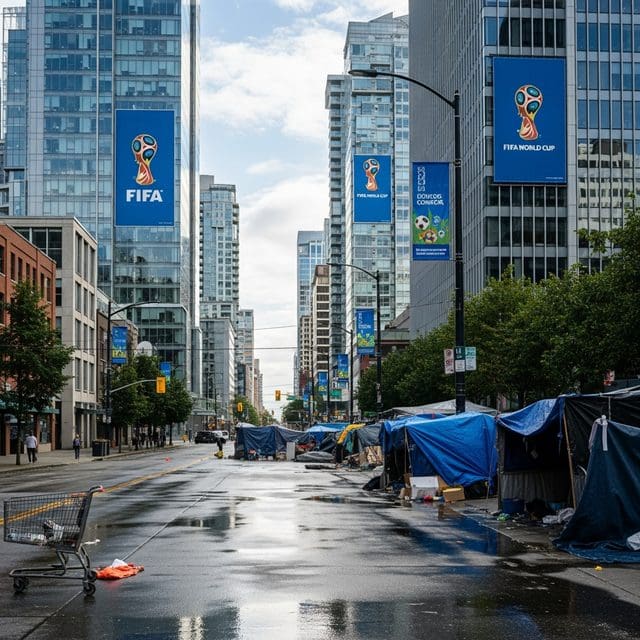
Host cities for the 2026 World Cup are implementing aggressive urban management strategies, leading to a conflict between municipal security goals and the stability of vulnerable local populations.
The logistical preparations for the 2026 World Cup are increasingly intersecting with local enforcement and housing policies across North American host cities. As municipal governments move to secure fan zones and transit corridors, the tension between public order and the stability of local populations has become a central point of contention. The scale of the event has forced a reckoning over how cities manage their most vulnerable districts under a global spotlight.
In Vancouver, reports from the Downtown Eastside indicate a significant split in the narrative regarding recent police activity. Residents and advocates describe intensified street sweeps and displacement linked directly to the tournament’s security requirements. Conversely, city officials and the Vancouver Police Department maintain that these operations are routine and not driven by the sporting event. The lack of consensus extends to housing, with advocates questioning whether promised units for displaced individuals are materializing or if the population is simply being pushed into less visible areas.
This enforcement-focused approach in Canada contrasts with strategies in several U.S. host cities, where the tournament is used as a catalyst for rapid infrastructure development. In Atlanta and Dallas, municipal leaders have framed the World Cup as a firm deadline for expanding social infrastructure. Atlanta’s “Downtown Rising” and Dallas’s “Housing Forward” programs claim to have reduced visible street homelessness near fan zones by prioritizing shelter placement. However, the speed of these transitions raises questions about long-term sustainability once international media departs.
The demographic impact remains difficult to quantify due to a lack of specific reporting on the immigration status of those affected. Current data has yet to establish a direct link between these security-driven sweeps and specific migrant or asylum-seeker populations, though these groups often overlap with vulnerable communities in urban centers. The absence of specific data on the DACA or refugee status of those displaced highlights a gap in understanding how international events affect the American social contract and community character.
Beyond displacement, the broader economic environment influences the social landscape. Rising gasoline prices and shifts in consumer demand are forcing adjustments in the retail and beverage sectors. Major brands like Pepsi have reported performance dampening due to fuel costs, pushing the industry toward “Americana” themed branding and value-conscious packaging. Even niche markets feel the shift; cannabis-beverage brand Cann is reportedly pivoting its strategy in response to regulatory and demand pressures within the U.S. market.
Financial markets are also reacting to the region’s stability. Analysts at Wells Fargo and Keefe, Bruyette & Woods recently raised price targets for firms like Arch Capital Group and State Street, signaling confidence in corporate earnings despite volatility. This institutional optimism contrasts with the ground-level uncertainty in neighborhoods like the Downtown Eastside. As the 2026 World Cup draws nearer, the divergence between economic indicators and the lived experience of displaced populations remains a critical metric for assessing the true cost of hosting global events.

Julie Harris serves as a Staff Writer for Just Right News, where she tackles some of the most pressing and complex issues facing the nation today. As the lead reporter for the Migration, Demographics & Cultural Shifts beat, Julie provides a grounded, principled perspective on how the movement of people and the changing makeup of communities are reshaping the American landscape. Her work is defined by a commitment to exploring the long-term consequences of social change, prioritizing the stability of local institutions and the preservation of national identity.
Her deep understanding of these issues is rooted in her upbringing in Tucson, Arizona. Growing up in a prominent border state, Julie witnessed firsthand the intricate realities of migration and the profound impact it has on local infrastructure, law enforcement, and the social fabric. This early exposure instilled in her a respect for the rule of law and a keen awareness of the challenges that arise when federal policies fail to align with the needs of border communities. Her reporting often reflects this lived experience, bringing a necessary level of nuance to topics that are often treated with abstraction in coastal newsrooms.
Now based in Santa Fe, New Mexico, Julie continues to report from the heart of the American Southwest. Her location provides a unique vantage point to observe the intersection of traditional regional cultures and the modern shifts brought about by both internal and external migration. In Santa Fe, a city defined by its rich history and distinct cultural heritage, she finds a perfect environment to explore how communities strive to maintain their character while navigating the pressures of a rapidly changing world. This perspective allows her to bridge the gap between policy debates in Washington and the reality of life in the high desert.
At Just Right News, Julie’s work is characterized by a dedication to examining the data and the human stories that define the “New Mosaic” of America. Her signature feature series, “The New Mosaic,” has become a cornerstone of her reporting. Through this series, Julie explores the evolving social architecture of the United States, documenting how shifts in population affect everything from local economies to the political landscape. She brings a critical eye to the narrative of demographic inevitability, instead asking how these shifts impact the average citizen’s sense of belonging and the integrity of the American social contract.
Julie’s background and her dedication to conservative principles make her a vital voice in contemporary journalism. She understands that demographics are more than just numbers on a spreadsheet; they represent the future of the American family and the nation’s enduring legacy. Through her diligent reporting and insightful analysis, Julie Harris ensures that her readers are informed about the forces shaping their world, providing a perspective that is as thoughtful as it is necessary for the modern era.