

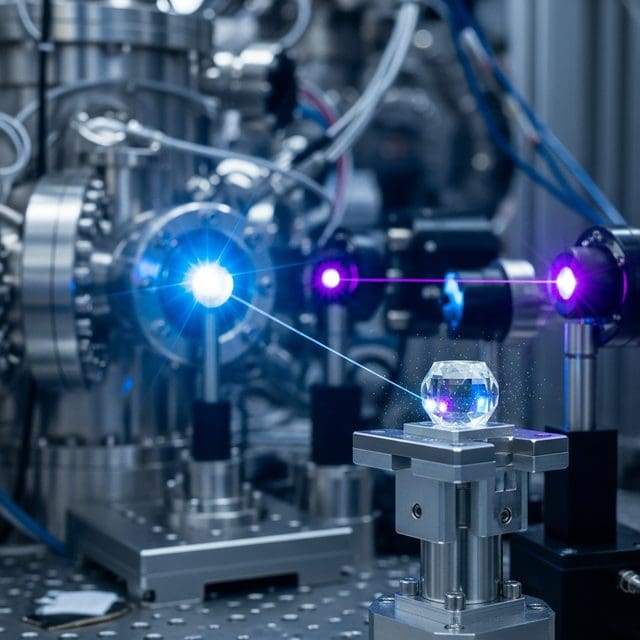
Recent discoveries in quantum entanglement and ultracold atoms are pushing the boundaries of physics, offering new ways to secure global navigation and understand the fundamental building blocks of the universe.
The quiet halls of high-energy physics laboratories have been disrupted this week by findings that suggest our understanding of the physical world is undergoing a profound shift. For decades, the strange laws of quantum mechanics—where particles exist in two places at once or remain linked across vast distances—were thought to be confined to the microscopic realm. New evidence suggests these boundaries are dissolving, with significant implications for American technological sovereignty and the future of secure infrastructure.
In a striking development reported by ScienceDaily, researchers have observed clear signs of quantum entanglement within a centimeter-sized crystal. This is not a subatomic speck visible only through an electron microscope; it is an object large enough to hold in one’s hand. The discovery that everyday objects can exhibit deep quantum connections challenges the long-held assumption that the macroscopic world is strictly governed by classical Newtonian physics. If large-scale matter can be entangled, the potential for decentralized, unhackable quantum networks becomes a matter of engineering rather than theoretical speculation.
Parallel to this, a team at the Fraunhofer ILT in Aachen has achieved a milestone in quantum control. By developing a laser-optical system managing 2,000 Rydberg atoms with submicrometer precision, they have provided the University of Stuttgart with the tools to build more robust quantum computers. This level of precision is essential for maintaining the integrity of quantum information against external noise. For those concerned with national security, these advancements represent the front line of a new arms race in computing power—one where the ability to simulate complex materials or break traditional encryption could shift the global balance of power.
Practical applications are already emerging from these abstract experiments. Researchers have recently applied quantum entanglement to secure ground-to-satellite timing for Global Navigation Satellite System (GNSS) applications. In an era where GPS spoofing and signal interference pose risks to domestic logistics and defense, utilizing the immutable laws of physics to synchronize time across the globe offers a layer of protection that traditional bureaucratic oversight cannot provide. This advancement in timing is complemented by discoveries at the University of Santiago, where researchers identified a quantum vacuum phenomenon that enables the breaking of chemical bonds with significantly reduced energy, potentially revolutionizing industrial manufacturing.
Furthermore, the discovery of high-energy gravitons as quasiparticles in quantum Hall systems near absolute zero offers a rare bridge between the worlds of gravity and quantum mechanics. While these experiments require extreme conditions, they provide a roadmap for understanding how mass and energy interact at the most fundamental level. This week’s findings also include a new quantum theory that resolves decades-old disputes regarding how impurities behave within many-particle systems. By bridging two rival models, physicists have resolved a challenge that has persisted for decades, which could reshape how we develop semiconductors and high-performance electronics.
As these technologies move from the lab to the marketplace, the challenge will be ensuring they serve the interests of individual liberty rather than centralized surveillance. The ability to control 2,000 atoms with submicrometer precision or to utilize optical tornadoes for quantum communication promises a future of abundance. However, we must remain vigilant that these powerful tools remain decentralized and transparent, honoring the constitutional principles that allow such innovation to flourish. From the Kuiper Belt, where NASA’s New Horizons is currently transmitting data, to the subatomic level, the American pursuit of knowledge continues to push the boundaries of the known frontier.

Mason Reed serves as a Staff Writer for Just Right News, where he spearheads the Future Frontiers & Special Projects desk. In an era defined by rapid technological shifts and evolving social landscapes, Mason provides a steady, principled voice, examining the innovations of tomorrow through the lens of traditional American values. His work is most prominently featured in his signature series, “The Next Horizon,” where he explores the intersection of emerging technology, national sovereignty, and the preservation of individual liberty.
A native of San Diego, California, Mason’s worldview was shaped by the unique culture of his hometown. Growing up in a region defined by its strong military presence and its history of maritime industry, he developed a deep-seated respect for the institutions that provide national stability and the entrepreneurial spirit that drives the American economy. This upbringing instilled in him a belief that true progress is not found in discarding the past, but in building upon a foundation of proven principles. His reporting often reflects this San Diego influence, emphasizing the importance of a robust national defense and the necessity of maintaining a competitive edge in the global marketplace.
Now based in San Francisco, Mason operates from the heart of the world’s technological engine. Living and working in the Bay Area provides him with a front-row seat to the advancements—and the ideological challenges—emanating from Silicon Valley. While many in the region embrace a “move fast and break things” mentality, Mason’s reporting serves as a vital counterweight. He offers Just Right News readers a “boots on the ground” perspective, documenting how radical local policies and the concentration of tech power impact the everyday lives of citizens. His proximity to the industry allows him to cut through the marketing jargon of big tech to uncover the real-world implications for privacy, free speech, and the nuclear family.
In his “Future Frontiers” beat, Mason tackles complex subjects ranging from the ethics of artificial intelligence to the burgeoning private space race. He approaches these topics with a healthy skepticism toward centralized bureaucracy, championing instead the decentralized innovations that empower individuals. Through “The Next Horizon,” he highlights the pioneers and thinkers who are working to ensure that the future remains a place where human dignity and constitutional rights are protected. He believes that the rapid pace of change requires more than just technical expertise; it requires a moral compass rooted in the Western tradition.
Throughout his tenure at Just Right News, Mason has remained committed to the idea that the future is something to be shaped, not merely accepted. His writing is characterized by a rigorous defense of American exceptionalism and a belief that the country’s best days lie ahead, provided it remains true to its founding ideals. Whether he is investigating the impact of automation on the American workforce or profiling the next generation of aerospace engineers, Mason Reed ensures that his readers are equipped with the insights they need to navigate a changing world with confidence and clarity.