

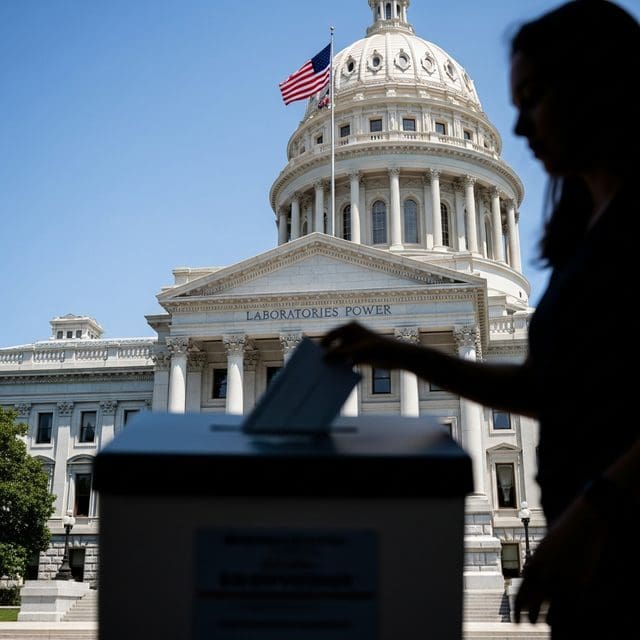
As America celebrates its 250th birthday, states like California, Texas, and Florida are asserting local sovereignty through diverse ballot measures, redistricting strategies, and updated primary election protocols.
The 250th anniversary of the United States has arrived with a stark reminder of the constitutional design: while the federal government handles the pageantry, the states manage the mechanics of power. As President Trump delivered a sharp rebuke of communism from Mount Rushmore and prepared for a high-heat address on the National Mall, the real work of governance continued in statehouses from Sacramento to Tallahassee. The contrast between federal gridlock and state-level activity has never been more pronounced than during this milestone summer, where local laboratories of power are testing the limits of their sovereignty.
In California, the laboratory of direct democracy is operating at full capacity. Voters are set to face 14 statewide ballot measures this November, covering a broad spectrum of policy including tax reform, housing, voter-ID requirements, and healthcare proposals. This decentralized approach allows Californians to bypass legislative gridlock, a sharp contrast to the federal SAVE America Act, which Senator Thom Tillis recently declared dead due to implementation timelines. California is also leading the charge on digital integrity, implementing disclosure rules for political deepfakes as part of a growing trend among 26 states to regulate artificial intelligence in elections. While Bloomberg pitches the 2026 cycle as the first “AI election,” states like Texas have already moved to ban deepfakes entirely, asserting local control over the digital town square.
Texas and Florida are simultaneously asserting their influence through redistricting and administrative shifts that carry national implications. In Texas, Republican strategists anticipate that new maps could net the party up to 13 House seats across several states, including Missouri, North Carolina, and Ohio, illustrating how state-level control over boundary lines remains a primary driver of national political shifts. Meanwhile, Florida has already set its 2026 primary machinery in motion. The state began dispatching vote-by-mail ballots to overseas and military voters on July 4, with domestic ballots scheduled to follow next week ahead of the August 18 primary. These administrative milestones occur even as the federal government remains preoccupied with international tensions, such as Vice President Vance’s warnings regarding the Iran ceasefire and Speaker Qalibaf’s threats from Tehran.
New York presents a different model of local governance, where the intersection of cultural institutions and progressive politics is reshaping the state’s trajectory. While Coney Island hosted the 23rd consecutive broadcast of the Nathan’s Hot Dog Eating Contest—where Joey Chestnut pursued his 18th title despite ongoing probation for a misdemeanor battery plea—the state’s political landscape is being redefined by Mayor Zohran Mamdani. Following a clean sweep for progressive candidates in the June primaries, Mamdani’s administration is testing the limits of local conservation mandates, drawing criticism for suggesting residents set thermostats to 78 degrees to conserve energy during the record-breaking 107-degree heatwave that delayed entry to the National Mall.
Even as Louisiana’s executive branch faces internal legal friction—highlighted by the state Supreme Court’s stay on the indictment of Attorney General Liz Murrill regarding malfeasance charges in New Orleans—the broader trend remains clear. Murrill had been facing 16 counts of malfeasance and intimidation tied to letters sent to local officials, but the high court’s intervention on July 4 underscores the complex checks and balances inherent in state-level governance. The states are not waiting for federal permission to innovate or litigate. Whether through Texas’s bans on AI-generated political content or Florida’s expedited election calendar, the Tenth Amendment remains the most active engine of American policy development. As the nation reflects on 250 years of history, the “Fifty Laboratories of Power” continue to prove that the most impactful governance often happens closest to home, far from the sweltering heat of the National Mall and the gridlock of the federal district.

Dylan Brooks serves as the Senior Correspondent for Statehouses and Local Governance at Just Right News, where he brings a principled, constitutionalist lens to the often-overlooked machinery of state-level politics. As the lead voice behind the acclaimed feature series “Fifty Laboratories of Power,” Dylan has dedicated his career to the idea that the most impactful governance happens closest to home. His reporting consistently champions the Tenth Amendment, exploring how individual states can serve as testing grounds for innovative, conservative policy solutions that prioritize personal liberty and fiscal responsibility.
A native of Des Moines, Iowa, Dylan’s journalistic philosophy was forged in the heart of the American Midwest. Growing up in a community where local school board meetings and town halls were the bedrock of civic life, he developed a deep appreciation for the “retail politics” of the heartland. This upbringing instilled in him a fundamental belief that the American experiment is best preserved when power is decentralized. He carries the values of his Iowa roots into every assignment, maintaining a healthy skepticism of federal overreach and a steadfast commitment to the concerns of everyday citizens over the interests of the administrative state.
Now based in Madison, Wisconsin, Dylan operates from one of the nation’s most pivotal political battlegrounds. His location in a state capital known for its rigorous policy debates allows him to provide Just Right News readers with a front-row seat to the legislative process. From Madison, he tracks the ripple effects of statehouse decisions on local municipalities, ensuring that the connection between high-level policy and community impact is never lost. His work often highlights the success of conservative governors and legislatures in fostering economic growth, protecting parental rights, and securing the integrity of local institutions.
As an African American man in the conservative media landscape, Dylan offers a vital perspective on how limited government and free-market principles empower individuals and families. He frequently reports on how deregulation and school choice initiatives provide new avenues for success in underserved communities, challenging the monolithic narratives often presented by legacy media outlets. Dylan’s work is characterized by a commitment to the facts and a refusal to shy away from the complex realities of modern governance.
Throughout his tenure at Just Right News, Dylan has become a trusted authority for readers who value a rigorous, principled approach to the news. Whether he is dissecting a complex state budget or profiling a local grassroots movement, his goal remains the same: to provide the American public with the information they need to hold their local leaders accountable. By focusing on the “Fifty Laboratories of Power,” Dylan Brooks ensures that the vital work being done in statehouses across the country receives the national attention it deserves, always through a lens that respects the traditions and sovereignty of the American people.