

Reporting on Taylor Swift’s wedding and Louisiana legal battles exposes a growing rift between anonymous sourcing and journalistic transparency.
The American media landscape is currently navigating a precarious intersection of celebrity obsession and institutional opacity. As the nation prepares for its 250th anniversary, the press is demonstrating a troubling reliance on anonymous sourcing and a selective approach to transparency that threatens to undermine public trust. This shift toward viral-ready narratives at the expense of rigorous verification is particularly evident in the high-profile coverage of pop culture icons and the legal challenges facing state officials.
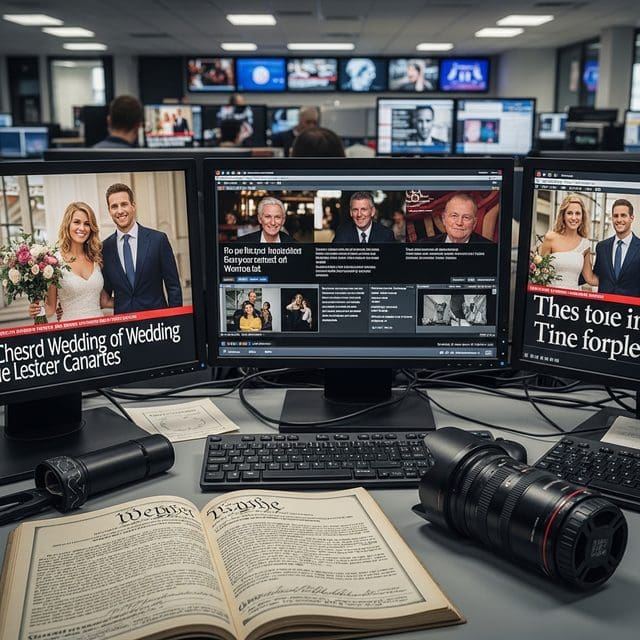
The frenzy surrounding the reported wedding of Taylor Swift and Travis Kelce at Madison Square Garden serves as a primary case study in modern media mechanics. While Variety and social media influencers have treated the event as a confirmed fact, the foundation of this certainty rests on a single anonymous law-enforcement source cited by the Associated Press. Despite the AP’s own caveats that neither the couple nor their representatives have publicly confirmed the nuptials, the broader media ecosystem has converted this thin sourcing into an absolute narrative. Outlets like PBS and CNN have attempted to maintain a veneer of caution by emphasizing what remains unknown—such as the guest list and specific ceremony details—yet they simultaneously broadcast visuals of tarp-covered loading docks and NYPD crowd-control preparations. This creates a feedback loop where the visual spectacle of security measures is used to validate a story that lacks official confirmation.
Simultaneously, a crisis of information integrity is unfolding in Louisiana. The state’s Supreme Court recently halted a criminal case against Attorney General Liz Murrill just one day after her 16-count indictment. Murrill, who faces eight counts of malfeasance and eight of intimidation with a $400,000 bond, has publicly attacked the case as retaliatory and unconstitutional. However, the media’s ability to report on the facts has been hampered by significant transparency concerns. Reports indicate that at least one journalist was allegedly handcuffed and barred from the grand jury proceedings, a move that contradicts the fundamental principles of open governance. When the state restricts the eyes and ears of the public during such high-stakes legal maneuvers, the resulting vacuum is invariably filled by partisan framing rather than factual clarity.
These domestic challenges are compounded by the rising threat of technological exploitation and the ongoing debate over platform moderation. The Guardian recently highlighted warnings from the National Crime Agency regarding the use of AI to generate abusive material from innocent photos of children posted online. This development underscores the urgent need for robust platform moderation and parental vigilance. While lawmakers push for the bipartisan Kids Internet and Digital Safety Act and courts deliver jury verdicts against tech giants like Meta and Google, the media’s role in educating the public on these risks remains inconsistent.
Even as President Trump prepares for a lengthy speech on the National Mall for America’s 250th birthday—despite a forecast of 107-degree heat and energy conservation warnings from local officials like NYC Mayor Zohran Mamdani—the media remains fixated on the intersection of politics and celebrity. Whether covering the spectacle of a potential wedding or the complexities of a state attorney general’s indictment, the duty of the press remains the same: to provide the public with objective truth grounded in verifiable evidence. When outlets prioritize the speed of a viral headline over the rigor of multi-source confirmation, or when legal institutions shroud their actions in secrecy, the American story is diminished. Reclaiming that story requires a return to intellectual honesty and a rejection of the manufactured narratives that currently dominate the digital square.

Chloe Foster serves as a Staff Writer for Just Right News, where she spearheads the outlet’s coverage of Media, Culture, and Information Integrity. In an era defined by rapid-fire digital communication and shifting societal norms, Chloe has distinguished herself as a vital voice for readers seeking clarity amidst the noise. Her signature feature series, “The Story Wars,” has become a cornerstone of the publication, offering a deep dive into the ideological battles currently shaping American life and the ways in which mainstream narratives are constructed, disseminated, and often manipulated.
Chloe’s unique perspective is informed by a life lived in two of the nation’s most influential cultural hubs. Raised in Los Angeles, California, she grew up in the shadow of the world’s most powerful media and entertainment apparatus. This upbringing provided her with a front-row seat to the “dream factory,” allowing her to observe firsthand how cultural exports are crafted and how they often diverge from the lived experiences of everyday Americans. Her time in Los Angeles instilled in her a healthy skepticism of manufactured consensus and a passion for uncovering the truths that lie beneath polished public relations campaigns.
Today, Chloe operates from Brooklyn, New York, a vantage point that places her at the epicenter of the modern media landscape. Living and working in a deep-blue urban environment as a conservative journalist has sharpened her reporting, requiring a rigorous commitment to intellectual honesty and a steadfast defense of traditional values. Her base in Brooklyn allows her to engage directly with the institutions and influencers who drive the national conversation, providing Just Right News readers with an “on-the-ground” look at the cultural shifts originating in the Northeast.
As a Hispanic woman, Chloe brings a nuanced understanding of community and heritage to her beat. She frequently explores how media portrayals of the Latino community often overlook the deep-seated faith, entrepreneurial spirit, and family-centric values that define it. Her work challenges the monolithic labels often applied by mainstream outlets, instead highlighting the diversity of thought and the conservative principles that resonate within her community.
In her role at Just Right News, Chloe views “Information Integrity” not merely as a buzzword, but as a mission. She believes that a healthy republic requires a media landscape where facts are prioritized over agendas and where the public is empowered to think for themselves. Through “The Story Wars,” she deconstructs the framing of major news events, exposing bias and providing the context necessary for readers to understand the broader cultural implications of the day’s headlines.
Chloe Foster’s reporting is more than just a collection of articles; it is a sustained effort to reclaim the narrative for those who feel sidelined by the prevailing media establishment. By bridging the gap between her West Coast roots and her East Coast base, she continues to provide essential commentary on the forces that define our shared American culture.