

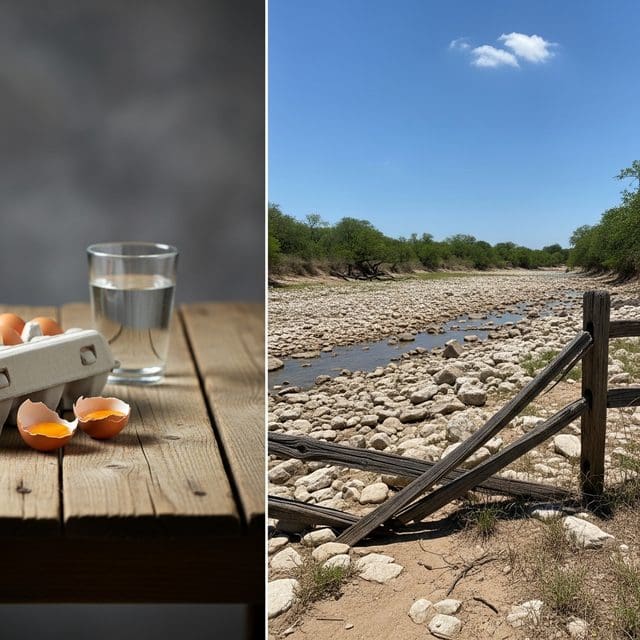
Massachusetts food companies settle deception claims while Texas Hill Country residents demand infrastructure accountability one year after a catastrophic flood.
The integrity of the American food supply and the resilience of rural infrastructure are under renewed scrutiny as legal settlements and somber anniversaries highlight a disconnect between regulatory promises and ground-level reality. In Massachusetts, the state’s pursuit of transparency in the agricultural sector culminated in two food companies agreeing to pay $495,000. The settlement follows allegations that these entities violated state animal cruelty laws and misled consumers regarding the confinement of farm animals. For the principled observer, this case is less about the fine and more about the erosion of trust; when corporate entities use deceptive labeling to mask industrial practices, they undermine local farmers who adhere to traditional, humane standards of stewardship.
This trend of reactive policing is not limited to the Northeast. In West Virginia, the labor landscape is shifting as 201 drivers and warehouse workers at Highline Warren in Glen Dale recently voted to join Teamsters Local 697. This move reflects a growing demand for stability within the supply chains that deliver essential automotive and chemical products. While labor organizers seek to fortify the workforce, federal agencies like the DEA are scrambling to regulate new substances, recently moving to temporarily schedule 7-hydroxymitragynine. These disparate actions point to a government frequently playing catch-up with the private sector rather than providing a stable framework for commerce and safety.
Nowhere is the failure of proactive stewardship more evident than in the Texas Hill Country. Residents of Kerr County are currently marking the one-year anniversary of a catastrophic flood that claimed more than 130 lives. The disaster, which centered around locations like Camp Mystic, remains a focal point for investigations into whether local and federal water management authorities failed to provide adequate warnings or maintain the infrastructure necessary to mitigate such a surge. While the Los Angeles City Council recently approved a $14 million initiative for animal services and the federal government considers taking equity stakes in tech giants like OpenAI, the families of the Hill Country are left wondering why basic infrastructure and flood prevention remain underfunded.
The recovery in Texas has been a grueling process, characterized by a push for legislative changes that many residents feel should have been in place decades ago. The contrast is stark: the administrative state is quick to levy fines against food companies for labeling errors, yet it appears sluggish when tasked with the heavy lifting of rebuilding bridges and hardening water systems in the American heartland. This disparity suggests a regulatory preference for high-profile litigation over the quiet, essential work of maintaining the nation’s physical foundations.
Furthermore, the financial sector is seeing turbulence that impacts the broader economy. The Federal Reserve Board recently issued an enforcement action against Small Business Bank while terminating actions against larger entities like BNP Paribas. This selective enforcement, coupled with the ongoing tension between the Trump administration and the Federal Reserve over the independence of governors like Lisa Cook, creates uncertainty for the agricultural sectors that rely on stable credit. When the mechanisms of the state are preoccupied with internal power struggles and corporate equity deals, the fundamental needs of the American producer—clean water, honest markets, and reliable infrastructure—often fall by the wayside.
Ultimately, these events serve as a reminder that local sovereignty and private-sector innovation are the most reliable safeguards for the American family. Whether it is ensuring that food is labeled honestly or ensuring that a Texas creek bed doesn’t become a death trap, the solution lies in grounded, local accountability. The families in Kerr County and the consumers in Massachusetts are both victims of a system that prioritizes optics and bureaucracy over the practical management of our nation’s resources.

Eric Nolan serves as the Senior Correspondent for Food, Water, and Environmental Health at Just Right News, where he brings a principled, common-sense perspective to the most fundamental issues facing the American public. With a career dedicated to uncovering the truth behind the policies that govern our natural resources, Eric has become a trusted voice for readers who value traditional stewardship over bureaucratic overreach. His reporting is defined by a commitment to the idea that true environmentalism is rooted in the protection of the American family and the preservation of the nation’s agricultural heritage.
Raised in Fresno, California, Eric’s worldview was shaped in the heart of the San Joaquin Valley. Growing up in one of the world’s most productive agricultural hubs, he witnessed firsthand the vital connection between the land, the water, and the dinner table. In Fresno, he saw the resilience of farmers and the devastating impact that distant, top-down regulations can have on local communities. This upbringing instilled in him a deep respect for the producers who feed the country and a lifelong skepticism toward the alarmist narratives often pushed by mainstream media. For Eric, environmental health is not an abstract political talking point; it is a matter of ensuring that the people who work the land have the freedom and the resources to do so effectively.
Now based in Eugene, Oregon, Eric operates from a unique vantage point in the Pacific Northwest. Living in a region often defined by intense environmental debate, he provides a necessary counter-narrative to the prevailing trends of the area. From his base in Eugene, he monitors the shifting tides of federal and state policies, ensuring that the voices of rural citizens and property owners are not drowned out by urban activism. His reporting often bridges the gap between the rugged realities of the outdoors and the legislative halls where decisions are made, offering a grounded perspective that prioritizes local sovereignty and practical solutions.
As the lead for the acclaimed feature series “Earth on the Table,” Eric explores the intricate journey of the American food supply. He tackles critical issues such as water rights, soil health, and food security through a lens of national stability and individual liberty. He believes that a healthy environment and a thriving economy are not mutually exclusive, but rather two sides of the same coin of national prosperity. His work consistently highlights how innovation and private-sector ingenuity are the most effective tools for ensuring clean water and a safe food supply, rather than the expansion of the administrative state.
At Just Right News, Eric’s reporting serves as a vital resource for those who seek accountability and transparency. Whether he is investigating the impact of federal land management on local economies or examining the safety of the national food infrastructure, his work remains anchored in the values of heritage and hard work. Eric Nolan continues to be a leading voice in environmental journalism, championing the belief that the best way to protect our natural resources is to empower the people who live and work closest to them.