

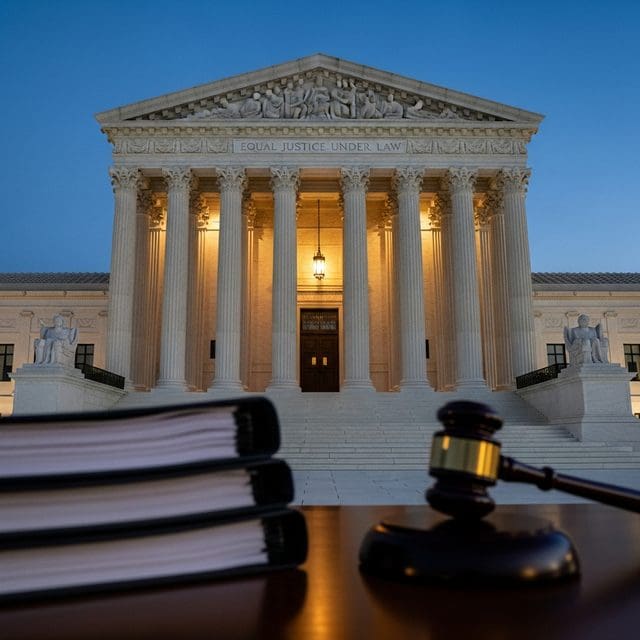
The Supreme Court’s 7-2 ruling for Bayer clarifies federal preemption and executive authority, providing a rigorous defense of the constitutional order against state-level regulatory overreach.
The Supreme Court issued a definitive 7-2 ruling on June 25, 2026, siding with Bayer in a high-stakes dispute regarding its Roundup herbicide. The Court held that federal pesticide law preempts state-level failure-to-warn claims, neutralizing thousands of pending lawsuits. This decision serves as a rigorous application of the preemption doctrine, asserting that when the EPA approves specific labeling under the Federal Insecticide, Fungicide, and Rodenticide Act (FIFRA), states cannot impose additional requirements through the courts. By affirming that federal regulatory standards act as a ceiling for compliance, the Court has signaled its commitment to a predictable legal environment for American industry.
From a constitutional perspective, the ruling provides doctrinal clarity on the separation of powers. The majority opinion emphasizes that allowing a patchwork of state-level jury verdicts to dictate product labeling would undermine uniform standards established by Congress and executed by the executive branch. This legal development arrived as the Trump administration pivoted toward a new agricultural strategy. Following the judicial blow to the ‘Make America Healthy Again’ (MAHA) movement’s anti-pesticide litigation, the President signed an executive order directing the USDA to maximize funding for a $700 million regenerative agriculture pilot program. This move suggests a shift from litigation-based reform toward administrative incentives for lower-risk production methods.
The Court’s end-of-term docket also extended deeply into national security and immigration authority. In a separate 6-3 decision, the justices ruled that the administration possesses the statutory authority to terminate Temporary Protected Status (TPS) for migrants from Haiti and Syria. This ruling affects approximately 1.3 million people, affirming the executive’s right to end legal protections when underlying conditions in those nations are deemed to have changed. Furthermore, the Court voted 6-3 to greenlight the ‘metering’ policy, allowing the government to turn back asylum seekers before they reach U.S. soil. Together, these rulings reaffirm the executive branch’s broad discretion in managing the border and enforcing immigration statutes as written in the federal code.
Beyond the domestic sphere, the geopolitical landscape remains volatile. On June 26, the U.S. military conducted retaliatory strikes against Iranian targets near the Strait of Hormuz after Iran fired at commercial vessels. These were the first U.S. strikes since the signing of the U.S.-Iran memorandum of understanding, highlighting the tension between diplomatic agreements and the executive’s duty to protect maritime security. Domestically, the administration continues to balance security concerns with agricultural priorities, as the President reiterated requests for $11.1 billion in agricultural disaster aid and signaled support for year-round E15 fuel sales. The USDA also released a final Regenerative Feedstock Rule, tying low-carbon fuel standards to the 45Z tax credit.
As the term concludes, these rulings underscore a judiciary focused on the text of the law and the structural integrity of the Constitution. By upholding federal preemption in the Bayer case and executive authority in immigration, the Court continues to dismantle ‘living’ interpretations of law in favor of a fixed standard that respects the distinct roles of the three branches of government. For those watching the ‘Rulebook of Power,’ the message is clear: the Constitution remains the final arbiter of administrative and state overreach, ensuring the law is interpreted as written rather than as a tool for social engineering.

Lila Hayes serves as a Staff Writer for Just Right News, where she anchors the “Courts, Law, and Constitutional Order” beat. Her work is defined by a steadfast commitment to the foundational principles of the American republic and a rigorous defense of the legal frameworks that ensure national stability. As a primary voice for the outlet, she provides readers with a clear-eyed analysis of the judiciary, focusing on the importance of originalism and the preservation of the separation of powers.
Lila’s perspective was forged in the American heartland. Raised in St. Louis, Missouri, she grew up in a Hispanic household where the values of hard work, faith, and respect for the law were paramount. Her upbringing instilled in her a deep appreciation for the American Dream and the legal protections that make it possible. This Missouri background remains a cornerstone of her reporting, providing a grounded, common-sense counter-narrative to the often-insular legal circles of the coastal elite. She understands that the decisions made in high-court chambers have real-world consequences for families and small business owners across the country.
At Just Right News, Lila has become widely recognized for her signature feature series, “The Rulebook of Power.” In this ongoing project, she delves into the mechanics of the federal government, examining how administrative overreach and judicial activism can threaten the delicate balance of the Constitution. She approaches her beat with the tenacity of a veteran journalist and the precision of a legal scholar, consistently advocating for a judiciary that interprets the law as written rather than legislating from the bench. For Lila, the Constitution is not a “living” document subject to the whims of modern social trends; it is a fixed standard that ensures the government remains the servant of the people, not their master.
Now based in Philadelphia, Pennsylvania, Lila finds herself at the very epicenter of American constitutional history. Living and working in the city where the Founders drafted the documents she defends daily provides a constant source of inspiration. The historic halls and landmarks of Philadelphia serve as a daily reminder of the high stakes involved in her reporting. Her presence in the city allows her to bridge the gap between the historical intent of the law and its contemporary application, ensuring that the legacy of the Founding Fathers remains central to the national conversation.
Throughout her career, Lila has remained dedicated to the idea that a free society requires an informed citizenry and a transparent legal system. Her reporting is more than just a collection of headlines; it is a defense of the constitutional order that has sustained the nation for over two centuries. By focusing on the “Rulebook of Power,” she ensures that her readers understand not just what is happening in the courtrooms, but why those decisions matter for the future of American liberty. Lila Hayes continues to be a vital voice for those who believe that the law should be a shield for the citizen and a constraint on the state.