

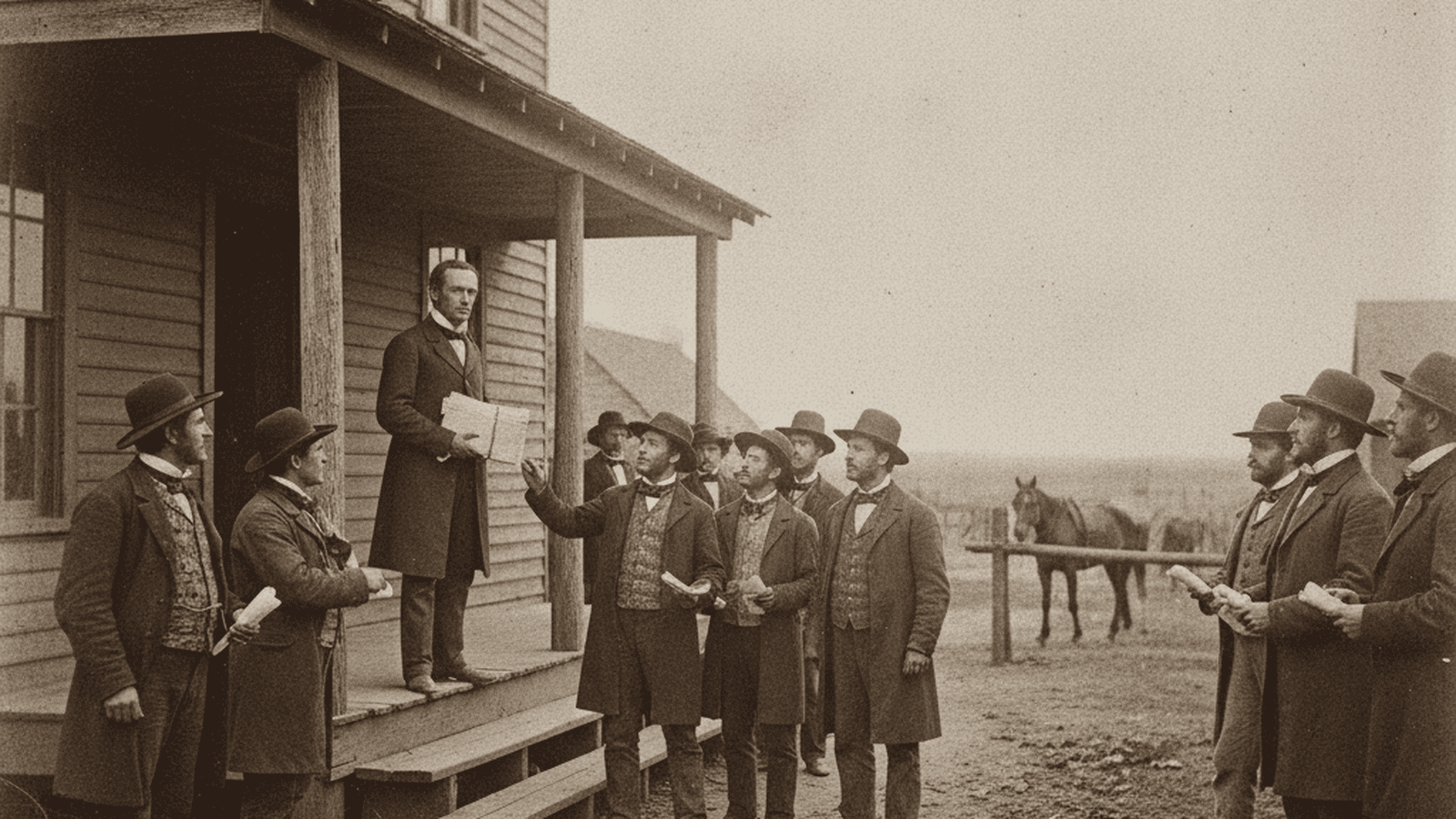
In 1857, Kansas Territorial Governor Robert J. Walker took a decisive stand against systemic voter fraud by throwing out thousands of fabricated ballots from Oxford and McGee counties. This intervention in the United States territory ensured that the Free-State majority gained control of the legislature, fundamentally altering the region’s political future.
TLDR: During the 1857 Kansas territorial elections, Governor Robert J. Walker invalidated massive fraudulent returns from pro-slavery precincts. By rejecting over 2,800 faked votes from sparsely populated areas, Walker secured a Free-State legislative majority. This act of electoral oversight was a critical turning point in the struggle over slavery in the American West.
The struggle for the Kansas Territory in the mid-1850s was defined by a violent tug-of-war between pro-slavery “Border Ruffians” and Free-State “Jayhawkers.” By 1857, the concept of popular sovereignty—the idea that residents should vote on the status of slavery—had devolved into a series of fraudulent contests and guerrilla warfare known as “Bleeding Kansas.” The October 1857 election for the territorial legislature became the flashpoint for a significant reform in how the United States government handled contested returns. This moment centered on the actions of Territorial Governor Robert J. Walker, a man appointed to maintain order in a region spiraling toward civil war.
Governor Walker arrived in Kansas with a reputation as a seasoned statesman, having served as a U.S. Senator and Secretary of the Treasury. Although he was a Democrat appointed by the pro-slavery-leaning Buchanan administration, Walker was committed to the principle that popular sovereignty must be practiced fairly to be legitimate. During the October balloting, the pro-slavery party attempted to secure a permanent majority through blatant fabrication of results. In the Oxford precinct of Johnson County, a settlement consisting of only eleven houses, the official return claimed a staggering 1,624 pro-slavery votes. Similar irregularities appeared in McGee County, a sparsely populated area along the border where over 1,200 votes were reported despite a near-total lack of eligible voters. These “census” votes were intended to overwhelm the growing Free-State population and ensure the passage of the pro-slavery Lecompton Constitution.
The scale of the deception was impossible to ignore. Alongside Territorial Secretary Frederick Stanton, Walker traveled to the disputed precincts to investigate the tallies personally. They discovered that the names on the Oxford poll books had been copied directly from a Cincinnati commercial directory in alphabetical order, a lazy but bold attempt at disenfranchising the actual residents. Despite intense pressure from pro-slavery leaders and threats of political ruin from Washington, Walker issued a proclamation on October 19, 1857, rejecting the returns from Oxford and McGee. He argued that his duty was to certify actual votes, not manifest forgeries. This administrative intervention was a rare instance of a federal official prioritizing procedural integrity over partisan advantage during the Antebellum era.
By discarding the fraudulent ballots, Walker shifted the balance of power, giving the Free-State party its first legitimate majority in the territorial legislature. This decision had immediate and explosive political consequences. Pro-slavery advocates burned Walker in effigy, and President James Buchanan, under pressure from Southern Democrats, eventually withdrew his support for the governor. Buchanan’s insistence on accepting the Lecompton Constitution despite the obvious fraud led to a permanent rift in the Democratic Party and Walker’s resignation in December 1857.
However, the newly seated Free-State legislature was able to block the Lecompton Constitution and eventually move Kansas toward admission as a free state in 1861. The incident highlighted the fragility of the frontier ballot box and the necessity of executive oversight in preventing systemic disenfranchisement. In the following years, the Oxford fraud became a cautionary tale used by reformers to advocate for more rigorous voter registration and canvassing laws. The precedent set by Walker’s refusal to accept “paper” majorities influenced later federal and state-level election contests. It underscored the principle that the legitimacy of a government depends not just on the act of voting, but on the verifiable accuracy of the count. This legacy of administrative scrutiny remains a cornerstone of American electoral law and the protection of democratic infrastructure.

Sophie Carter serves as a Staff Writer for Just Right News, where she anchors the outlet’s critical coverage of Elections, Influence, and Democracy Infrastructure. In an era where the mechanics of voting and the flow of political capital are under constant scrutiny, Sophie provides a steady, principled voice dedicated to the preservation of American institutional integrity and the rule of law.
Raised in Charlotte, North Carolina, Sophie’s perspective was forged in a community that balances rapid modern growth with a deep respect for tradition and civic duty. Growing up in the Queen City, she witnessed firsthand how a robust local culture depends on the trust between the citizen and the state. This upbringing instilled in her a foundational belief that the right to vote is a sacred trust—one that must be protected from both administrative overreach and the encroaching influence of special interest groups. Her reporting reflects these North Carolina roots, emphasizing the importance of community-led governance and the preservation of the individual’s voice in the face of nationalized political movements.
Now based in Atlanta, Georgia, Sophie operates from the heart of one of the nation’s most pivotal and contested political landscapes. Her location allows her to report from the front lines of the debate over election security, legislative reform, and the modernization of voting systems. For Sophie, the “infrastructure” of democracy is not merely a matter of machines and ballots; it is the collection of laws, people, and transparent processes required to maintain public confidence. Her work often highlights the necessity of clear, enforceable standards that ensure every legal vote is counted fairly and that the machinery of our republic remains accountable to the taxpayers who fund it.
Central to her work at Just Right News is her acclaimed feature series, “The Price of a Vote.” Through this ongoing project, Sophie explores the complex web of influence that shapes modern campaigns and policy decisions. She delves into how high-level lobbying, non-governmental organizations, and shifting bureaucratic regulations impact the weight of an individual citizen’s ballot. By examining the financial and structural pressures placed on the electoral process, she provides readers with a comprehensive look at the forces vying for control over the American political system.
Sophie’s approach to journalism is rooted in a commitment to the constitutional framework. She views her role as a watchdog for the voter, ensuring that the systems meant to serve the public remain transparent and free from corruption. Whether she is analyzing the implementation of new voting technologies or investigating the influence of outside money on state-level policy, her work is characterized by a rigorous adherence to facts and a refusal to succumb to the sensationalism that often plagues modern political reporting.
At Just Right News, Sophie Carter continues to be a vital resource for readers who value clarity, conviction, and a defense of traditional American values. Her deep ties to the Southeast and her specialized focus on the mechanics of our republic make her an essential voice in the ongoing conversation about the future of American self-governance. Through her reporting, she remains dedicated to the idea that a secure and honest electoral system is the bedrock of a free and prosperous society.