

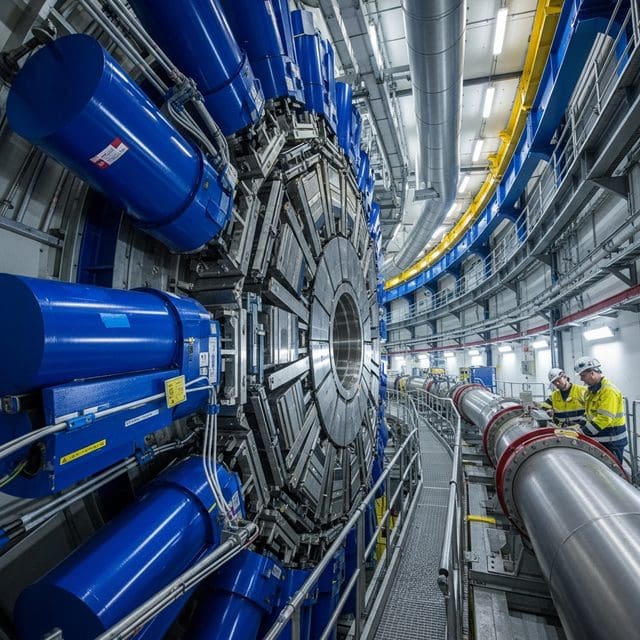
CERN begins a massive 1.2 billion Swiss franc overhaul of the world’s largest particle accelerator to hunt for dark matter and unlock the secrets of the early universe.
The pursuit of the fundamental building blocks of the universe entered a critical phase this week. On June 29, 2026, operations at the Large Hadron Collider (LHC) at CERN officially ceased, marking the beginning of a four-year shutdown. This hiatus is a transition toward the High Luminosity LHC (HL-LHC), a technical overhaul designed to push the boundaries of particle physics. For the next several years, the 27-kilometer ring beneath the Franco-Swiss border will be a hive of construction rather than collisions, preparing for high-intensity research starting in 2030.
Project leader Markus Zerlauth described the moment as a pivot into a new era. The upgrade, costing 1.2 billion Swiss francs, involves replacing components across 1.2 kilometers of the underground ring. These improvements center on new Nb3Sn triplet quadrupole magnets capable of focusing particle beams with unprecedented precision. When the facility reopens, the rate of collisions is expected to jump from 60 per bunch crossing to as many as 200. This allows physicists to expect up to 100 times more data over the machine’s lifetime than has been recorded since 2008. Such a massive increase in luminosity is essential for explaining the 95 percent of the universe currently categorized as dark matter and dark energy.
American interest in this project reflects a commitment to international scientific leadership. The United States, alongside Japan, Canada, and China, provides roughly 15 percent of the project’s funding through in-kind contributions. This cooperation is centered on the ATLAS detector, which will receive a completely new inner tracker and upgraded calorimeter electronics to handle the higher trigger rates. Hardware milestones for the inner tracker were completed at CERN in late 2025, ensuring the facility is ready for the intense data environment of the 2030s.
A central focus of the HL-LHC will be the Higgs boson. Since its discovery in 2012, the particle has been a focal point for understanding how matter acquires mass. CERN officials expect the upgraded collider to produce 380 million Higgs bosons over its operational life, a staggering increase from the 55 million produced to date. Physicist Nedaa-Alexandra Asbah noted that observing “double-Higgs production”—where two Higgs bosons are produced simultaneously—could provide essential clues regarding how the universe evolved shortly after the Big Bang. Recent results already show strong evidence of quantum entanglement between Z bosons produced in Higgs decays, suggesting the particle is a perfect testbed for high-energy quantum phenomena.
This new frontier also necessitates a revolution in data processing. Asbah emphasized that while artificial intelligence is becoming a central tool for real-time event selection, it serves to augment rather than replace the human physicist. The volume of data generated requires advanced, error-resilient computing infrastructure. This mirrors broader trends in the field, such as recent breakthroughs at Johns Hopkins University where researchers developed a noise-modeling framework for quantum processors that improved predictive accuracy sevenfold. Whether in the tunnels of CERN or quantum labs, the goal remains reducing the “noise” of the unknown to reveal the signal of truth.
As the physical tunnel goes dark for renovations, the work shifts to laboratories where the next generation of detectors and magnets are being finalized. The four-year silence at CERN is a necessary prelude to a decade of research seeking to defend the principles of decentralized innovation and secure a deeper understanding of physical laws. By the time the beams return in 2030, the world will see if the HL-LHC can finally illuminate the dark corners of the cosmos that have eluded humanity for generations.

Mason Reed serves as a Staff Writer for Just Right News, where he spearheads the Future Frontiers & Special Projects desk. In an era defined by rapid technological shifts and evolving social landscapes, Mason provides a steady, principled voice, examining the innovations of tomorrow through the lens of traditional American values. His work is most prominently featured in his signature series, “The Next Horizon,” where he explores the intersection of emerging technology, national sovereignty, and the preservation of individual liberty.
A native of San Diego, California, Mason’s worldview was shaped by the unique culture of his hometown. Growing up in a region defined by its strong military presence and its history of maritime industry, he developed a deep-seated respect for the institutions that provide national stability and the entrepreneurial spirit that drives the American economy. This upbringing instilled in him a belief that true progress is not found in discarding the past, but in building upon a foundation of proven principles. His reporting often reflects this San Diego influence, emphasizing the importance of a robust national defense and the necessity of maintaining a competitive edge in the global marketplace.
Now based in San Francisco, Mason operates from the heart of the world’s technological engine. Living and working in the Bay Area provides him with a front-row seat to the advancements—and the ideological challenges—emanating from Silicon Valley. While many in the region embrace a “move fast and break things” mentality, Mason’s reporting serves as a vital counterweight. He offers Just Right News readers a “boots on the ground” perspective, documenting how radical local policies and the concentration of tech power impact the everyday lives of citizens. His proximity to the industry allows him to cut through the marketing jargon of big tech to uncover the real-world implications for privacy, free speech, and the nuclear family.
In his “Future Frontiers” beat, Mason tackles complex subjects ranging from the ethics of artificial intelligence to the burgeoning private space race. He approaches these topics with a healthy skepticism toward centralized bureaucracy, championing instead the decentralized innovations that empower individuals. Through “The Next Horizon,” he highlights the pioneers and thinkers who are working to ensure that the future remains a place where human dignity and constitutional rights are protected. He believes that the rapid pace of change requires more than just technical expertise; it requires a moral compass rooted in the Western tradition.
Throughout his tenure at Just Right News, Mason has remained committed to the idea that the future is something to be shaped, not merely accepted. His writing is characterized by a rigorous defense of American exceptionalism and a belief that the country’s best days lie ahead, provided it remains true to its founding ideals. Whether he is investigating the impact of automation on the American workforce or profiling the next generation of aerospace engineers, Mason Reed ensures that his readers are equipped with the insights they need to navigate a changing world with confidence and clarity.