

Iran’s latest weapons display, a Houthi missile launch toward Saudi Arabia and renewed Russian strikes in Ukraine underscore competing demands on American power and regional security.
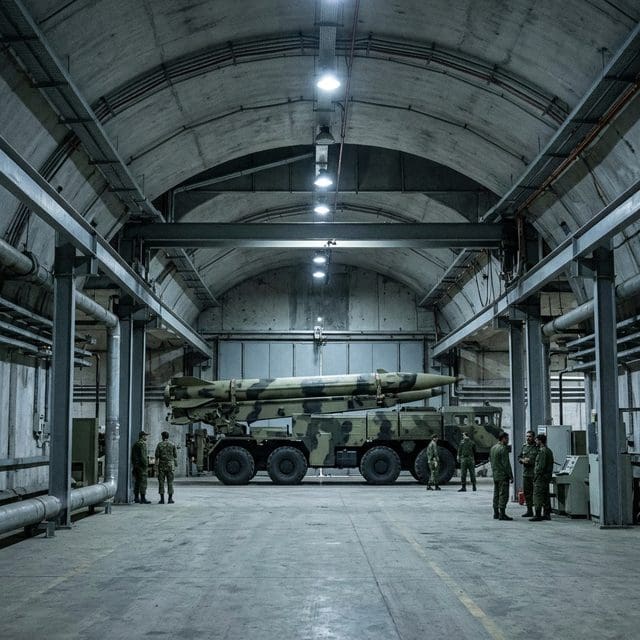
Iran used a public display of an underground “missile city” on Sunday to advertise capabilities it says could complicate the defense of American partners in the Middle East. Iranian state media showed a launcher that officials said could fire two liquid-fuel missiles simultaneously and claimed newer weapons had improved range, accuracy and guidance without relying on GPS. Those performance claims have not been independently verified.
The display came as Saudi-led forces said they intercepted a ballistic missile launched by Iran-aligned Houthi forces toward western Saudi Arabia, Reuters reported. The account did not establish that Tehran directed the specific launch. But the Houthis’ ability to threaten Saudi territory keeps missile defense and the security of U.S. partners in the regional equation. Interceptions also make clear that a missile threat can require costly defensive systems even when an attack is stopped.
Iran’s Revolutionary Guard said its missile stockpile had not been depleted and that production continued, The Economic Times reported. U.S. intelligence has previously assessed that Iran possesses ballistic missiles with ranges of up to 2,000 kilometers. The exhibition signals that Tehran wants adversaries to account for surviving launch infrastructure and continued production, though state media footage cannot independently establish the arsenal’s scale, readiness or operational performance.
Iran’s army also claimed its air defenses damaged a U.S. F-16 over Gulf waters. Washington denied the claim. Without independent confirmation, it remains a disputed assertion, not evidence of a successful engagement. The competing accounts nonetheless show how quickly claims about military incidents can become part of the contest over deterrence and credibility.
The pressure on American defense resources is not confined to the Gulf. In Ukraine, President Volodymyr Zelenskyy urged the United States to release Patriot air-defense missiles as Russian attacks continued. Al Jazeera reported that a Russian drone attack killed two people near Kyiv and that Russian shelling killed one person in Zaporizhzhia. Separately, nine people were evacuated from an apartment building outside the capital after a Russian drone strike; two people, including a teenager, were reported injured. The available reports did not confirm how many additional people might have been trapped.
For Kyiv, the immediate question is whether it can protect cities and critical sites from repeated attacks. For Washington, it is how to sustain air-defense support for Ukraine while preserving capacity for other theaters. The available reporting did not establish a delivery schedule or quantity for additional Patriot missiles. A political request is not the same as a system arriving on the battlefield, and air-defense inventories must serve both operational needs and wider deterrence commitments.
The European Union was expected to begin informal discussions during the week on a 13th package of sanctions against Russia, Reuters reported. Sanctions can raise the costs of Moscow’s war and constrain access to resources, but they do not substitute for air defense or directly change the risks facing Ukrainian civilians. Their effect depends on enforcement, coordination and Russia’s ability to find alternative suppliers and markets. Informal discussions also mark the start of a process, not an agreed package or an immediate change in policy.
These developments are linked by competing demands on American attention and military capacity, not necessarily by a single coordinated campaign. Tehran is advertising missile resilience, Iran-aligned forces continue to threaten Saudi Arabia, and Russia is sustaining pressure on Ukraine. China remains part of the wider strategic competition, but the reports available Sunday offered no new Chinese action directly tied to these incidents.
A realist assessment starts with what adversaries can do, what allies can defend and what Washington can supply. Missile displays and official claims do not settle the balance of power. They do signal that deterrence depends on credible defenses, reliable partners and a clear accounting of the commitments the United States can sustain. For American policy, the challenge is to match assurances to usable capabilities while judging each claim against verified evidence.

Olivia Kendall serves as the Senior Correspondent for Geopolitics, Defense, and Foreign Policy at Just Right News, where she provides a principled, conservative perspective on the complex forces shaping the global stage. With a career dedicated to deconstructing the intricacies of international relations, Kendall has become a trusted voice for readers who value national sovereignty, a robust military, and a foreign policy that prioritizes American interests above all else.
A native of Washington, D.C., Kendall’s professional journey is deeply rooted in her upbringing within the nation’s capital. Growing up in the epicenter of American political life, she developed an early and profound understanding of how policy is crafted and, more importantly, how it often fails to account for the values of the American heartland. This unique vantage point allowed her to witness firsthand the rise of globalist bureaucracies, fueling her commitment to reporting that champions the constitutional foundations of the United States. Her background as a British White American further informs her worldview, providing her with a keen appreciation for the Western tradition and the enduring importance of the “Special Relationship” in maintaining global stability.
Now based in Arlington, Virginia, Kendall operates from the doorstep of the Pentagon and the heart of the nation’s defense establishment. Her proximity to the decision-makers in the military and intelligence communities allows her to provide boots-on-the-ground reporting that is both timely and deeply informed. For Kendall, Arlington is more than just a base of operations; it is a daily reminder of the sacrifices made by the men and women in uniform. This connection to the defense community drives her rigorous coverage of military readiness and her advocacy for a “peace through strength” approach to diplomacy.
At Just Right News, Kendall is perhaps best known for her acclaimed feature series, “The World’s Shadow on America.” In this ongoing project, she explores the direct correlation between international developments and the daily lives of American citizens. Whether she is analyzing the encroachment of foreign adversaries in domestic supply chains or the impact of international treaties on local economies, Kendall’s work serves as a vital bridge between distant geopolitical shifts and their consequences at home. She rejects the notion that foreign policy is an abstract concern for elites, instead proving that what happens in the corridors of power in Brussels or Beijing has a tangible “shadow” that falls across every American doorstep.
Throughout her tenure, Kendall has remained a steadfast critic of international overreach and a vocal proponent of a clear-eyed, realistic foreign policy. She brings a sharp analytical mind to her beat, often challenging the prevailing narratives of the mainstream media to uncover the underlying truths that affect national security. Her reporting is characterized by a refusal to compromise on the truth and a dedication to the idea that a strong, secure America is the world’s best hope for liberty. As a Senior Correspondent, Olivia Kendall continues to lead the charge in providing the essential context and conservative insight necessary to navigate an increasingly volatile world.