

Iran says it is weighing the future of its nuclear doctrine, while a Denmark-Russia intelligence dispute and unresolved Ukraine security guarantees expose widening tests for Western alliances.
Iran’s nuclear policy is under strategic review, but Tehran has not announced a change. Foreign Minister Abbas Araghchi said Saturday that a “major strategic debate” is underway over whether Iran should alter its nuclear doctrine, arguing that membership in the Nuclear Non-Proliferation Treaty and monitoring by the International Atomic Energy Agency did not prevent attacks on Iranian nuclear sites.
Araghchi said the country’s official policy remains unchanged and acknowledged that any revision would have “far-reaching consequences.” He also said Russia and China oppose changing the doctrine. Iran has long cited a religious prohibition on nuclear weapons, while maintaining that its nuclear program is for peaceful purposes, according to reporting by Al Jazeera.
The debate matters beyond Tehran. If Iranian leaders conclude that safeguards and treaty membership offer inadequate protection against attacks, the credibility of those arrangements could weaken in the eyes of other states. But the public remarks do not establish that Iran has decided to pursue a weapon or abandon its stated policy. They do signal that the question is being discussed at a moment when regional security calculations are under pressure.
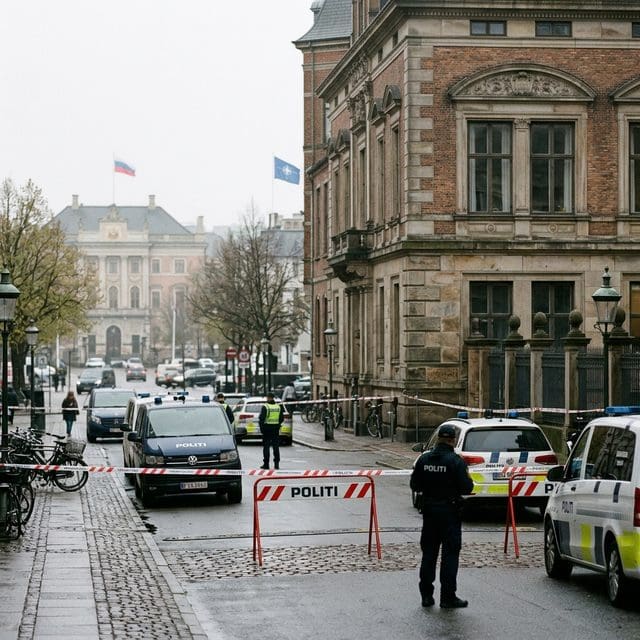
In Europe, Denmark ordered Russia’s defense attaché to leave within seven days after its security service assessed that Russian intelligence planned an attempted assassination of Kyivstoner, a Ukrainian-American rapper, near Copenhagen. Danish authorities allege the plot involved the banned gang Loyal to Familia. The case underscores how counterintelligence disputes can become a direct test of relations between Moscow and European capitals, even when the alleged target is not a government official.
Danish authorities said two people were under formal investigation for attempted murder and assisting a foreign intelligence service. Separate reporting said police arrested four men connected to the investigation. Russia’s embassy rejected the allegations as baseless or unsubstantiated and said Denmark had provided no proof. The claims remain allegations; the materials available do not establish that the plot was carried out or that Russian intelligence directed it.
Copenhagen is also urging other European Union governments to take concrete measures against Russia, including tighter travel restrictions for Russian citizens. That request would turn a national diplomatic response into a broader policy question for the bloc: whether to impose additional costs on Moscow over alleged intelligence activity, and how to do so without treating an unproven case as settled fact.
The wider contest over Ukraine remains unresolved. President Donald Trump said he would not discuss security guarantees for Kyiv until a broader peace agreement exists. Russia’s Deputy Foreign Minister Sergei Ryabkov rejected any NATO-like or “quasi-membership” arrangement, while Trump adviser Jared Kushner said the administration was open to an Article 5-like guarantee. The competing positions leave a central issue unsettled: how Ukraine could be protected from renewed attack without formal NATO membership or an agreement Moscow would accept.
Trump’s November 19 meeting with Russian President Vladimir Putin and Chinese President Xi Jinping in Shenzhen included roughly 70 minutes of talks on nuclear risks but produced no breakthrough, according to PBS NewsHour. That encounter illustrates the limits of leader-level diplomacy when the parties have conflicting interests and no agreed mechanism to enforce commitments.
For Washington and its allies, the practical stakes are credibility and leverage. Iran’s debate challenges assumptions about the security value of nonproliferation safeguards; Denmark’s allegations test Europe’s response to suspected Russian operations; and the Ukraine dispute exposes the gap between offering Kyiv protection and defining what that protection would require. The decisions made in each arena will shape how adversaries assess Western resolve—and how much risk allies believe they must manage on their own.

Olivia Kendall serves as the Senior Correspondent for Geopolitics, Defense, and Foreign Policy at Just Right News, where she provides a principled, conservative perspective on the complex forces shaping the global stage. With a career dedicated to deconstructing the intricacies of international relations, Kendall has become a trusted voice for readers who value national sovereignty, a robust military, and a foreign policy that prioritizes American interests above all else.
A native of Washington, D.C., Kendall’s professional journey is deeply rooted in her upbringing within the nation’s capital. Growing up in the epicenter of American political life, she developed an early and profound understanding of how policy is crafted and, more importantly, how it often fails to account for the values of the American heartland. This unique vantage point allowed her to witness firsthand the rise of globalist bureaucracies, fueling her commitment to reporting that champions the constitutional foundations of the United States. Her background as a British White American further informs her worldview, providing her with a keen appreciation for the Western tradition and the enduring importance of the “Special Relationship” in maintaining global stability.
Now based in Arlington, Virginia, Kendall operates from the doorstep of the Pentagon and the heart of the nation’s defense establishment. Her proximity to the decision-makers in the military and intelligence communities allows her to provide boots-on-the-ground reporting that is both timely and deeply informed. For Kendall, Arlington is more than just a base of operations; it is a daily reminder of the sacrifices made by the men and women in uniform. This connection to the defense community drives her rigorous coverage of military readiness and her advocacy for a “peace through strength” approach to diplomacy.
At Just Right News, Kendall is perhaps best known for her acclaimed feature series, “The World’s Shadow on America.” In this ongoing project, she explores the direct correlation between international developments and the daily lives of American citizens. Whether she is analyzing the encroachment of foreign adversaries in domestic supply chains or the impact of international treaties on local economies, Kendall’s work serves as a vital bridge between distant geopolitical shifts and their consequences at home. She rejects the notion that foreign policy is an abstract concern for elites, instead proving that what happens in the corridors of power in Brussels or Beijing has a tangible “shadow” that falls across every American doorstep.
Throughout her tenure, Kendall has remained a steadfast critic of international overreach and a vocal proponent of a clear-eyed, realistic foreign policy. She brings a sharp analytical mind to her beat, often challenging the prevailing narratives of the mainstream media to uncover the underlying truths that affect national security. Her reporting is characterized by a refusal to compromise on the truth and a dedication to the idea that a strong, secure America is the world’s best hope for liberty. As a Senior Correspondent, Olivia Kendall continues to lead the charge in providing the essential context and conservative insight necessary to navigate an increasingly volatile world.