

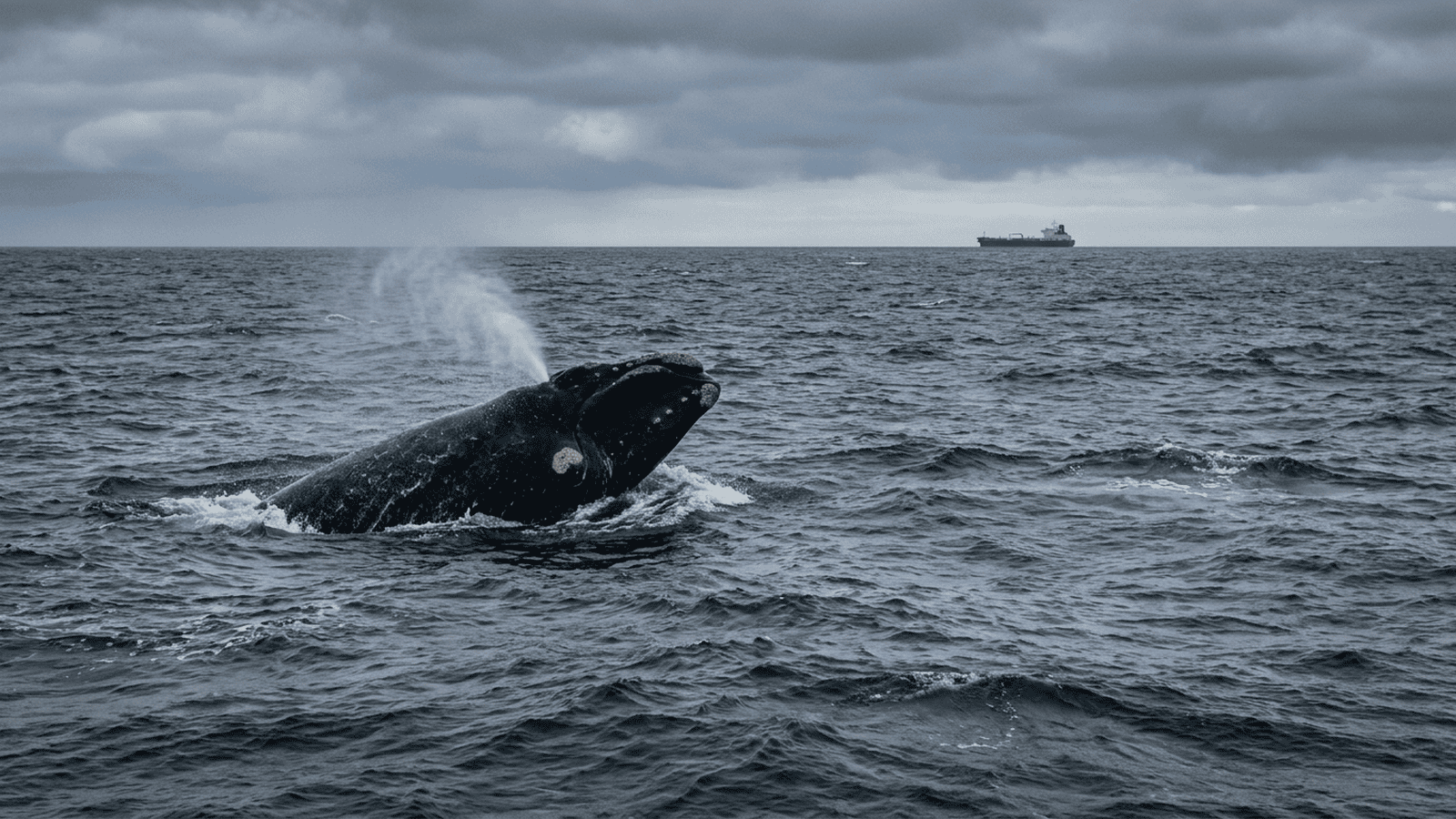
A new annual estimate puts the North Atlantic right whale population at 382, about 2% below last year’s figure and a reversal of recent slow growth. Scientists point to fishing-gear entanglements, ship strikes and shifting food sources as continuing threats, and say protection must account for the whales’ broad range. More than 20 calves were born last year, but only 73 reproductive females remain. The House has passed a proposal to delay new protections until 2035, a measure intended to shield commercial fishing interests from regulations described by industry members as burdensome. Specific fees, compliance rules and state enforcement plans are not provided in the account.
TLDR: Scientists estimate that 382 North Atlantic right whales remain, a decline of about 2% from last year, with only 73 reproductive females. The population report sharpens a debate over protections, fishing interests and the threats posed by gear entanglements and ship strikes.
The North Atlantic right whale population has fallen to an estimated 382 animals, reversing a slow climb in recent years and renewing scientists’ concerns about the species’ survival. The consortium of scientists that issued its annual estimate Monday said the count was about 2% lower than last year’s estimate. The number is a reminder that a brief period of improvement does not settle whether this population can recover.
The immediate concern is the range of dangers these whales face as they move through coastal waters. They can become entangled in fishing gear or be struck by ships. Warming ocean conditions are also shifting the location of their food, which can change where the whales travel. Heather Pettis, chair of the North Atlantic Right Whale Consortium, said the whales follow tiny organisms called copepods into areas where they may not be protected from those hazards. She said protections need to cover the whales throughout their range.
The population’s history offers little room for complacency. Centuries of commercial whaling sharply reduced the species, with most such hunting ending in the 1930s. The whales have recovered slowly. Their numbers fell about 25% from 2010 to 2020 as poor reproduction coincided with high mortality. Recent years brought some improvement, but that progress has not erased the losses or removed the risks. Scientists and conservationists say recovery requires both years with high birth counts and protections that reduce threats to the animals.
The latest estimate follows a strong calving season. More than 20 calves were born last year, making it one of the most successful seasons on record. Yet the total population declined, and only 73 reproductive females remain. The contrast matters because births are only one part of the population picture. A strong season does not guarantee that enough young whales will survive, or that the total population will rise the following year. The new estimate shows why scientists look beyond a single year’s births when assessing the species’ prospects.
The whales’ movements make the issue regional as well as national. They give birth off the Carolinas, Florida and Georgia in winter, then travel north toward feeding grounds off New England and Canada. Groups that can include a fifth of the entire population have been seen off Massachusetts in spring. The animals do not stay within one state’s waters, and their path takes them through different coastal areas. That broad range is one reason Pettis says protections need to follow the whales rather than focus on a single location.
The National Oceanic and Atmospheric Administration has reported unusually high numbers of injuries and deaths during the last nine years. Fishing gear and ship strikes are among the threats described in the account. The House has passed a congressional proposal to delay new right whale protections until 2035. The stated purpose of the proposal is to protect commercial fishing interests from the regulations. Fishing industry members have called the proposed rules burdensome, while environmental groups have opposed the delay.
The account does not specify what costs, paperwork, enforcement steps or operating changes the proposed protections would require of fishing businesses or other affected parties. It also gives no details about state enforcement plans, compliance rules or deadlines for new protections. Those practical impacts remain unreported, so the effects on individual businesses and communities cannot be measured from the information available here. What is clear is that the proposal would postpone new protections, while the documented hazards to whales continue. That leaves the policy debate focused on the balance between commercial fishing interests and efforts to reduce risks to a critically endangered population.
Nora Ives, a marine scientist with Oceana’s right whale campaign, said the population loss makes recovery take longer and that the whales cannot escape extinction if their numbers do not grow. Oceana and other environmental groups opposed the proposed delay. Their concern is that a population already reduced to a few hundred animals has little margin for further losses. The estimate does not say how many whales may be lost in the coming year, but it records a drop despite the strong calving season.
The immediate facts are clear: the estimate is 382 whales, the population is down about 2% from last year, and just 73 reproductive females remain. Scientists say sustained births and protections against entanglement and ship strikes are needed for the population to rebuild. The account describes continued attention to the protection debate and the annual population estimate, but gives no further deadline or oversight schedule. Those developments will keep the numbers and conservation choices in view. For now, the population estimate and the threats described by scientists point to a recovery that remains uncertain.

Dylan Brooks serves as the Senior Correspondent for Statehouses and Local Governance at Just Right News, where he brings a principled, constitutionalist lens to the often-overlooked machinery of state-level politics. As the lead voice behind the acclaimed feature series “Fifty Laboratories of Power,” Dylan has dedicated his career to the idea that the most impactful governance happens closest to home. His reporting consistently champions the Tenth Amendment, exploring how individual states can serve as testing grounds for innovative, conservative policy solutions that prioritize personal liberty and fiscal responsibility.
A native of Des Moines, Iowa, Dylan’s journalistic philosophy was forged in the heart of the American Midwest. Growing up in a community where local school board meetings and town halls were the bedrock of civic life, he developed a deep appreciation for the “retail politics” of the heartland. This upbringing instilled in him a fundamental belief that the American experiment is best preserved when power is decentralized. He carries the values of his Iowa roots into every assignment, maintaining a healthy skepticism of federal overreach and a steadfast commitment to the concerns of everyday citizens over the interests of the administrative state.
Now based in Madison, Wisconsin, Dylan operates from one of the nation’s most pivotal political battlegrounds. His location in a state capital known for its rigorous policy debates allows him to provide Just Right News readers with a front-row seat to the legislative process. From Madison, he tracks the ripple effects of statehouse decisions on local municipalities, ensuring that the connection between high-level policy and community impact is never lost. His work often highlights the success of conservative governors and legislatures in fostering economic growth, protecting parental rights, and securing the integrity of local institutions.
As an African American man in the conservative media landscape, Dylan offers a vital perspective on how limited government and free-market principles empower individuals and families. He frequently reports on how deregulation and school choice initiatives provide new avenues for success in underserved communities, challenging the monolithic narratives often presented by legacy media outlets. Dylan’s work is characterized by a commitment to the facts and a refusal to shy away from the complex realities of modern governance.
Throughout his tenure at Just Right News, Dylan has become a trusted authority for readers who value a rigorous, principled approach to the news. Whether he is dissecting a complex state budget or profiling a local grassroots movement, his goal remains the same: to provide the American public with the information they need to hold their local leaders accountable. By focusing on the “Fifty Laboratories of Power,” Dylan Brooks ensures that the vital work being done in statehouses across the country receives the national attention it deserves, always through a lens that respects the traditions and sovereignty of the American people.