

A court order and an incoming Democratic Congress put Trump’s Washington projects under legal and budgetary pressure, while his Oval Office monument proclamation creates a review process rather than an absolute ban on future changes.
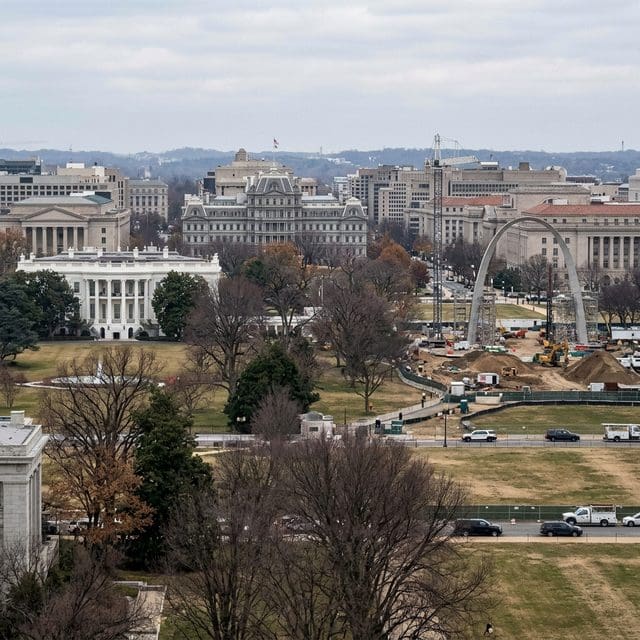
President Donald Trump’s Washington projects are facing two distinct tests: a federal court’s review of his proposed memorial arch and the prospect of a Democratic-controlled Congress scrutinizing federal projects and spending beginning in January. Together, the disputes put renewed focus on the boundaries among presidential authority, congressional control of public funds and local interests affected by federal construction.
On November 5, Trump signed a proclamation designating the Oval Office, Outer Oval Office and Cabinet Room as a national monument under the Antiquities Act. He said the move would help prevent a future president from making major structural changes without congressional approval. The proclamation came two days after the midterm elections, in which Democrats won control of Congress; the new majorities take office in January 2027.
The proclamation does not permanently bar future presidents from redecorating, changing furnishings or making ordinary operational and security modifications. Instead, substantial alteration or demolition would require documentation, review and consideration of alternatives. The text also says the proclamation does not diminish Congress’s authority over federal property. That qualification matters: the order establishes a preservation process, but does not settle how far a president can bind successors or limit Congress’s role.
Trump framed the step as a way to protect the rooms from major changes, saying that if someone wanted to “make [the Oval Office] square,” the matter would have to go back to Congress. But the practical effect is narrower than an absolute freeze on the White House’s appearance. The distinction between routine changes and substantial alteration is central to how the proclamation operates, and future disputes could turn on how that line is applied.
The proposed arch faces a more immediate obstacle. The National Capital Planning Commission approved the project, but U.S. District Judge Tanya Chutkan temporarily blocked construction after the District of Columbia, Virginia and other opponents challenged it. They argue that the project lacks required congressional authorization and could disrupt traffic and emergency mutual-aid operations, while raising environmental and historic-preservation concerns.
Chutkan rejected the administration’s reliance on a 1925 law as authorization for construction. The District and Virginia also argue that the project could impose unrecoverable costs. D.C. Council Chairman Phil Mendelson said Congress had not approved the arch or appropriated money for it; the administration disputes that interpretation. The temporary order pauses construction while the legal dispute proceeds, but does not resolve every question about the project’s future.
Congressional scrutiny is likely to follow. Democrats’ control of both chambers will give them committee gavels, investigative authority and influence over appropriations. Rep. Jared Huffman, expected to chair the House Natural Resources Committee, called the arch “ill-advised and illegal” and said it was a tribute to Trump rather than veterans. Those remarks signal an oversight agenda, but they are not a judicial finding. The current Congress still has a lame-duck period before the new majorities take office, while the next Congress will have a direct role in determining what federal projects receive funding.
Other Washington initiatives could draw attention as well, including renovations at the Kennedy Center, work at East Potomac Golf Links and the proposed National Garden of American Heroes. Congress previously appropriated $257 million for Kennedy Center renovations. That figure provides a starting point for oversight, though the amount alone does not answer whether particular work complies with the appropriation or other applicable requirements.
The broader issue is the division of authority over federal property and public money. Presidents can direct executive agencies and advance projects, but Congress controls appropriations and has a role in federal property decisions. Courts can assess whether the administration has statutory authority and whether affected parties have established legal grounds for relief. The arch’s pause and the White House proclamation therefore represent different stages of the same institutional question: what the executive can do on its own, and where law or Congress imposes limits.
Neither development settles the underlying disputes. The proclamation does not freeze the White House in its current form, and the court order does not finally decide whether the arch can be built. The next tests will come through litigation, the administration’s response and Congress’s review of the projects’ legal authority, funding and effects on local governments.

Miles Harrington serves as the Senior Correspondent for Federal Systems & Executive Power at Just Right News, where he brings a disciplined, constitutionalist lens to the inner workings of the American government. With a focus on the mechanics of the federal bureaucracy and the limits of executive authority, Harrington has established himself as a vital voice for readers who value transparency, accountability, and the preservation of the separation of powers.
A native of Richmond, Virginia, Harrington’s perspective is deeply rooted in the traditions of the Old Dominion. Growing up in a city defined by its historical significance and its role as a center of American jurisprudence, he developed an early appreciation for the foundational principles of the Republic. His upbringing in Richmond—a place where the legacy of the Founding Fathers is woven into the landscape—instilled in him a belief that the federal government should remain within its constitutional bounds. This background informs his skepticism of centralized overreach and his commitment to reporting on the ways in which the administrative state impacts the lives of everyday citizens.
In his current role, Harrington specializes in the complexities of federal systems. He doesn’t just report on the headlines of the day; he digs into the structural shifts within the executive branch that often go unnoticed by the mainstream press. Whether he is analyzing the implications of a new federal regulation or investigating the expansion of agency jurisdiction, his work is characterized by a rigorous adherence to the facts and a dedication to the rule of law.
Harrington is perhaps best known for his signature feature series, “How Washington Works.” Through this ongoing project, he demystifies the often-opaque processes of the nation’s capital, pulling back the curtain on the “Deep State” and the unelected officials who wield significant influence over national policy. By breaking down complex legislative maneuvers and executive orders, he empowers Just Right News readers to understand the true levers of power in Washington. His reporting serves as a necessary check on the federal government, ensuring that the actions of those in power are held up to the light of public scrutiny.
Now based in Washington, D.C., Harrington operates at the epicenter of the political world, yet he remains intentionally distanced from the “Beltway bubble.” His proximity to the halls of power allows him to maintain a robust network of sources across the federal landscape, but his heart remains in the principled conservatism of his Virginia roots. He views his role not merely as a reporter, but as a steward of the public trust, dedicated to providing the clarity and context that conservative voters need to navigate an increasingly complex political environment.
Through his sharp analysis and unwavering commitment to the truth, Miles Harrington continues to be a cornerstone of the Just Right News team. His work ensures that the principles of limited government and executive restraint remain at the forefront of the national conversation, providing a crucial service to those who believe in a government that is truly of, by, and for the people.