

President Trump said Mary Peltola should not be allowed to run after a report alleged that a Democratic operative helped recruit a candidate named Daniel J. Sullivan, sharing a name with Republican Sen. Dan Sullivan. Peltola’s campaign and the Democratic Senatorial Campaign Committee deny involvement, and the second Sullivan says he is genuinely interested in running. The Alaska Supreme Court ruled that he can remain on the ballot after state officials sought to remove him. The Justice Department has sued to prevent certification if Sen. Sullivan loses because of voter confusion. Voters will choose among four candidates next week using a ranked-choice ballot, while the lawsuit and the election process determine what happens next.
TLDR: The Alaska Senate race features two candidates named Sullivan, prompting accusations, denials, a state court ruling, and a federal lawsuit over possible voter confusion. Voters use a ranked-choice ballot next week, and the Justice Department’s request concerns certification only if Sen. Dan Sullivan loses.
President Donald Trump said Mary Peltola “shouldn’t be allowed to run” in next week’s Alaska Senate race after a report said people aligned with her campaign helped recruit a candidate named Daniel J. Sullivan. The candidate shares the first and last name of Republican Sen. Dan Sullivan, Peltola’s main opponent. Trump called the alleged effort election fraud, but the reported claims have not established a legal basis for barring Peltola from the ballot.
The stated rationale for Trump’s criticism is concern that a second candidate named Sullivan could confuse voters and affect the election’s result. The Justice Department has separately sued to prevent certification if Sen. Sullivan loses because of voter confusion. Attorney General Todd Blanche described the lawsuit as an effort to put guardrails in place.
The dispute concerns political conduct and ballot clarity, but the accounts in the report conflict. The New York Times reported that a Democratic operative who worked with Peltola’s campaign and national Democrats encouraged Daniel J. Sullivan to run, citing text messages and interviews. The newspaper said the effort appeared to be part of a wider attempt to draw more candidates into the race. Peltola’s campaign and the Democratic Senatorial Campaign Committee deny involvement.
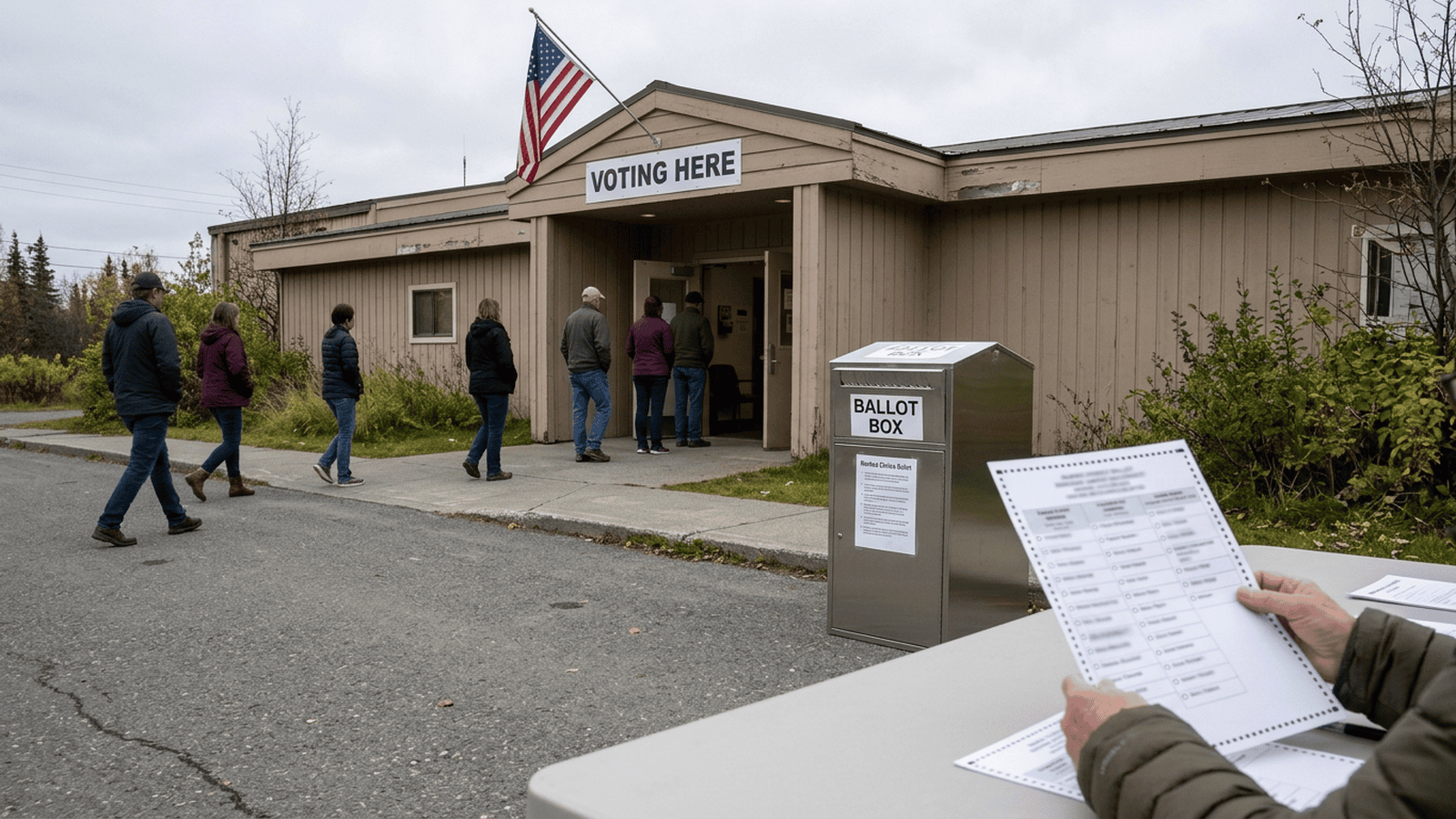
Alaska voters are choosing among four candidates who advanced from a nonpartisan primary earlier this year. The ballot allows voters to rank candidates rather than select only one. It identifies Sen. Dan Sullivan as a Republican and incumbent, while Daniel J. Sullivan Jr. has no party affiliation listed. The similar names have prompted months of dispute, but the two candidates have different ballot descriptions.
Sen. Sullivan has called the challenger a “sham candidate” who was trying to trick voters. Daniel J. Sullivan has denied that allegation and said he is genuinely interested in running for Senate. State officials first sought to remove him from the ballot, arguing that his candidacy was not in good faith and could confuse voters. The Alaska Supreme Court rejected that decision and ruled that he could remain on the ballot.
The court’s ruling is central to the distinction between allegations about campaign tactics and a candidate’s legal right to run. Trump’s statement that Peltola should not be allowed to run expresses his view; the excerpt reports no court decision disqualifying her. The Justice Department lawsuit concerns certification under a specific possible result, not a stated order removing Peltola or either Sullivan from the ballot.
The Times report has sharpened the political dispute. Sen. Sullivan’s campaign spokesperson Nate Adams said Alaskans deserve the truth and accused Peltola and her campaign of denying a scheme. Trump called the situation “voter fraud at the highest level” and said, “They created a fake candidate.” Those are accusations. Peltola’s campaign says it had no involvement with either Sullivan campaign, while the DSCC says it was not involved with Dan J. Sullivan.
The practical election impact is clear in some respects and unresolved in others. Four candidates are on a ranked-choice ballot, including two named Sullivan, and voters will cast ballots next week. The Justice Department filed suit last week seeking to prevent certification if Sen. Sullivan loses because of confusion over the names. The excerpt gives no filing fee, new voter form, added election cost, or separate compliance deadline. The immediate process is therefore the vote, followed by any certification question covered by the lawsuit.
The dispute puts ballot access and voter confidence in tension. State officials attempted to exclude Daniel J. Sullivan, but the state supreme court ruled he could appear. Removing a candidate can narrow voter choice, while leaving two similarly named candidates on the ballot can make distinctions harder for some voters. The court’s ruling preserved access for the challenger; the federal lawsuit seeks a remedy only if the specified outcome occurs.
Next week’s election and the lawsuit’s possible effect on certification are the next steps described in the record. The court has already ruled on Daniel J. Sullivan’s ballot access, while the Justice Department’s request remains a separate matter. Those proceedings will determine what oversight applies to certification if the lawsuit’s stated condition arises; no further outcome is reported.

James Foster serves as the Senior Correspondent for Inequality and the Social Safety Net at Just Right News, where he brings a principled and nuanced perspective to the most pressing economic challenges facing the nation. With a career dedicated to exploring the intersection of policy and personal responsibility, Foster has become a leading voice in documenting how government programs and economic shifts impact the American family. His reporting is characterized by a commitment to the “human element,” moving beyond cold statistics to highlight the stories of resilience, work, and community that define the modern American experience.
Foster’s perspective is deeply rooted in his upbringing in Birmingham, Alabama. Growing up in a city with a rich industrial heritage and a history of economic transformation, he witnessed firsthand the importance of the dignity of work and the strength of local institutions. In Birmingham, he saw how the most effective safety nets were often those woven by neighbors, faith-based organizations, and local civic groups. This background instilled in him a lifelong skepticism of “one-size-fits-all” solutions from distant bureaucracies, favoring instead the localized, community-driven support systems that he frequently champions in his writing.
Now based in Atlanta, Georgia, Foster operates from one of the most dynamic and rapidly evolving metropolitan hubs in the South. His location provides a front-row seat to the stark contrasts of the modern economy. From the gleaming towers of Atlanta’s financial districts to the struggling neighborhoods on the city’s periphery, Foster finds the stories that illustrate the complexities of upward mobility. His reporting from the Sun Belt serves as a microcosm for the national debate on poverty, highlighting how inflation, housing costs, and labor market shifts affect the working class in real-time.
As the lead for the acclaimed feature series “America’s Balancing Act,” Foster explores the delicate tension between providing a necessary hand up and fostering long-term independence. The series has become a cornerstone of Just Right News, offering a deep dive into the unintended consequences of social welfare policies. Foster’s work often focuses on the “cliff effect” and other systemic hurdles that can inadvertently discourage employment, arguing that true compassion is measured by how many people are empowered to leave the safety net, rather than how many are added to it.
Throughout his tenure, Foster has remained dedicated to the mission of Just Right News, providing a clear-eyed, conservative analysis of social issues. He believes that a free society thrives when individuals are empowered and the private sector is allowed to innovate. Whether he is interviewing small business owners about the challenges of a changing workforce or documenting the success of private charitable initiatives, Foster’s goal is to provide readers with the truth about the state of the American Dream. His work serves as a vital reminder that while the challenges of inequality are great, the solutions are often found in the strength of the American spirit and the preservation of traditional values.