

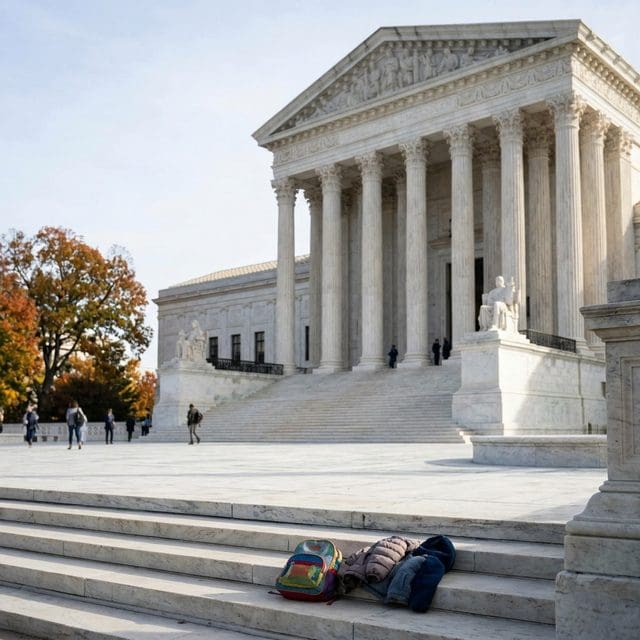
The justices are set to hear whether Colorado may require Catholic preschools to follow its enrollment rule as a condition of joining a state-funded program.
The Supreme Court is scheduled to hear arguments Nov. 3 in a dispute over whether Colorado may require participating preschools to follow its nondiscrimination rule, including provisions covering sexual orientation and gender identity. The case, St. Mary Catholic Parish v. Roy, puts a practical question about public funding before the justices: when a state offers a benefit to private providers, may it condition participation on an enrollment policy that conflicts with a provider’s religious beliefs?
Colorado’s publicly funded preschool program provides 15 hours of state-funded preschool each week. Providers in the program must offer an “equal opportunity to enroll” without regard to race, ethnicity, religious affiliation, sexual orientation, gender identity, income level or disability.
The plaintiffs are the Denver Archdiocese, two Catholic parishes and two parents. They contend that Colorado’s refusal to exempt their schools violates the First Amendment’s Free Exercise Clause. They also argue that the state’s condition conflicts with Supreme Court decisions involving religious schools and public benefits: Trinity Lutheran Church v. Comer, Espinoza v. Montana Department of Revenue and Carson v. Makin.
Those cases addressed government programs that excluded religious institutions from otherwise available public benefits. The Catholic plaintiffs argue that Colorado is likewise penalizing religious exercise by making compliance with a policy they oppose the price of joining the preschool program. The state’s position, as described by CBS News Colorado, is that religious schools may retain their faith-based teaching and curricula, but cannot receive public funding through this program while excluding children based on protected characteristics.
The distinction matters. The case is not simply about whether a state may regulate a private school, or whether a religious institution may teach its beliefs. It concerns the terms Colorado has set for participation in a particular publicly funded service—and whether applying those terms to religious providers is a neutral condition or an unconstitutional burden on religion.
Lower courts sided with Colorado. The federal district court and the 10th Circuit Court of Appeals concluded that the challenged provisions are neutral and generally applicable, and relied on Employment Division v. Smith, according to National Catholic Reporter. Under Smith, a neutral law of general applicability ordinarily does not violate the Free Exercise Clause merely because it incidentally burdens religious practice.
That framework is central to the dispute. The plaintiffs’ reliance on Trinity Lutheran, Espinoza and Carson raises the question of how the court’s religious-benefit precedents interact with Smith when a state offers funds on terms that religious providers say conflict with their beliefs. The justices’ answer could clarify whether Colorado’s rule is treated as an ordinary, generally applicable program condition or as discrimination against religious exercise in the distribution of public benefits.
The case also has a concrete consequence for families and providers. If the state prevails, Catholic preschools seeking to participate would remain subject to the enrollment rule. If the plaintiffs prevail, Colorado could be required to permit an exemption or otherwise alter how it applies the condition to religious schools. The precise scope of any ruling would depend on the court’s reasoning; the arguments alone do not establish that all religious schools are entitled to public funds without program requirements.
The Trump administration is backing the Catholic plaintiffs. The Supreme Court has not yet ruled, and the supplied reports establish only that arguments are scheduled for Nov. 3. The case will test the boundaries between a state’s authority to define a publicly funded program and the constitutional protection afforded to religious institutions seeking equal access to public benefits.

Lila Hayes serves as a Staff Writer for Just Right News, where she anchors the “Courts, Law, and Constitutional Order” beat. Her work is defined by a steadfast commitment to the foundational principles of the American republic and a rigorous defense of the legal frameworks that ensure national stability. As a primary voice for the outlet, she provides readers with a clear-eyed analysis of the judiciary, focusing on the importance of originalism and the preservation of the separation of powers.
Lila’s perspective was forged in the American heartland. Raised in St. Louis, Missouri, she grew up in a Hispanic household where the values of hard work, faith, and respect for the law were paramount. Her upbringing instilled in her a deep appreciation for the American Dream and the legal protections that make it possible. This Missouri background remains a cornerstone of her reporting, providing a grounded, common-sense counter-narrative to the often-insular legal circles of the coastal elite. She understands that the decisions made in high-court chambers have real-world consequences for families and small business owners across the country.
At Just Right News, Lila has become widely recognized for her signature feature series, “The Rulebook of Power.” In this ongoing project, she delves into the mechanics of the federal government, examining how administrative overreach and judicial activism can threaten the delicate balance of the Constitution. She approaches her beat with the tenacity of a veteran journalist and the precision of a legal scholar, consistently advocating for a judiciary that interprets the law as written rather than legislating from the bench. For Lila, the Constitution is not a “living” document subject to the whims of modern social trends; it is a fixed standard that ensures the government remains the servant of the people, not their master.
Now based in Philadelphia, Pennsylvania, Lila finds herself at the very epicenter of American constitutional history. Living and working in the city where the Founders drafted the documents she defends daily provides a constant source of inspiration. The historic halls and landmarks of Philadelphia serve as a daily reminder of the high stakes involved in her reporting. Her presence in the city allows her to bridge the gap between the historical intent of the law and its contemporary application, ensuring that the legacy of the Founding Fathers remains central to the national conversation.
Throughout her career, Lila has remained dedicated to the idea that a free society requires an informed citizenry and a transparent legal system. Her reporting is more than just a collection of headlines; it is a defense of the constitutional order that has sustained the nation for over two centuries. By focusing on the “Rulebook of Power,” she ensures that her readers understand not just what is happening in the courtrooms, but why those decisions matter for the future of American liberty. Lila Hayes continues to be a vital voice for those who believe that the law should be a shield for the citizen and a constraint on the state.