

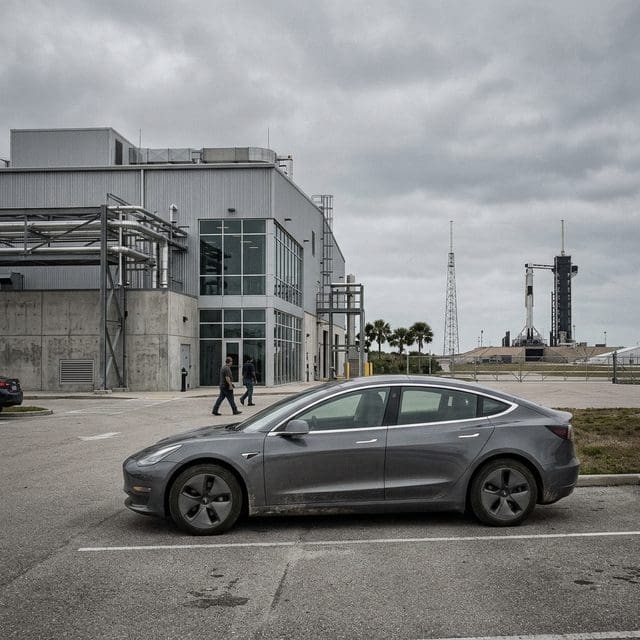
Independent committees are exploring a possible SpaceX-Tesla merger, but with no agreed terms, the deal’s competitive and national-security implications remain open questions.
A possible merger between SpaceX and Tesla has moved from speculation to formal talks, but the companies have not agreed on terms—and the prospect raises questions about how much economic and strategic power should be concentrated around one executive’s business empire.
Reuters reported that the companies formed independent special committees at shareholders’ request. Elon Musk said the committees had not agreed to terms and that a merger was not certain. A source told Reuters that the talks could result in SpaceX acquiring Tesla. Tesla is working with an investment bank, according to the report.
Musk has said he cannot take part in the negotiations because he is a “conflicted party.” The committees consist of independent directors, according to his remarks reported by Investor Daily. That recusal is a necessary safeguard, not an answer to the broader governance questions. Independent directors will have to assess a transaction involving companies led by the same prominent executive, while shareholders would face a proposal whose terms remain unknown.
The available reporting does not establish a purchase price, deal structure, or timetable. Nor does it report that the Federal Trade Commission or Department of Justice has opened a merger review. Without a defined transaction, claims about specific antitrust violations or an agency’s likely decision would be premature. The distinction matters: talks can end without a deal, and an announced combination would still face scrutiny before it could be completed.
Still, the potential combination warrants close examination. SpaceX operates in aerospace and satellite services; Tesla makes electric vehicles. Those businesses do not, on the facts currently available, establish a straightforward overlap in the same product market. Antitrust review would require a careful assessment of competitive effects rather than treating company size, Musk’s profile, or the breadth of his ventures as proof of harm.
That assessment would need to define relevant markets and examine how a combined company could affect competition within them. It would also have to look beyond a simple count of direct rivals. A merger can matter to customers, suppliers, workers, and smaller competitors if it changes access to essential services, bargaining leverage, or the ability of other firms to compete. The reports provide no transaction details with which to test those possibilities, so any conclusion about likely consumer effects remains premature.
The regulatory questions may extend beyond conventional competition review. Time reported that Morningstar analysts flagged potential U.S. national-security concerns involving the combined supply chain. JPMorgan also identified possible Chinese regulatory obstacles, citing SpaceX’s defense and U.S. government ties alongside Tesla’s operations in China. Those are reported concerns, not official findings or evidence that regulators have blocked a transaction. They underline that cross-sector consolidation can raise public-interest issues even where direct product overlap is not evident.
For consumers and smaller businesses, the central question is practical: would a combined company gain leverage that rivals cannot match, or would the merger create efficiencies that benefit customers? The available reports do not provide enough information to answer either way. Any review should turn on evidence about markets and competitive effects, not on executive assurances or the assumption that a large deal is automatically beneficial—or automatically harmful.
The committees’ work is therefore only the beginning. If the companies produce a formal proposal, regulators and shareholders will need clear disclosures about control, governance, supply relationships, and the businesses’ relevant markets. They would also need to weigh whether any claimed benefits could be achieved without combining the companies. Until then, the story is one of a potential merger—not a completed deal, an announced agreement, or a reported antitrust enforcement action.

Greg Sanders serves as the Senior Correspondent for Corporate Power and Antitrust at Just Right News, where he brings a principled, conservative perspective to the complex intersection of big business, government regulation, and the American consumer. With a career dedicated to investigative depth and economic clarity, Greg has become a leading voice in examining how the consolidation of industry power impacts the foundational values of the free market and individual liberty.
Raised in Denver, Colorado, Greg’s reporting is deeply informed by the Western spirit of independence and a healthy skepticism of centralized authority. Growing up in the shadows of the Rockies, he witnessed firsthand the importance of local entrepreneurship and the vital role that small-medium enterprises play in sustaining vibrant communities. This upbringing instilled in him a belief that the American Dream is best preserved when the playing field remains level and when competition—rather than backroom deals between corporate lobbyists and federal regulators—dictates success. For Greg, the rugged individualism of his home state serves as a constant reminder that the economy should serve the people, not the other way around.
Now based in Chicago, Illinois, Greg operates from the heart of the nation’s industrial and financial crossroads. His location in the Midwest provides him with a unique vantage point to observe the real-world consequences of corporate overreach. From the boardrooms of the Loop to the manufacturing hubs that define the region, he tracks the movement of capital and the shifting tides of market influence. Chicago’s history as a center of trade and labor offers a rich backdrop for his work, allowing him to bridge the gap between high-level economic theory and the lived experiences of hardworking Americans who feel the squeeze of monopolistic practices.
At Just Right News, Greg’s beat focuses on the “new monopolies” and the rise of “woke” corporate culture. He argues that when corporations become too large, they often abandon their fiduciary duties to shareholders in favor of social engineering and political posturing. His reporting seeks to hold these “Titans” accountable, ensuring that the power of the purse is not used to silence dissent or bypass the democratic process. He is a firm advocate for the idea that true conservatism requires a vigilant defense of competition, preventing any single entity—public or private—from exerting undue control over the lives of citizens.
This mission is most clearly seen in his acclaimed feature series, “The Titans and the Toll.” In this ongoing project, Greg explores the human cost of market consolidation, from the erosion of consumer choice to the decline of local economies. Through rigorous analysis and boots-on-the-ground reporting, he documents how the concentration of power in sectors like tech, agriculture, and finance creates a “toll” paid by the average family.
Greg Sanders remains committed to the idea that a transparent, competitive market is the greatest engine for prosperity ever devised. Through his work at Just Right News, he continues to provide the essential oversight necessary to protect that engine from the encroaching influence of corporate giants and the bureaucratic structures that enable them.