

A Nature Physics study found that a hidden electronic state in cuprate materials appears when superconductivity is suppressed, strengthening evidence that the two may compete.
A flash of light has helped expose a hidden state inside cuprate superconductors—and the observation strengthens the case that this state may rival, rather than prepare the way for, superconductivity.
Researchers at the Institut national de la recherche scientifique in Quebec reported that a light-induced pseudogap appeared when superconductivity in a cuprate material was suppressed, then faded as superconductivity returned. The study, “Light-induced asymmetric pseudogap below the critical temperature in cuprates,” appeared in Nature Physics. Phys.org reported the finding on October 20, 2026, and updated its report the next day.
The result addresses a longstanding question: What is the pseudogap’s relationship to superconductivity? A pseudogap describes a state in which a material’s electronic behavior shows a partial gap, but it is not the same as the superconducting state. Physicists have debated whether it helps produce superconductivity or competes with it.
That debate matters because cuprates are materials that can superconduct at comparatively high temperatures, yet the underlying mechanism remains incompletely understood. In superconductors, electrical current can flow without resistance under suitable conditions. A clearer account of how cuprates reach that state could help researchers identify materials with improved superconducting behavior. The new experiment does not explain the full mechanism or deliver a practical new material; it provides evidence about the states involved.
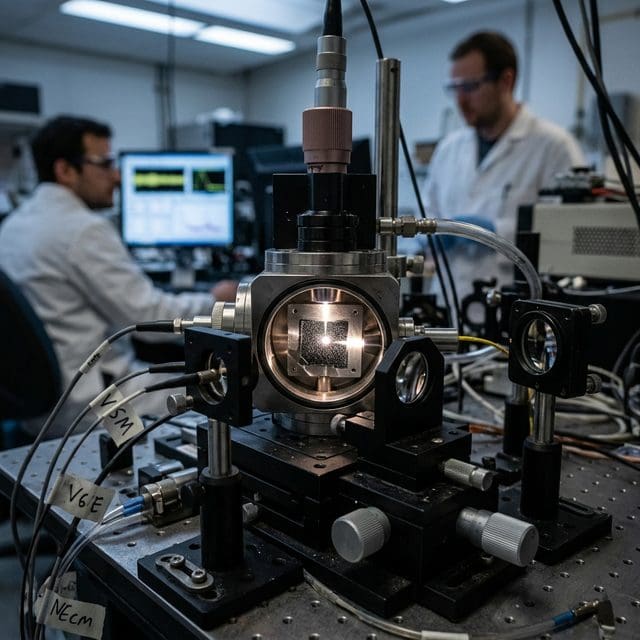
According to the report, the researchers used light to reveal electronic states that conventional techniques had not directly exposed. The pseudogap was transient: it emerged as superconductivity was suppressed and faded as superconductivity returned. That sequence supports the interpretation that the pseudogap and superconductivity compete.
The timing is important. Finding a pseudogap in a material that also superconducts would not, by itself, reveal how the two states relate. Here, researchers observed the pseudogap change in relation to superconductivity. Its appearance as superconductivity weakened, followed by its fading as superconductivity returned, provides evidence of a connection. It is not proof that competition alone explains the material’s behavior.
The finding also challenges a simpler interpretation: that the pseudogap is merely a precursor that develops into superconductivity. The observed pattern instead points to a more complicated relationship, in which the pseudogap becomes pronounced as superconductivity is suppressed. The study supports that interpretation without settling why either state arises or how they interact.
For non-specialists, the observation can be pictured as two patterns whose prominence shifts: one becomes visible as the other weakens. That is only an analogy, not a literal description of electrons. The scientific point is the measured change over time, rather than a claim that the material contains two simple, separate substances.
Understanding which features of cuprates enable superconductivity, and which may work against it, could guide future research into materials that superconduct under more practical conditions. But the available report does not describe a direct commercial application or a specific follow-up experiment. The next challenge is to establish how broadly the light-induced behavior applies and how it fits with other observations of cuprates.
Other recent physics reports highlight different lines of inquiry, though neither amounts to a new particle discovery or quantum-computing hardware milestone. A Physical Review Letters study reported detecting individual collisions between gas particles and a levitated silica sphere about 100 nanometers across. Another paper in the journal proposed a theoretical mechanism for deterministic energy transfer without a corresponding transfer of entropy under the model’s conditions. That proposal remains theoretical, not a demonstrated power device.
The cuprate result is a focused advance rather than a final answer. Light has exposed a fleeting electronic state, and its timing adds evidence to a debate central to understanding high-temperature superconductivity. The finding gives researchers a sharper question to pursue: whether the pseudogap is a rival state, and how that rivalry shapes the material’s behavior.

Mason Reed serves as a Staff Writer for Just Right News, where he spearheads the Future Frontiers & Special Projects desk. In an era defined by rapid technological shifts and evolving social landscapes, Mason provides a steady, principled voice, examining the innovations of tomorrow through the lens of traditional American values. His work is most prominently featured in his signature series, “The Next Horizon,” where he explores the intersection of emerging technology, national sovereignty, and the preservation of individual liberty.
A native of San Diego, California, Mason’s worldview was shaped by the unique culture of his hometown. Growing up in a region defined by its strong military presence and its history of maritime industry, he developed a deep-seated respect for the institutions that provide national stability and the entrepreneurial spirit that drives the American economy. This upbringing instilled in him a belief that true progress is not found in discarding the past, but in building upon a foundation of proven principles. His reporting often reflects this San Diego influence, emphasizing the importance of a robust national defense and the necessity of maintaining a competitive edge in the global marketplace.
Now based in San Francisco, Mason operates from the heart of the world’s technological engine. Living and working in the Bay Area provides him with a front-row seat to the advancements—and the ideological challenges—emanating from Silicon Valley. While many in the region embrace a “move fast and break things” mentality, Mason’s reporting serves as a vital counterweight. He offers Just Right News readers a “boots on the ground” perspective, documenting how radical local policies and the concentration of tech power impact the everyday lives of citizens. His proximity to the industry allows him to cut through the marketing jargon of big tech to uncover the real-world implications for privacy, free speech, and the nuclear family.
In his “Future Frontiers” beat, Mason tackles complex subjects ranging from the ethics of artificial intelligence to the burgeoning private space race. He approaches these topics with a healthy skepticism toward centralized bureaucracy, championing instead the decentralized innovations that empower individuals. Through “The Next Horizon,” he highlights the pioneers and thinkers who are working to ensure that the future remains a place where human dignity and constitutional rights are protected. He believes that the rapid pace of change requires more than just technical expertise; it requires a moral compass rooted in the Western tradition.
Throughout his tenure at Just Right News, Mason has remained committed to the idea that the future is something to be shaped, not merely accepted. His writing is characterized by a rigorous defense of American exceptionalism and a belief that the country’s best days lie ahead, provided it remains true to its founding ideals. Whether he is investigating the impact of automation on the American workforce or profiling the next generation of aerospace engineers, Mason Reed ensures that his readers are equipped with the insights they need to navigate a changing world with confidence and clarity.