

A Nature-reported optical design aims to scale neutral-atom computers, while an MIT calculation identifies a promising candidate for an exotic quantum-Hall state.
Quantum researchers are advancing on two fronts this week: an optical design intended to help neutral-atom computers grow beyond thousands of atoms, and a calculation that identifies a candidate for an exotic state of matter proposed as a foundation for more robust quantum information. The advances address different stages of the same broader ambition: building quantum machines large and reliable enough to perform useful computations.
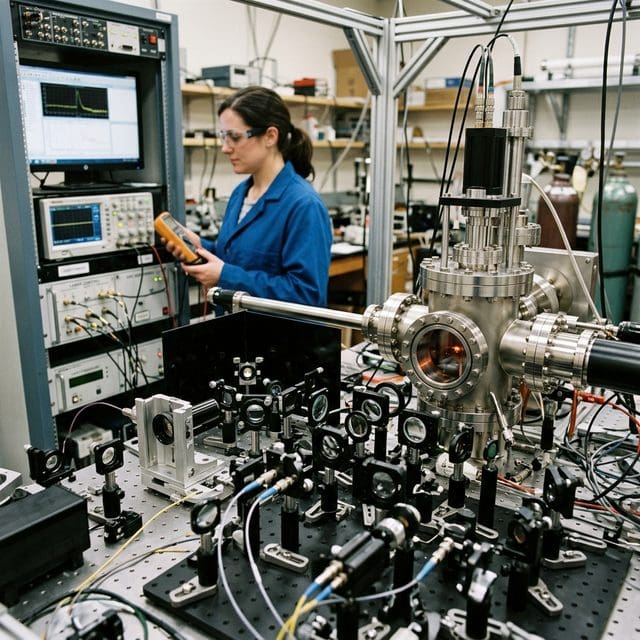
The engineering advance, reported by Nature on October 19, concerns how light is routed in a neutral-atom quantum computer. The architecture uses mirrors, lenses and other optical instruments to direct photons collected from optical cavities, with the aim of improving control as the machines expand. The optical arrangement is the substance of the proposal, not simply an effort to add more atoms to an existing device.
Neutral atoms are held and manipulated with light, and each can serve as a quantum bit, or qubit. These systems already encompass thousands of atoms, but adding more requires keeping them controllable and coordinating their interactions. The reported method is intended to help scale beyond that size. It does not show that a large, fault-tolerant computer is already operating, nor does the available report establish that the approach has solved the full engineering problem of error correction.
A separate result from MIT researchers Pierre-Antoine Graham, Ahmed Abouelkomsan and Liang Fu addresses which quantum state interacting electrons form under particular conditions. In a paper posted to arXiv on October 13, the team reports what it calls the first complete solution of the non-Abelian quantum-Hall problem that includes all electrons and all Landau levels, at filling factor ν = 3/2.
In the quantum Hall effect, electrons in a strong magnetic field can organize into collective states with properties unlike ordinary matter. Landau levels are the quantized energy levels that electrons occupy in such a field. Including all of them, rather than simplifying the calculation by retaining only a limited set, makes the problem especially demanding. The researchers used a momentum-resolved neural-network variational wave function to calculate the system’s behavior. They optimized it solely on the microscopic Hamiltonian—the mathematical description of the physical system—without encoding the expected topological outcome.
The calculation produced a degenerate ground-state manifold whose entanglement has a distinctive signature: anyons with quantum dimension √2, associated with Ising-type non-Abelian order. Anyons are unusual collective excitations that can behave differently from familiar particles when moved around one another. In a non-Abelian system, the result of exchanging them depends on the order of the exchanges. Their properties have drawn interest because they could, in principle, store quantum information less vulnerable to some local disturbances.
The team’s overlap calculations also indicate that strong mixing between Landau levels favors the anti-Pfaffian state over competing candidates. That may help interpret recent experiments, but the result remains theoretical evidence about which state is favored. It is not a direct observation of mobile anyons or proof that a topological quantum computer is near. The calculation offers a candidate for experimental comparison, not a substitute for that comparison.
The distinction matters. Neutral-atom machines face the engineering challenge of controlling and correcting errors across a growing system. A topological approach would seek protection from the properties of matter itself, but researchers still need to establish which states occur in real materials and how to create and manipulate them. Even a promising theoretical state would have to be identified in experiments before its potential as a platform for quantum information could be assessed.
Industry claims offer another measure of the distance ahead. Quantinuum said October 19 that its Apollo-scale approach could require 30 times fewer physical qubits than other leading approaches. The company also acknowledged that magic-state preparation has not yet demonstrated below-threshold scaling. Magic states are a resource in many fault-tolerant schemes, and preparing them efficiently remains a significant cost. The projected reduction is a company comparison, not a demonstration that the full architecture has already achieved that advantage in practice.
These results do not settle quantum computing’s hardest problems. They point instead to the next tests: whether optical systems can scale reliably, whether experiments can confirm the predicted quantum-Hall order, and whether error-correction methods continue to work as their demands grow. Progress will depend not only on increasing qubit counts, but on showing that increasingly complex systems can be controlled and their errors managed.

Mason Reed serves as a Staff Writer for Just Right News, where he spearheads the Future Frontiers & Special Projects desk. In an era defined by rapid technological shifts and evolving social landscapes, Mason provides a steady, principled voice, examining the innovations of tomorrow through the lens of traditional American values. His work is most prominently featured in his signature series, “The Next Horizon,” where he explores the intersection of emerging technology, national sovereignty, and the preservation of individual liberty.
A native of San Diego, California, Mason’s worldview was shaped by the unique culture of his hometown. Growing up in a region defined by its strong military presence and its history of maritime industry, he developed a deep-seated respect for the institutions that provide national stability and the entrepreneurial spirit that drives the American economy. This upbringing instilled in him a belief that true progress is not found in discarding the past, but in building upon a foundation of proven principles. His reporting often reflects this San Diego influence, emphasizing the importance of a robust national defense and the necessity of maintaining a competitive edge in the global marketplace.
Now based in San Francisco, Mason operates from the heart of the world’s technological engine. Living and working in the Bay Area provides him with a front-row seat to the advancements—and the ideological challenges—emanating from Silicon Valley. While many in the region embrace a “move fast and break things” mentality, Mason’s reporting serves as a vital counterweight. He offers Just Right News readers a “boots on the ground” perspective, documenting how radical local policies and the concentration of tech power impact the everyday lives of citizens. His proximity to the industry allows him to cut through the marketing jargon of big tech to uncover the real-world implications for privacy, free speech, and the nuclear family.
In his “Future Frontiers” beat, Mason tackles complex subjects ranging from the ethics of artificial intelligence to the burgeoning private space race. He approaches these topics with a healthy skepticism toward centralized bureaucracy, championing instead the decentralized innovations that empower individuals. Through “The Next Horizon,” he highlights the pioneers and thinkers who are working to ensure that the future remains a place where human dignity and constitutional rights are protected. He believes that the rapid pace of change requires more than just technical expertise; it requires a moral compass rooted in the Western tradition.
Throughout his tenure at Just Right News, Mason has remained committed to the idea that the future is something to be shaped, not merely accepted. His writing is characterized by a rigorous defense of American exceptionalism and a belief that the country’s best days lie ahead, provided it remains true to its founding ideals. Whether he is investigating the impact of automation on the American workforce or profiling the next generation of aerospace engineers, Mason Reed ensures that his readers are equipped with the insights they need to navigate a changing world with confidence and clarity.