

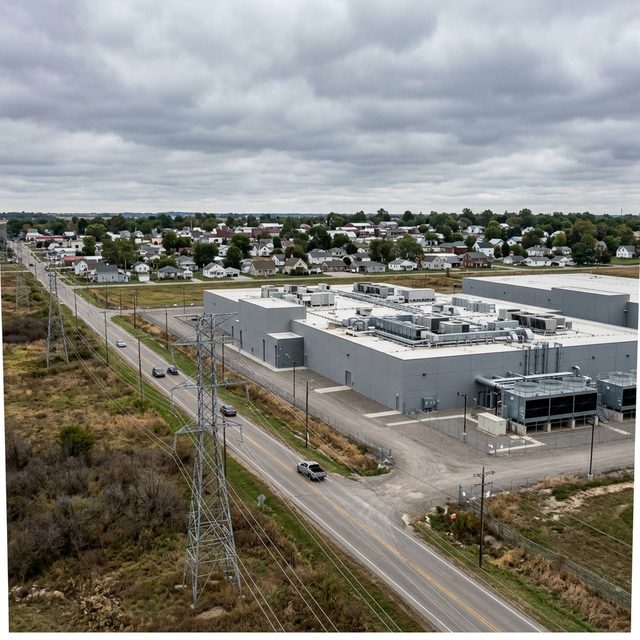
Recent headlines include projections for a vast data-center buildout, but offer no new evidence on rents, mortgages, transit or homelessness.
A scan of recent headlines turned up no verified new developments on mortgage rates, rents, homelessness, transit or housing policy—the issues most directly shaping household budgets. The strongest infrastructure-related material concerns the growing demands of artificial-intelligence data centers. Those demands could have implications for electricity and investment, but the available reporting does not demonstrate a connection to residential costs.
Deutsche Bank Research, citing Epoch AI, estimated that the cost of achieving a given level of AI performance has fallen about 47 percent per quarter since 2023, or roughly 13 times a year. The finding appeared in an Oct. 14 report. Falling costs could make more applications economical, but the supplied reporting does not say savings are reaching consumers or reducing household expenses. Cheaper computing does not, by itself, establish that housing, transportation or other living costs will fall.
A separate Deutsche Bank scenario, published Oct. 13, outlined the possible infrastructure demands of advanced AI training. A hypothetical AGI-like model might need $300 billion to $500 billion in infrastructure and about six gigawatts of power, the analysis estimated. A four-month training run using Nvidia Vera Rubin chips could require 7.8 million chips, 26 gigawatts of facility power and about $900 billion at current prices. If efficiency trends continue, a comparable cluster could cost about $200 billion by 2030, the bank estimated.
These are scenarios, not announced projects or guaranteed outcomes. The figures describe hypothetical requirements, and the supplied material does not identify where facilities might be built or how their power needs would be met. Deutsche Bank also estimated that Alphabet, Amazon, Meta, Microsoft and Oracle would spend almost $800 billion on capital expenditure in 2026, mostly on data centers. The bank said that spending could exceed $1 trillion annually through 2030 and beyond. Those projections do not specify how much new generation or transmission capacity would be needed in particular communities, or who would pay for it.
That distinction matters for household costs. Large energy users can raise questions for regulators and local officials about grid capacity, infrastructure upgrades and how expenses are allocated. If a project requires new facilities or transmission, those decisions may have local consequences. But the supplied material includes no utility filings, rate projections, construction plans or evidence that data-center demand has increased household electricity bills. It cannot support a claim that the projected spending will raise or reduce residents’ costs.
Another prominent infrastructure-related item concerns space, not housing or mobility. NASA said Uzbekistan signed the Artemis Accords in Samarkand on Oct. 19, becoming the 77th signatory. The State Department said U.S. outreach and implementation are led by the department and NASA. Uzbekistan cited potential cooperation with NASA, specialist training and space-technology transfer. The agreement concerns space exploration, not federal housing or transportation investment.
A headline about Whatnot expanding its Irish workforce does not fill the gap. Available research could not independently verify details beyond the plan to add staff to the company’s Irish operation. The item concerns a company’s European workforce, rather than U.S. housing, commuting costs or infrastructure policy.
For renters, prospective buyers and commuters, the practical news in this batch is the absence of verified local or federal decisions affecting their costs. Data-center estimates may warrant scrutiny as communities weigh power demand and infrastructure financing. But without utility filings, project details or public spending decisions, any effect on household budgets remains an open question—not a reported outcome.

Deborah Cole serves as a Senior Correspondent for Just Right News, where she spearheads the network’s coverage of Housing, Infrastructure, and Mobility. With a career defined by a commitment to rigorous reporting and a focus on the fundamental pillars of American community life, Deborah brings a principled perspective to the complex issues that dictate how and where we live. Her work is grounded in the belief that sound policy, fiscal responsibility, and respect for private property are the essential foundations of a prosperous society.
Originally from Boston, Massachusetts, Deborah’s upbringing in one of the nation’s oldest and most historically significant cities deeply influenced her professional trajectory. Growing up amidst the architectural legacy and dense urban planning of New England, she developed an early appreciation for the importance of durable infrastructure and the role of local tradition in shaping neighborhoods. Her perspective is informed by the classic American values of her hometown—hard work, community cohesion, and a healthy skepticism of top-down bureaucratic mandates that often overlook the unique needs of individual citizens.
Today, Deborah operates from her base in Austin, Texas, a city that serves as a primary laboratory for her reporting. Austin’s rapid expansion and its status as a hub for innovation and migration provide her with a front-row seat to the most pressing challenges in modern infrastructure and housing. From the Lone Star State, she chronicles the tensions between rapid growth and the preservation of the American Dream, often highlighting how market-driven solutions and deregulation can address the housing shortages that plague many of the country’s metropolitan areas.
At Just Right News, Deborah is perhaps best known for her signature feature series, “Where We Live.” Through this platform, she explores the intersection of public policy and private life, moving beyond mere statistics to tell the stories of families, small business owners, and local developers. Her reporting frequently highlights the importance of mobility—not just in terms of transportation and transit, but as a vehicle for economic opportunity and social stability. She remains a staunch advocate for the taxpayer, consistently scrutinizing government spending on large-scale projects and advocating for transparency in how infrastructure dollars are allocated.
Deborah’s beat is more than just a collection of policy topics; it is an investigation into the physical and legal structures that allow families to flourish. Whether she is reporting on the impact of zoning laws on suburban development or the necessity of maintaining the nation’s highway systems, her work is characterized by a dedication to the facts and a respect for the constitutional principles that protect the rights of homeowners.
As a Senior Correspondent, Deborah Cole continues to be a vital voice for Just Right News, providing the audience with the clarity and context needed to navigate an ever-changing landscape. Her reporting ensures that the values of individual liberty and local sovereignty remain at the forefront of the national conversation regarding the future of our cities and towns. Through her tireless efforts, she remains committed to informing the public on the issues that hit closest to home.