

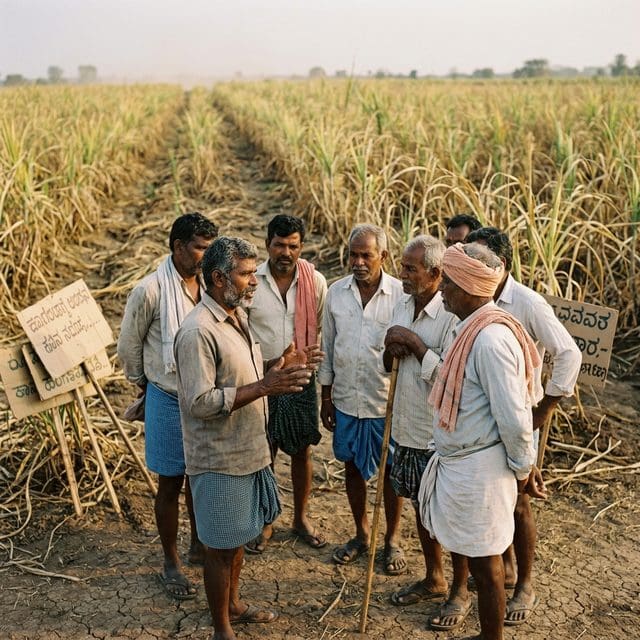
As sugarcane growers press for higher prices amid drought concerns, Karnataka’s chief minister is seeking talks with India’s prime minister while farmers keep protesting.
A dispute over sugarcane prices and drought in Karnataka is testing whether India’s state and central governments can agree on support for growers before the season’s crop picture becomes clearer. Farmers continued their protest on October 18, even after Karnataka Chief Minister D.K. Shivakumar said he had sought an appointment with Prime Minister Narendra Modi to discuss their concerns.
Shivakumar also said he planned to request a meeting with Modi that would include an all-party delegation. ThePrint, citing the Press Trust of India, reported that protesters were marching from Belagavi toward the residence of Union Minister Pralhad Joshi after receiving no clear assurance from the central government.
The demands are specific: ₹5,500 per tonne for sugarcane, a minimum selling price of ₹60 per kilogram for sugar, and revised ethanol prices, according to ThePrint/PTI. Those demands link farm-gate compensation to the economics of sugar mills and to government decisions affecting what mills can sell.
But the immediate impasse is also about process. The New Indian Express reported that farmers rejected a call to suspend the agitation because the state had not announced a specific cane price or a firm date for negotiations. Shivakumar’s effort to secure a meeting in New Delhi has not, by itself, resolved that concern.
Drought is central to the dispute, but the full scale of damage remains uncertain. A New York Times report published October 17 described parched sugarcane fields and attributed the drought conditions to this year’s El Niño. The available reporting does not provide a verified estimate of crop losses or production, and the sugar industry has said a yield assessment is still needed. That distinction matters: field stress can signal risk, but the eventual harvest is what determines how much cane is available to growers, mills and consumers.
The Financial Express has also reported that officials are weighing restrictions on mills’ use of sugarcane juice and B-heavy molasses for ethanol, a move intended to protect domestic sugar supplies. The figures associated with that report could not be verified in the material available for this account, so no forecast of national output, stocks or consumer prices can be stated here. The policy tension, however, is clear from the reported proposal: diverting cane products toward fuel can support ethanol production, while limiting diversion could leave more sugar available for the food market.
For growers, those competing uses are not an abstraction. Their income depends on what mills can pay and what products mills are permitted to make. For consumers, drought-related supply pressure can matter through food prices, although no verified price change is established by the reporting cited here. The dispute is therefore about both immediate farm payments and how India balances food supply with energy goals.
There is no reported food-safety alert, water-contamination finding or environmental enforcement action in the source material behind this story. The practical environmental issue is agricultural water stress: whether rainfall shortfalls have damaged cane enough to alter the harvest, and whether governments respond with timely, transparent decisions. Those answers will require reliable yield assessments and clear communication, not assumptions based on incomplete figures.
For now, the protest remains active, growers are still seeking a firm price and negotiations, and Shivakumar is pursuing a meeting with Modi. Until crop assessments and government decisions are available, the clearest measure of progress will be whether the parties set a concrete timetable and address the farmers’ demands directly.

Eric Nolan serves as the Senior Correspondent for Food, Water, and Environmental Health at Just Right News, where he brings a principled, common-sense perspective to the most fundamental issues facing the American public. With a career dedicated to uncovering the truth behind the policies that govern our natural resources, Eric has become a trusted voice for readers who value traditional stewardship over bureaucratic overreach. His reporting is defined by a commitment to the idea that true environmentalism is rooted in the protection of the American family and the preservation of the nation’s agricultural heritage.
Raised in Fresno, California, Eric’s worldview was shaped in the heart of the San Joaquin Valley. Growing up in one of the world’s most productive agricultural hubs, he witnessed firsthand the vital connection between the land, the water, and the dinner table. In Fresno, he saw the resilience of farmers and the devastating impact that distant, top-down regulations can have on local communities. This upbringing instilled in him a deep respect for the producers who feed the country and a lifelong skepticism toward the alarmist narratives often pushed by mainstream media. For Eric, environmental health is not an abstract political talking point; it is a matter of ensuring that the people who work the land have the freedom and the resources to do so effectively.
Now based in Eugene, Oregon, Eric operates from a unique vantage point in the Pacific Northwest. Living in a region often defined by intense environmental debate, he provides a necessary counter-narrative to the prevailing trends of the area. From his base in Eugene, he monitors the shifting tides of federal and state policies, ensuring that the voices of rural citizens and property owners are not drowned out by urban activism. His reporting often bridges the gap between the rugged realities of the outdoors and the legislative halls where decisions are made, offering a grounded perspective that prioritizes local sovereignty and practical solutions.
As the lead for the acclaimed feature series “Earth on the Table,” Eric explores the intricate journey of the American food supply. He tackles critical issues such as water rights, soil health, and food security through a lens of national stability and individual liberty. He believes that a healthy environment and a thriving economy are not mutually exclusive, but rather two sides of the same coin of national prosperity. His work consistently highlights how innovation and private-sector ingenuity are the most effective tools for ensuring clean water and a safe food supply, rather than the expansion of the administrative state.
At Just Right News, Eric’s reporting serves as a vital resource for those who seek accountability and transparency. Whether he is investigating the impact of federal land management on local economies or examining the safety of the national food infrastructure, his work remains anchored in the values of heritage and hard work. Eric Nolan continues to be a leading voice in environmental journalism, championing the belief that the best way to protect our natural resources is to empower the people who live and work closest to them.